
Bienvenido a Miami Short Story Collection
Eleanor’s Multiple Inceptions
One Mother; Multiple Identities
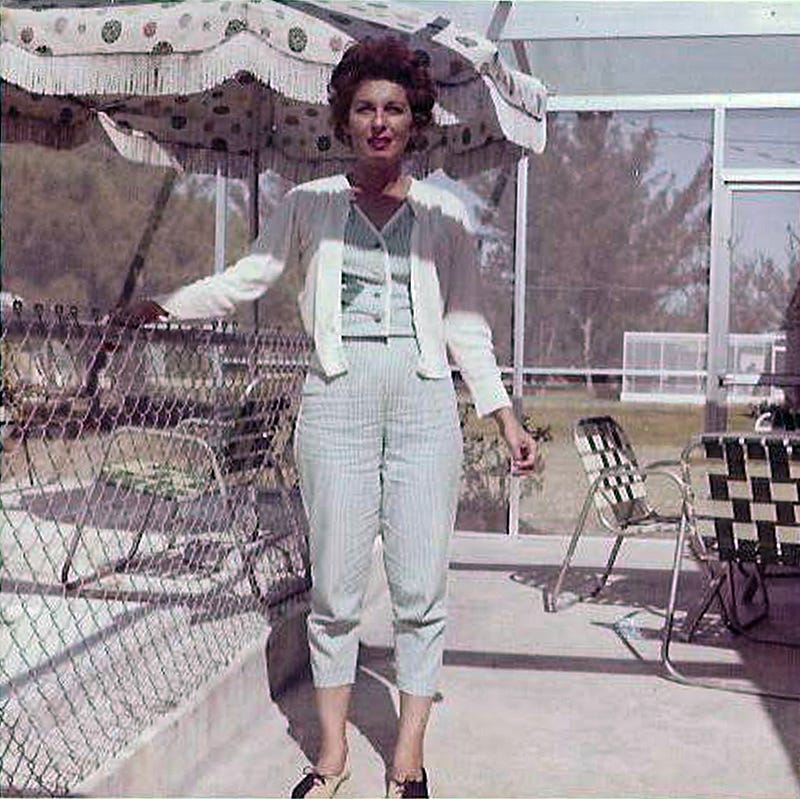
Eleanor in my heart was a mother of multiple personalities. It’s not that she had the psychological condition of the same name. She was more fluid than that. Her interactions support the linguistic ideas of people changing as they move from one speech community to another. The process is similar to a ubiquitous Florida lizard, changing colors to match its environment.
As a confidant, metaphysical advisor, palmist, astrologer, and psychic healer to a tight-knit Cuban American community, Eleanor had an escape route from the mother role of caring for her three sons. Rising from the dawn of Little Havana, the fledgling community of Cuban immigrants, came Lenora: “Astrologica del Amor.” Her style — distinctly Batista’s Havana — cultured, debonair with just a hint of Caribbean casual came donned in an almost-transparent button-down blouse, outlined by the firm curvature of her bosom wrapped securely in a 36D cup. The Latin husbands made a habit of bowing beneath the bosoms to kiss her hand.
Eleanor to her Southern friends was a woman with just a twang of dialect from the Florida Panhandle, matching that of best girlfriends Mildred of North Carolina and Evelyn of Apalachicola. Mildred, an older version of Snow White, was the wife of a local television producer and Evelyn, a single mom whose son never got past third grade. It was Eleanor’s Southern inception that I liked best. Maybe because her Southern friends were the most fun, with lollipop accents that I wanted to lick, pretending I, too, was a real Southerner, and not just a Miami-born Jew.
Eleanor, gentle, yet tempestuous, fought for women’s rights, equal justice for all, and for the sanctity of her family — her mother, her husband, and, oh yes, her three boys.
Our Florida lifestyle, Eleanor often commented, “was living in paradise,” taking off on a how-sweet-it-is lecture about Miami’s “Magic City” image, the name used by the tourist bureau of a resort whose wares had much to offer in the middle of the century when I was born. “The water sparkles across the street,” she said of the canal where she fished near our home. “The weather is never cold, never bitter like New York. I can remember days…” she lamented.
Eleanor, a golden woman in South Florida’s golden age, a housewife and mother whose Jewishness spoke up only in anger, incipient anger at those who crossed us, a physical energy that wore on her well except when it erupted. Those who saw the dragon of kinetic energy were scolded and scalded, literally. Make any negative reference to Judaism and hot beverage made it your way along with a fierce lecture of the evils of anti-Semitism. Isn’t it lovely when you can bring your loved ones back from the dead. The southernisms of Eleanor sticks with me, honey dripping from a hive. The sweetness of her stories and the ones she told me are eternal. Eleanor, a writer, left her writings behind, playthings for my soul. For that, I feel blessed. I feel that I can continue a family tradition with her help. That tradition begins with her mother, my grandmother.
Inner tubes from old tires, rainbow-colored beach balls, and a bathing suit were all that one needed in South Florida. The beach was life and life focused on South Beach. Every chance we had was time for the beach and South Beach was the place to go because Grandma lived there. In fact, just about every grandmother of every Jewish boy in the country lived there. Gray-haired, with a will stronger than dirt, Grandma was a Picasso painting, her form was deep and complex, a warming round body, clear blue eyes, and periodic fire-breathing voice, her color alive, her presence, a paradox. Hair in rollers, covered with an orange and red plaid scarf, a blouse of purple stripes, and lavender pants, her body was held up with patent leather flats and a wooden cane. Her made-in-Nassau straw shopping bag in hand she arrived at Eleanor’s with it filled to the brim, full of sweet goodies for only me.
After stuffing my face with all of the chocolate-covered cherries that I grabbed from the top of her bag, Grandma watched as I bit into the last one. The filling — gooey and drippy — Grandma’s face widening from a stretched grimace thrilled at her young grandson’s satisfaction. I slurped the cherry out. “Stop that,” she said without really meaning it. It took two buses to get to the beach, a two-hour ride, with a stop in downtown Miami to pick up some more candy.
Once at Grandma’s apartment on the beach, I loved to sit and watch her clean the chocolate out of her dentures. She loved to take them out for me and show me her gums. I kind of enjoyed it too, watching her lips turn inside her mouth and her voice lower almost an octave as she started talking.
“Maphew,” she said,” I wuv yew. Yew bet hansumer by ba bay.”
“Gee thanks, Grandma, “ I said, trying to find a mirror to look at my deranged head of curly hair and protruding stomach filled with chocolate-covered, cherry-filled baby fat. I’d lift my shirt and jiggle it, saying to myself sometimes this has to go.
I watched Grandma’s large mouth open as she’d shoved her dentures, like magic her voice and face changed, “Marvin,” she said,” I’m going to play cards. You stay here and watch TV.” I had no problem with that. I loved TV. Nothing better than the reruns of Lucy, Beaver, Donna Reed, Make Room for Daddy, Underdog, That Girl, Bewitched, and my favorite game show, To Tell the Truth. My ultimate fix was a dose of Kitty Carlisle, that dark-haired game show panelist who could spot a liar half a room away in no time. Well, let’s see that TV schedule leaves Grandma three and a half hours to play bridge.
One Saturday afternoon, Grandma came back from her bridge madder than hell. “They said I cheat. I never cheat.” Her voice was much louder than the TV, so I couldn’t help but notice her dilemma. “I never cheat, either,” I responded. That got me a big grandma hug, a several-minute affair that was like being wrapped in between two sagging potato sacks. The day nearly gone, it was time to leave Grandma, a sad moment.
Now that I’ve brought these characters back, they become larger than they were when they were living. They get big, really big that I have to look way up in the sky to see them all. I can make them so large that not only do we become a family again, but we can become entwined in Eleanor’s powerful story of her “Mama” by adding myself, another generation.
Eleanor won a prize in 1963 that today is my prize, motivation to make new forms of text in a new age. Her “Portrait of Mama,” was her pride and joy, a sketch of her “Mama,” first written from the ink of pens, then typed on her manual typewriter.
Random House published the story in their “1963 Best College Stories.” At the time she was a thirty-something housewife who never graduated college. I have and she finally did at fifty. Now that I’m nearing the same age as “Mama,” I find some time to join Eleanor and her Mama, by adding another generation to her story. Her two-way conversation with Mama now has me as a child butting in, morphing the story from the comedy of two generations to three, a back-to-the-future trip, stunning oversights of a two-generation old Miami culture revealing themselves through the eyes of Eleanor’s prose.
In the restaurant, Mama’s eyes across the white linen tablecloth send her daughter a warm message of love. Her reaching hand takes Eleanor’s at the same time it reaches for mine. A circle of smiles generates simulated happiness among the chatter of older diners sitting at tables with stiff white tablecloths. Mama thanks mom for the large luncheon treat.
“You are so good to me and the boys, baby,” she says. “You’re my blessing. I’m so proud of you — and Harry — and, turning her head slightly to me, my special boy. She sighs deeply, poignantly. “If you only knew how much I love you all…” Eleanor’s face furrows, questioning the syrupy tone of her mama’s voice.
Mama’s manner bespeaks the tacit promise: she will not mention wanting to live with our family. The tight breath in Eleanor’s chest eases and she smiles back at Mama, “I do know, Mama.” Dutifully she tells her what she wants to hear.
“We love you, too,” Mom and I lament. Our nods are in dual affirmative motions.
Mama relaxes and leans back in her chair. Her face is content. The waitress brings our order of tea sandwiches, lime sherbet, and coffee. As Mama and Mom munch through thin layers of ham salad, chicken salad, egg salad, and tuna salad, they chat like a couple of good friends. I listen. Mama begins to tell of her old gentleman acquaintance, Mr. Flender, a kind old man who lives in her apartment building.
“Did I tell you he asked to marry me?” she says, as my mom’s heart leaps in hope.
“No!” Eleanor replies as her head leans forward over the salad plates.
“The old bag of bones,” she says. Eleanor’s mood turns downtrodden.
“He goes around telling everyone he’s seventy-five. Ha!” she says. “He’s young if he’s eighty-nine.”
“Jeez, I hope I’m dead by then,” I think. Mama waits while the waiter pours more coffee. He smiles at me and asks if I want another Coke. I shake my head and whisper thank you as my mom and Mama continue their gabfest.
“He does have money,” her tone redeemed him from the bone heap. “But it’s all in his children’s hands, and they dole it out penny by penny to the old man.” I can almost hear the rattle of his poor old bones as Grandma tosses him back to the heap.
“I told old man Fender,” she continues, “that before I marry any man, he has to settle ten thousand dollars on me. “So far,” Mama says indignantly, “all the old man has ever settled on me is boiled chicken.”
“I hate boiled chicken,” I state. The two ladies lean toward me with grand grins. Eleanor reaches over, dispensing a hug to both of us together. Mama’s eyelids widen. “And believe me, it’s awful,” she says. “When it comes to boiled chicken, Flender is the world’s worst. He’s on a salt-free diet because he’s sick, so he makes it three times a week.” Mama has both my mother’s and my sympathy. Mama shakes her head disapprovingly.
“Don’t feel sorry for him,” she says. “He’s an old fool!” Her body leans taking over the whole table. “He’s taken up with that Mrs. — that creature — that miserable, money-greedy, hungry man-chaser…Mrs.?” A furrow creases her brow. “She’s been married so many times I can’t remember from one day to the next all the names she’s been called. That one!” Mama’s eyes imply sex. “She’ll kill the old man.” Mama looks puzzled. I’m feeling inquisitive. Mama tones down her rhetoric and reaches for my hand. “Never mind our conversation, dear. You’ll understand about these things when you get older.”
With pursed lips, I shutter, “I am older!”
“You are Marvin, Marvin, you’re a big boy.”
Grandma pulls out a coloring book. “Color, Marvin. I know how you like to color. Put the dark lines around the picture.”
She handed me a pack of Crayola 64s.
“Neato,” I say. Biting on my lower lip, I take the crayons and color the picture on the first page of the coloring book, a picture of the Beatles. “I know that woman. Mrs. Romaine, right?”
“Right! Well, Flender has been fixing her chicken, too — on the sly.” Looking up between an exchange of copper for light blue, I see Mama’s face, wonder and outrage vying for expression.
“She must like it,” Mama says, “because the last I heard they’re going to get married and live up north near Flender’s family.”
I stop coloring all together, seeing Mama with a unusual look of thought, she looked like a college professor, much younger than she is. My ears are open.
“The way I see the whole thing,” she says, “is that they deserve each other.” “You mean they’re going to get married?”
“Hush, Marvin, let Grandma finish her story.”
Mama wipes her mouth slowly and methodically with a napkin. Eleanor swipes a dab of lipstick across her lips, removing the excess by holding her napkin to her lips and closing her mouth quickly over it. As she peeled the napkin away from her mouth, she gives me a slight wink of her eye and a morning smile that make a tear or two run down my face. “She’s letting me listen, I’m grown up!” I think.
“Ready dear,” she directs.
My head leans upward, my face content from reinforcement. I look at her puzzled as she lifts her mama out of her chair with the resistance of two elk horns locked within each other. “ Let me alone,” Mama demands, “I can get up myself.”
Knowing that a war is brewing I head for the restaurant’s exit.
Painfully, Mama gets up and walks feebly, giving up control again.
“Marvin, get over here, take Grandma’s other arm.” I turn back and assist. In the parking lot next to the Miracle Theater, Mama gets out of the car more nimbly than she got in at the restaurant, perhaps because her diabetic fluctuations are weaning after such a nice lunch. She walks to the other side of the car while Eleanor is fidgeting once again with her lipstick. Mama opens the door politely for her with renewed strength. Her large hand reaches in and grabs Eleanor’s vanity bag. “Eleanor” she shouts, “you look beautiful, but we’re going to miss the movie. Marvin is waiting!” Eleanor grabs the vanity bag back, put the lipstick back and put it back in her purse. She smiles briefly at Mama and gently hit me on the shoulder. “Marvin, let’s go. Are you excited about the movie?”
“A little,” I say reluctantly, thinking of how I much rather be at home playing with Gigi.
“A little?” Mama and Mom repeat in unison, “I thought you were having a nice day with us.”
“Yeah, I am. I can’t wait to see Funny Girl and Oliver!”
“Two movies for the price of one,” Mama says.
The theater, with its tall atrium and terrazzo floors, captivates the crowd as they walk inside. Our faces light up as our feet squish on the red carpet leading to the box office.
Mama walks closer and pulls me toward her with her large hands. “Marvin, this is marvelous.”
“Hi Eleanor, I haven’t seen you in ages,” a voice from behind exclaims. It’s Edith Bain, our neighbor down the street.
“Oh! Hi, Edith, so nice to see you.”
“Look Eleanor, my husband is parking the car and I have to meet him in front of Chippy’s now, but call me, okay!” She runs off.
“Call me!” Eleanor mimics. “Why doesn’t she call me!” Mama politely comments about how gorgeous she is. “Has she had plastic surgery?”
“Plastic surgery? Why would you say a thing like that?”
“Her nose looks a little funny.” Mama’s fault-finding skills were relentless. I zip my lips and fall into the ignoring phase, scared of an incipient screaming match. It can happen anytime, anyplace.
Mama turns her head, watching as Eleanor hands the ticket taker money for the movie. We walked into the theater. Grandma gives me her arm so that she can take me to the candy counter. We buy a huge box of peanut M&Ms. She hands it to me to open. We walk inside the theater popping handfuls of candy into our mouths.
Mama’s deep throat laugh cuts through every scene, enough to interrupt hearing the best lines. While I want to hit my grandmother, the sound of her pleasure is like a reward to Eleanor, who is glad that she arranged today’s jaunt into the city.
“Next week we shall do this again.”
I turn to her, “Next week what?”
“Oh, never mind, I was thinking to myself.” She grabbed my hand sweetly, contently smiling while watching the movie. I squeezed her hand slightly and lifted myself upright. Yes indeed, it was nice skipping school and having the day off with mom and Mama.
After the movie, we walk toward the exit chuckling over the show. Then, abruptly, in the lobby, a change comes over Mama. Without rhyme or reason, a radical glint sparks her eyes and she says, “Now listen, babies, you wait here.”
With an imperious wave of her hand, she indicates a seat. “I’ll be right back.”
Before Eleanor can question her, she hurried off through the doorway of an office labeled MANAGER. Two minutes later she reappears, and with her is a short, bald, well-dressed man.
“But, madam,” I hear him say to Mama, “it is not our policy to refund money.”
“Why, I never heard of such a thing,” Mama bellows, drawing the attention of several onlookers. “Every other theater I go to refunds my money when I miss half the feature and have to leave before the next one.” Seeing what has happened, Eleanor takes my hand and approaches the arguing pair.
Like a fever, the blood burns in her face as we approach them.
“I am very sorry, madam” — the man’s voice is a gelid sound — “but all I can do is give you a re-admittance ticket. We absolutely do not refund money.” “Mama,” Eleanor pleads,” please!”
Mama has the grace to become slightly abashed at our obvious embarrassment, but not abashed enough to leave without the ticket. She waits for the tight-lipped manager to give it to her.
Away from the theater, in the street, Mom turns on her, “Why in heaven’s name did you do that? Whatever possessed you to ask for a refund? Why? What for?”
“Marvin, Logan, Jerry!”
“The boys, my boys?”
I stepped in the back of the feuding damsels, preferring to notice the towering Art Deco style facade of the movie theater.
The bickering between Eleanor and Mama generates a higher level. For Mom, it’s like trying to scream underwater.
Patiently, as if Mama were talking to an idiot, she repeats, “Yes for the boys. I want to buy them something, but I’m short of money.”
Eleanor does not take issue with her intention. It is her method that infuriates.
“If you need more money, why don’t you ask me for it? Why did you go to the theater manager and make a spectacle of yourself and disgrace Marvin and me? Did you need the dollar?”
“Listen, young lady,” Mama rasps back, “don’t you dare raise your voice to me. I’ve got my pride. I take enough money from you and Harry.”
“Yes, you do,” Eleanor retorts. “And if you didn’t lose it at those stupid card games, you wouldn’t be so short.”
Mom realizes her anger has lost its direction. Rage shoots up like a rocket launching: Mama shakes from head to foot. “You would deny a beholden old woman every pleasure?” she asks illogically.
I attach myself to every sign, post, bush, and wall, playing hide-and-seek with the arguing ladies. Mama steps close to me and stops walking as I grab a stop sign, her eyes blazing. “Don’t send me any more money,” she says. “I’d rather be dead than have you dictate how I should act because you give me money.”
Before Eleanor can answer, she turns on her heel and walks away, yanking me from the sign. She stops, standing there, watching Mama. After inhaling deeply, she exhales, “Let her go home alone.”
In our house, Eleanor’s bedroom is the center of activity. Mom’s a working writer. Her office is her queen-size bed. She alternates from reading classics such as The Thin Red Line and Valley of the Dolls to writing short stories for American Girl, the Girl Scout magazine.
Observing Mama’s approach to Eleanor since last Tuesday’s outing from my bedside post in Eleanor’s bedroom, I hear sounds of goodness between the two. Weeks pass, as they grow progressively sweeter to one another. Only once, overhearing them both on the telephone, after Mama thanked Mom for her weekly check, does Mama allude in a perverse fashion to that Tuesday.
On her faux French night table sits a pink portable princess rotary phone ringing while she is very preoccupied with the ending of her latest story, Merry Christmas, Mary Catherine. After the third ring, she picks up the receiver as the pink sleeve of her nightgown dips into her lipstick-stained cup of coffee sitting by the phone.
“Slade (that’s Eleanor’s Southern speak for shit)!” she utters, her face looking mildly distressed. “…Hello.”
“Baby,” she says, her voice candy-coated, “I want you to know I realize I have my faults, too”
“You do?” This admission is almost shattering. “What are they, Mama?”
“My worst one,” she says, her voice strengthening in conviction, “is that I’m too good to everyone.”
Hostility against her is impossible for Eleanor to sustain over a protracted period. Love and charm spread from her in such vastness that Mom dissolves into aching sorrow. I can see it on her face as I watch from the edge of her bed. Her expression and voice reveal her mama’s stooped shoulders and the white, thinning hair and the thick bifocals on eyes so dearly blue they will never fade.
And, in this lulling hiatus, Eleanor feels her sense of aloneness. She says to me: I want to cry to her, “Mama, we don’t want to close you out. Mama, come live with us.”
“Grandma’s going to come live with us?” I say.
“No not now, but maybe one day.”
They’re all gone now as is the odd Jewish culture that rings with stereotypes, adages of a people who pinch every penny, save every dime, invest all of their quarters, and take everyone’s dollar. Maybe that’s true as it may appear in Mama’s story if it is taken out of its emotional and cultural context — a way propagandists use as the building blocks of fascinating tales, irking-yet-interesting, true, but only half-so, whimsical adventures that when fastened to a media engine can kill. Possibly, Eleanor’s inceptions were an escape from religion. Even if they were, each inception puzzled me, yet laughter roared deep inside.
Just as my fondness for my mother’s inceptions, her keen hospitality, a come-on-in approach to life runs up and down from fiber to fiber of my being. As a Jewish woman, Eleanor’s personality flung from left to right, taking on a Miami social scene as a rabbi or priest would say a prayer.