avatarMalky McEwan

Free AI web copilot to create summaries, insights and extended knowledge, download it at here

3800

Abstract

id="5bb6">Multitasking doesn’t work if we are rushing around, trying to do the ironing, the dishes and the vacuuming all at once. But we find it works quite brilliantly if we slow it down.</p><p id="b11e">For decades, psychologist <a href="https://calteches.library.caltech.edu/2211/1/eiduson.pdf">Bernice Eiduson</a> studied the personalities and working practices of 40 leading scientists. Four of her subjects went on to win Nobel Prizes, including <a href="https://en.wikipedia.org/wiki/Richard_Feynman">Richard Feynman</a>.</p><p id="7324">Her probing question asked: <i>How do some scientists go on producing important work all through their lives?</i></p><p id="38d8">The pattern that emerged was surprising.</p><p id="5684">The top scientists kept changing subjects. They shifted topics repeatedly. On average, the most enduringly creative scientists switched topics 43 times in their first 100 research papers.</p><p id="b368">The secret to creativity is multitasking —<b> </b>in slow motion.</p><h2 id="e8b9">Three things make it powerful</h2><ol><li><i>Creativity comes when you take an idea from its original context and you move it somewhere else. It’s easier to think outside the box if you spend your time clambering from one box to another.</i></li><li><i>Learning to do one thing well can often help you do something else. It’s <a href="https://www.verywellfit.com/cross-training-improves-fitness-and-reduces-injury-3120769">cross-training</a> for the mind.</i></li><li><i>It can provide assistance when we are stuck. If you get stuck on a crossword clue — go do something else.</i></li></ol><h2 id="51db">Michael Crichton</h2><p id="a13d"><a href="https://en.wikipedia.org/wiki/Michael_Crichton">Michael Crichton</a> trained as a doctor and then moved on to write novels. He directed (the original <i>Westworld</i> movie), and he wrote non-fiction books about art, medicine and computer programming.</p><p id="27f0">One of my favourite travel books was by Michael Crichton.</p><figure id="7cf8"><img src="https://cdn-images-1.readmedium.com/v2/resize:fit:800/0*EdG7nIjEEncsrw-t.jpg"><figcaption><a href="https://www.goodreads.com/book/show/7665.Travels?from_search=true&amp;from_srp=true&amp;qid=XUnwIct7Vm&amp;rank=2">Goodreads</a></figcaption></figure><p id="e3a7">In 1995, Michael Crichton used his lasting curiosity to pen the world’s most commercially successful<a href="https://en.wikipedia.org/wiki/The_Lost_World_(Crichton_novel)"> book</a>, the world’s most commercially successful <a href="https://en.wikipedia.org/wiki/ER_(TV_series)">TV series</a> and the world’s most commercially successful <a href="https://en.wikipedia.org/wiki/Jurassic_Park_(film)">movie</a>.</p><p id="8b3b">In 1996, he did it <a href="https://en.wikipedia.org/wiki/Michael_Crichton#Commercial_success_and_collaboration_with_Steven_Spielberg_(1989%E2%80%931999)">all over again</a>.</p><p id="bcce">Getting stuck can prove disastrous for your ego — if that is all you have to work on. But if you have another challenging project, getting stuck is just another opportunity to work on something else.</p><h2 id="5af3">Author’s perspective</h2><p id="a408">I have a home full of books. There are half a dozen on my bedside cabinet, another three by my chair and more on the shelf above my computer. Three part-read books sit on my left-hand side as I type this.</p><p id="18f5">I have one fiction book on the go at all times. The rest are non-fiction: Bill Bryson, Malcolm Gladwell, Richard Wiseman, Scott Adams, Richard Feynman, Tim Harford, Michael Lewis and many more.</p><p id="6182">The topics are wide and varied.</p><p id="0133">I make time to read. I sit with a highlighter pen. I take notes. I go over the sections I last read — a proven method for enhanced learning. And I often find I mak

Options

e connections with other books I have on the go.</p><p id="f610">Writing is never a chore. I don’t stick to the one subject. If I get stuck or bored, I move on to another project. I have over 100 articles part written, some I might never finish. I have three book projects I add to as and when I feel the urge.</p><p id="bcc5">Slow-Motion Multitasking keeps me at my desk. Changing my focus and mixing up the subject matter keeps me refreshed and interested.</p><p id="6b9b">If you get stuck, try it out. Try writing about something else. It might not turn you into Michael Crichton, but it’ll keep you in good shape.</p><p id="9562">If you are worried about all your projects becoming overwhelming or remembering every undertaking, there is a practical solution — write it down, type it up, file it, or mark it with a highlighter.</p><p id="1a11">Putting a title to your project and making notes, adding text, and expanding ideas mean you never have to worry about forgetting anything. You know where it is. It’s all there for your future reference.</p><p id="f18f">There is no hurry to finish creating if you are always creating.</p><h2 id="f74a">Charles Darwin</h2><p id="fdd4"><a href="https://en.wikipedia.org/wiki/Charles_Darwin">Charles Darwin</a> was initially interested in <i>zoology</i> and <i>geology</i> — useful for his expedition around the southern oceans.</p><p id="ffe4">He added <i>psychology</i> and <i>botany</i> to his studies. Moving between these fields didn’t stop him from being interested in them all. Later, he studied <i>economics</i>. It is from this that his theory of evolution emerges. Survival of the fittest.</p><p id="24ba">When Darwin’s son is born, he studies him.</p><p id="e55c">He studies <i>taxonomy</i>, the classification of species, and becomes the world’s leading expert. He publishes his <i>Origin of Species</i> and his <i>The Descent of Man</i> while continuing to work on <i>Natural Selection</i>.</p><p id="6648">It's 37 years after the birth of his child before he completes his <i>Biographical Sketch of an Infant</i>.</p><p id="2a88">Be like Darwin — stay curious through slow-motion multitasking.</p><h2 id="2f40">To sum up</h2><p id="b417">Einstein, Crichton and Darwin are just three examples of highly successful slow-motion multitaskers. They have led the way. We can learn from them.</p><p id="334f">We do not have to focus on one subject, to the exclusion of everything else. It is possible to make multitasking work to unleash our natural creativity.</p><ul><li><i>Slow it down.</i></li><li><i>Vary your interests.</i></li><li><i>Make a list of your projects.</i></li><li><i>Get to work on one until you get stuck, then switch.</i></li></ul><p id="c7bc">I’d be interested in your experience.</p><p id="8f9d"><a href="https://malkymcewan.medium.com/"><i>Ahem — there’s more by Malky here</i></a><i>. Get <a href="https://malkymcewan.medium.com/subscribe">an email when Malky publishes</a>. Read and learn, write and earn by<a href="https://malkymcewan.medium.com/membership"> joining here.</a> And remember — Nobody really cares if you don’t go to the party.</i></p><div id="b13d" class="link-block"> <a href="https://malkymcewan.medium.com/membership"> <div> <div> <h2>Join Medium with my referral link - Malky McEwan</h2> <div><h3>As a Medium member, a portion of your membership fee goes to writers you read, and you get full access to every story…</h3></div> <div><p>malkymcewan.medium.com</p></div> </div> <div> <div style="background-image: url(https://miro.readmedium.com/v2/resize:fit:320/0*HMo_0g4cxprwkGXl)"></div> </div> </div> </a> </div></article></body>

Einstein Supercharged His Productivity With This Stupid-Simple Multitasking System

Other geniuses use it and so can you

Photo by MART PRODUCTION

We can’t multitask

We can’t text whilst driving, spot the gorilla, or give our undivided attention to our partner while Rangers are playing in the European Cup final.

We can’t split our attention. We can focus on our prey or our escape — flight or flight.

If we try—we freeze. It’s what happens when we try to do both at the same time.

“To do two things at once is to do neither.” — Tim Harford

That belief has become the accepted wisdom.

However, there is a powerful way to multitask. Creativity researcher Howard Gruber studied this for years and identified an evolving systems approach to creativity.

He showed that people with the most productive minds, in any sphere, do multitask. Not in the conventional sense, but their form of multitasking has resulted in staggering achievements for our species.

Slow-motion multitasking

A term first phrased by Tim Harford, The Undercover Economist.

In his 2018 TED Talk, Tim asks what we can learn from the world’s most enduringly creative people.

Computers can multitask — we can’t. We used to think we could, but we were fooling ourselves.

We are not wired to handle multiple tasks at once, so when we think we are multitasking, we are likely just switching from task to task. Focusing on a single task is a much more productive approach.

Tim Harford argues that we can do two or three or four things at once and it is exactly what we should aim for.

Albert Einstein

Albert Einstein laid out the foundation for modern physics and changed the way we understand our universe. In 1905, he published four remarkable papers.

  • He provided empirical evidence that atoms exist — Brownian Motion theory.
  • He explained how heat is a form of molecular motion — microscopic particles colliding with gas molecules.
  • His theory of special relativity gave us his classic equation E = mc².
  • He detailed the photoelectric effect — how solar panels work, and it earned him a Nobel prize.

Einstein wasn’t thinking about these at the same time. He was doing something very different from playing Wordle while watching The West Wing.

The pattern of behaviour Einstein was demonstrating is not unique. It is very common among highly creative people.

Harford called it slow-motion multitasking. Having multiple projects on the go at the same time and moving backwards and forward between these projects as the mood takes you or as your situation demands.

Multitasking doesn’t work if we are rushing around, trying to do the ironing, the dishes and the vacuuming all at once. But we find it works quite brilliantly if we slow it down.

For decades, psychologist Bernice Eiduson studied the personalities and working practices of 40 leading scientists. Four of her subjects went on to win Nobel Prizes, including Richard Feynman.

Her probing question asked: How do some scientists go on producing important work all through their lives?

The pattern that emerged was surprising.

The top scientists kept changing subjects. They shifted topics repeatedly. On average, the most enduringly creative scientists switched topics 43 times in their first 100 research papers.

The secret to creativity is multitasking — in slow motion.

Three things make it powerful

  1. Creativity comes when you take an idea from its original context and you move it somewhere else. It’s easier to think outside the box if you spend your time clambering from one box to another.
  2. Learning to do one thing well can often help you do something else. It’s cross-training for the mind.
  3. It can provide assistance when we are stuck. If you get stuck on a crossword clue — go do something else.

Michael Crichton

Michael Crichton trained as a doctor and then moved on to write novels. He directed (the original Westworld movie), and he wrote non-fiction books about art, medicine and computer programming.

One of my favourite travel books was by Michael Crichton.
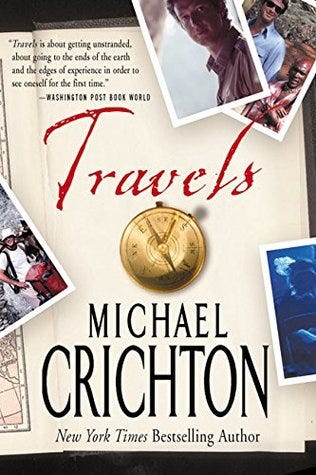
Goodreads

In 1995, Michael Crichton used his lasting curiosity to pen the world’s most commercially successful book, the world’s most commercially successful TV series and the world’s most commercially successful movie.

In 1996, he did it all over again.

Getting stuck can prove disastrous for your ego — if that is all you have to work on. But if you have another challenging project, getting stuck is just another opportunity to work on something else.

Author’s perspective

I have a home full of books. There are half a dozen on my bedside cabinet, another three by my chair and more on the shelf above my computer. Three part-read books sit on my left-hand side as I type this.

I have one fiction book on the go at all times. The rest are non-fiction: Bill Bryson, Malcolm Gladwell, Richard Wiseman, Scott Adams, Richard Feynman, Tim Harford, Michael Lewis and many more.

The topics are wide and varied.

I make time to read. I sit with a highlighter pen. I take notes. I go over the sections I last read — a proven method for enhanced learning. And I often find I make connections with other books I have on the go.

Writing is never a chore. I don’t stick to the one subject. If I get stuck or bored, I move on to another project. I have over 100 articles part written, some I might never finish. I have three book projects I add to as and when I feel the urge.

Slow-Motion Multitasking keeps me at my desk. Changing my focus and mixing up the subject matter keeps me refreshed and interested.

If you get stuck, try it out. Try writing about something else. It might not turn you into Michael Crichton, but it’ll keep you in good shape.

If you are worried about all your projects becoming overwhelming or remembering every undertaking, there is a practical solution — write it down, type it up, file it, or mark it with a highlighter.

Putting a title to your project and making notes, adding text, and expanding ideas mean you never have to worry about forgetting anything. You know where it is. It’s all there for your future reference.

There is no hurry to finish creating if you are always creating.

Charles Darwin

Charles Darwin was initially interested in zoology and geology — useful for his expedition around the southern oceans.

He added psychology and botany to his studies. Moving between these fields didn’t stop him from being interested in them all. Later, he studied economics. It is from this that his theory of evolution emerges. Survival of the fittest.

When Darwin’s son is born, he studies him.

He studies taxonomy, the classification of species, and becomes the world’s leading expert. He publishes his Origin of Species and his The Descent of Man while continuing to work on Natural Selection.

It's 37 years after the birth of his child before he completes his Biographical Sketch of an Infant.

Be like Darwin — stay curious through slow-motion multitasking.

To sum up

Einstein, Crichton and Darwin are just three examples of highly successful slow-motion multitaskers. They have led the way. We can learn from them.

We do not have to focus on one subject, to the exclusion of everything else. It is possible to make multitasking work to unleash our natural creativity.

  • Slow it down.
  • Vary your interests.
  • Make a list of your projects.
  • Get to work on one until you get stuck, then switch.

I’d be interested in your experience.

Ahem — there’s more by Malky here. Get an email when Malky publishes. Read and learn, write and earn by joining here. And remember — Nobody really cares if you don’t go to the party.

Multitasking
Self Improvement
Writing Tips
Success
Learning
Recommended from ReadMedium