
Einstein, Epicurus, and the True Nature of Reality
The medieval discovery that changed the history of thought.
Some people take comfort from the idea that all suffering has a purpose.
That some intelligence is directing the world toward ends we can’t see. It’s unnecessary to state that there is no evidence that’s true. More importantly, it’s better that it isn’t true.
It’s better that we exist by chance, the chaos hemmed in only by the blind and unconscious laws of reality. There are no gods to fear. No version of us survives death to feel bad about it.
Even our thoughts arise out of atoms, the rippling electrical currents of brain waves given physical presence inside your skull by the constant transformation of matter and energy. This is what life is. And all it needs to be.
I imagine it like this.
A swarming spring day, with bees buzzing from the yellow bowl of one carefully nurtured flower to another. Monks often kept bees. Bees live like monks. Or more correctly like nuns, since they are generally female. And the honey was useful, especially in a time when sugar was scarce.
Poggio Bracciolini was a scholar and secretary to seven different popes. Despite living close to the obscene riches of the 15th century church, Poggio was never tempted to join the ecclesiastical life. Instead, he stayed a scholar, known for his grasp of languages and his beautiful penmanship. And when he wasn’t writing letters for popes, he spent his time in search of old manuscripts.
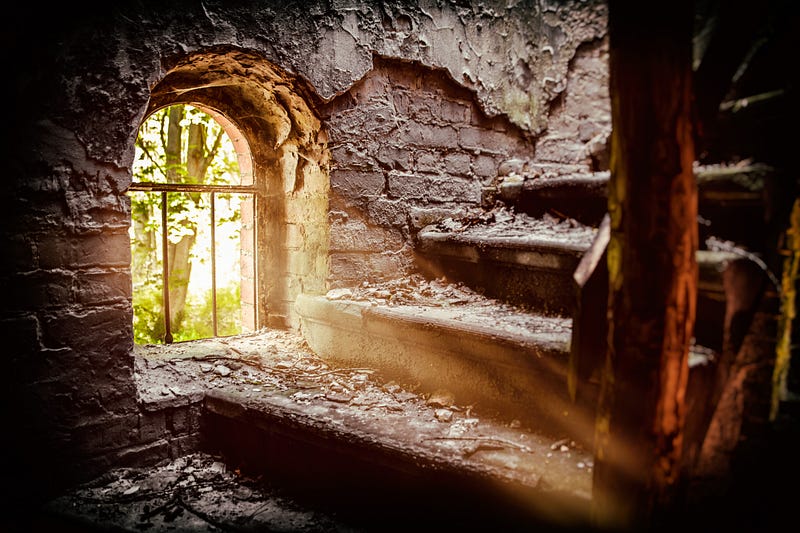
As a monk opened the door to the library, the air pressure would’ve changed. A bright bolt of sunlight from the gorgeous gardens would have pierced the gloom, redolent with that rich smell of old paper. Dust danced and swirled in the stream of brilliance, shifting and rippling like waves of the sea, battered by currents of air. Poggio, stepping confidently into the bookish gloom, felt right at home.
In among the dusty scrolls, Poggio found a treasure whose value he may not have realized. But he did have the good sense to send the manuscript to his friend Niccolo Niccoli, who made a copy. Twelve years after he sent the manuscript, Poggio was still asking for it back from his friend. If you’ve ever lent out a book, you probably know how that goes.
But Poggio’s loss was Western civilization’s gain.
What Poggio discovered in the monastery library was an ancient copy of De rerum natura. This poem, written in the first century BC, was made to explaining Epicurean philosophy to the Romans. The works of Epicurus himself are mostly lost. Much of what we know about Epicurean philosophy comes from this rediscovery of the poem in 1417.
Elinor Clark has a highly readable breakdown of the main points of Epicurus’ philosophy. But the rediscovery of De rerum natura had implications that go beyond philosophy and into the realm of science.
Epicurus didn’t believe in any gods. While Lucretius does not deny the existence of gods in his poem, he argues that the gods are content with the universe as it is and don’t concern themselves with human affairs. We need not fear divine interference in our lives.
And from Lucretius, and through him Epicurus, comes an echo of one of the most profound leaps of logic in the history of knowledge. In De rerum natura, the world is composed of atoms.
Even before the rediscovery of the poem, Epicureanism was known through surviving fragments and references in the work of other philosophers. The church saw Epicureanism as dangerously atheistic and had tried to suppress this crucial scientific insight.
But the atomism of Epicurus, influenced in its turn by the ancient philosopher Democritus, is an idea too powerful to be done away with.
Twenty-five centuries ago, Greek philosophers had determined that all matter in the universe is composed of atoms.
And that the motion of these atoms in space is what gives rise to the total fabric of reality. In Lucretius’ universe, there is no need for gods to direct the fates of men. The motion of atoms determines everything.
After nearly fifteen hundred years of obscurity, De rerum natura quickly spread throughout Europe and became an essential part of any scholar’s education.
Montaigne quoted Lucretius nearly a hundred times in his Essays. Thomas Jefferson owned five copies in the original Latin as well as translations into English, Italian, and French. It’s not an exaggeration to say that the history of thought might look entirely different if Poggio hadn’t stepped into that dusty library one day.
But the theory of atoms remained unproven into the twentieth century. Prior to the invention of the electron microscope, individual atoms were no more visible in my great-grandfather’s day they were in the time of Epicurus. It took another leap of logic by another genius to prove what Epicurus had said two thousand years earlier.
Poggio didn’t know it. But the dust that swirled in the shaft of sunlight that pierced the library moved according to atomic principles.
Lucretius uses this exact example in De rerum natura to describe ‘particles under the impact of invisible blows.’ But it was a twenty-five-year-old Albert Einstein who calculated the formula to describe the way the atoms move and dance. And it’s this Brownian waltz that gives rise to everything that exists.
As a poet, Lucretius isn’t afraid to delve deeper into what an atomic understanding of the universe entails. “Everything passes from one state to another,” he writes. “Nothing stays like itself.”
You can read Lucretius’ entire text, translated into English, here.
Death is as powerless as the gods.
We are made of the same stuff as the stars, and that matter flows through us every second of every day, according to the impersonal laws of Brownian motion.
The Greeks were good at this kind of thing. Two thousand five hundred years ago, there was no strict delineation between philosophy and science, between physics and metaphysics. Our current era of ever-increasing specialization has led to some remarkable discoveries that eclipse even those of the ancient Greeks.
But there’s something to be said for a holistic view. The murmuring of the mystics, the deep spiritual poetry of the soul, is not refuted by the current state of scientific knowledge. Far from it.
What the great minds of the past have given us is a world more filled with wonder and beauty than any conceived by some gap-toothed priest squinting in the dark. The world revealed by Lucretius in his rediscovered poetry is far richer and more beautiful than any conceived of by princes and popes. And it’s made even more beautiful by the fact that this is provably the world that we live in.
No gods. No divine plan. No fear. Just the gorgeous unfolding process of the natural world, as seen in the swirling motes of dust in an ancient library.


