
Egg Vilification. Way Back In Time…
Health warnings that got stuck in our brains.
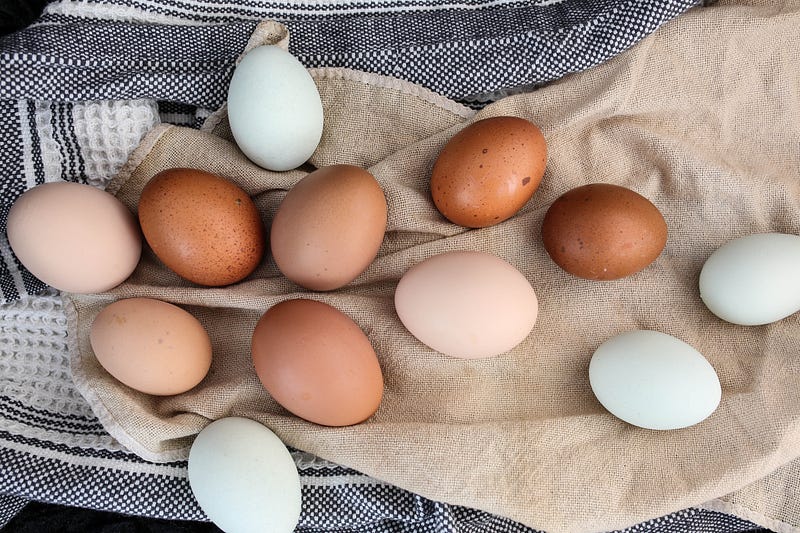
Here’s my dirty little secret. For many years I subjected my family to a diet short on eggs. In fact, a dozen of those little powerhouses would have lasted two to three weeks in our home…at least!
And yet, I was raised on a diet rich in eggs. We had back-yard chickens and so, fresh eggs each and every day were the norms.
A winter breakfast in our house was often hot rolls straight from the bakery, with butter, and a fried egg in between, appealing in the dark winter months!
My mother was a baker, rather than a cook, and almost everything was rich in eggs…scones, sponge cakes, egg custards, fried eggs, poached eggs, hidden-in-food eggs, all cheap and easy, yet nutritious fare that we gobbled up as hungry, non-discerning kids.
But then suddenly things changed. The media, not to mention the medical profession, wormed their way into the psyche of those open to fear. Overnight eggs were totally vilified, and soon off-limits.
Theses two agencies had us believing that the cholesterol in eggs (or animal foods for that matter,) would have the effect of raising our own cholesterol…censuring and scare-mongering at its best!
Though somewhat skeptical, I gradually used fewer and fewer eggs, as did many of my contemporaries.
I often wonder what happened to the poor farmers. Obviously, nobody considered them to any extent.
How did eggs get so controversial in the first place?
‘A lot of it has to do with cholesterol. A large egg contains about 185 mg of cholesterol. And since the American Heart Association (AHA) recommends a limit of 300 mg per day, eat two eggs and you’ve exceeded that limit.
The trouble with this theory is that the authorities had it wrong. Your cholesterol levels don’t increase in direct proportion to the cholesterol you take in. Indeed ‘the research consistently and reliably shows that the cholesterol you eat has very little impact on how much cholesterol is in your blood.
In fact what actually happens is that your body makes cholesterol each and every day, a lot more of it than you’ll find in one egg, and given that your body has its inbuilt cholesterol set point (the point at which a variable physiological state tends to stabilize), it is regulated by a few things, maybe your genetic blueprint, the amount of exercise you engage in, and how you respond to stress in your day-to-day life.
A white omelette, please….
It’s not so many years ago that we were reading about movie stars maintaining their flawless figures by eating the protein part of the egg only, in the belief that it was healthy and would ensure the ongoing svelte figures so popular in the industry. What a waste of an egg. The tasty bit, after all, is the yolk!
These days we know better and the poor old demonized egg is now embraced into a healthy lifestyle. When you think about it, an egg has all the components, and promise for a new life, so why would it not be a good thing to eat?
Besides, if we eat cholesterol-rich foods, our bodies sit back and make less of it, but if we deprive our bodies of cholesterol, the body has to make more. For most of us, the balance will be there.
Eggs, butter and liver are all rich in cholesterol, and if we deprive our bodies of these foods, our systems ramp-up to synthesize more.
So eggs are good for us, but not all eggs are created equal…
Some eggs are simply not worth eating. In fact, we should seriously consider by-passing an industry that puts profit above humanity.
Compromised living conditions, dubious feeding, and seriously unhappy, chickens are not going to produce great-quality eggs. So if you are going to eat eggs, it’s a great idea to find a source that you can rely on.
Here in Canberra, we are lucky enough to have a farm pretty close to us, where, the lucky little blighters are roaming 45 chickens to one hectare, as opposed to supermarket offerings where chooks are roaming no more than 15000 per hectare! We’re supposed to be comforted by the latter statistic!
Sure the ones living the relatively-idyllic lifestyles are more expensive, but even if you have two every day, you’re still eating super-nutritious food, for not a lot of money!
The eggs we buy are moved around the farm regularly, and their feeding is only supplemented very occasionally with organic grains, resulting in much healthier animals and more nutritious eggs.
Yes, they’re more expensive, but I don’t pay any medical bills, so I have no issue in forking out for them. The farmer assures me that his eggs contain more vitamin A, omega-3 fatty acids, and lots more vitamin E and carotene. It’s the very reason why you should consider high-standard eggs — either pay for the product or pay the price at the doctor’s surgery.
I came across this poem today as I was writing this post. To say I was moved is an understatement.
Sound of a Battery Hen You can tell me if you come by the North door, I am in the twelfth cage On the left-hand side of the third row From the floor; and in that cage I am usually the middle one of eight or six or three. But even without directions, you’d Discover me. We have the same pale Comb, clipped yellow beak and white or auburn Feathers, but as the door opens and you Hear above the electric fan a kind of One-word wail, I am the one Who sounds loudest in my head.
You can find Karen here, where she writes about battery hens, a topic for another time.


