
Hong Kong English/Cantonese (XXIX)
Eggs Have Proteins and Can Make You Strong
A typo that kinda makes sense
I hope you have read the Mr Men and Little Miss series by Roger Hargreaves. If you have read it, you may remember that Mr Strong is very strong and eats eggs (tons of!) in every meal (and an ice-cream for a cheat dessert, too).
Mr Strong’s eating habit is a bit worrying, as meals having eggs don’t give you much of the nutrients but proteins. There are other essential nutrients such as carbohydrates and lipids that cannot be well provided by the eggs. Also, his meals are high in cholesterol which may be harmful to his blood circulation. Therefore, I don’t think it is recommended to eat like Mr Strong.
Go find some professionals to help you become strong and healthy. I definitely can’t be that person to offer help.Being created in the era of pre-protein shakes, it was reasonable that Mr Strong’s eating habits look like this could make him strong.
There’s still some relations connecting eggs and strength, I believe.
But in Hong Kong, there is another relation between eggs and strength.
This is a typo when using an Chinese input method namely Quick (速成/簡易).
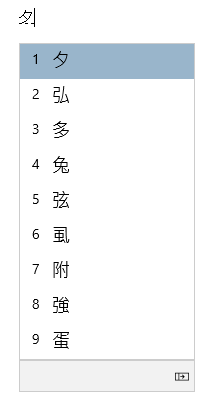
I hardly use this input method and so I don’t think I am good enough to explain how this input method works, which depends on how the characters are shaped.
Anyway, as shown on the picture on the left, the words for strong (強, Jyutping: koeng4) and egg (蛋, Jyutping: daan6/daan2) share the same code (“ni” to be precise). But when we need to choose the correct word, one is on the 8th place while the other is on the 9th.
Having these placed adjacent to each other may not be easy when we type quickly. Even if you only know one language you know the struggles: sometimes you just pressed the wrong key, the key that is next to the one you wanted to type.
As a result, and it is the most comedic when one types “ni9” (“egg”) but mistakenly types “ni8” (“strong”).
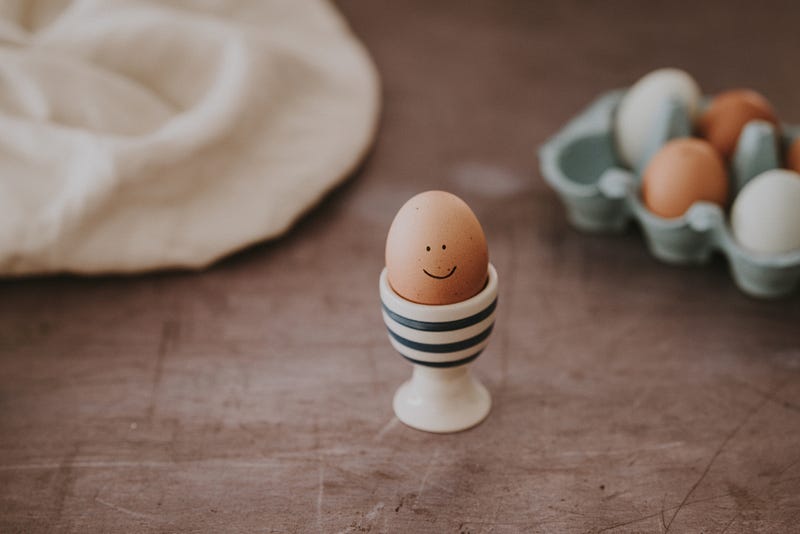
In the past, people mocked this by using the typo intentionally, i.e. write “strong” at the place of “egg”. However, people also speak it now. Mind you, we don’t do this replacement every time we see/speak of “egg”. For example, I have never heard of anybody who says 強糕 instead of 蛋糕 (cake, Jyutping: daan6 gou1).
Though the internet says the first recorded typo of this kind being laughed at was about scrambled eggs (滑蛋, Jyutping: waat6 daan2), it doesn’t seem that people nowadays replace “strong” with “eggs” in this context.
What I hear now is usually about McDonald’s.
Sausage McMuffin with Egg (豬柳蛋漢堡, “burger with pork fillet and egg”, Jyutping: zyu1 lau5 daan2 hon3 bou2) is one of Hongkongers’ favourite on the McDonald’s menu. Not only does it taste good, but it is also an economy option.
I still don't understand why it's a muffin and why that is a sausage. If I am to call the parts separately, I'd call the muffin "bread" (包, Jyutping: baau1) but I don't have any idea what to call the sausage. Even 豬柳 sounds weird to me (by how it looks).Having a name with five syllables may be too long, so the nickname for Sausage McMuffin with Egg is shortened. 漢堡 in the Chinese name is omitted and 蛋 gets its substitute. Therefore, the nickname becomes 豬柳強 (“pork fillet strong”, Jyutping: zyu1 lau5 koeng4). So when people talk about this food, I usually get to hear the nickname instead of the full name, with an exception of ordering the food, where I have never heard of the nickname.

But with the crazy Hongkongese McDonald’s menu, some people found that a Sausage McMuffin with Egg is cheaper than the option without egg. Therefore, some people who don’t want to have the egg at that moment may customise a Sausage McMuffin with Egg and take out the egg in the order. We may say that they order a 豬柳蛋漢堡走蛋 (“Sausage McMuffin with Egg without egg”), or even call it by the nickname, 豬柳強走強 (“pork fillet strong without strength”).
What's more, I call Egg McMuffin (煙肉蛋漢堡, "bacon and egg burger") 煙肉強 ("bacon strong", Jyutping: jin1 juk6 koeng4) too. But I don't know whether other people call it like this too.It sounds pretty logical to call eggs “strong” as having eggs (properly) can really make you strong. Although this all started from a typo, Hongkongers still enjoy it. Let me just remind myself how nutritious an egg is.
Well, there are other nicknames on the McDonald’s menu, even the fast food chain has local nicknames too.
Lastly, 強 has some more slang meanings apart from a way to call an egg, I may write more in the future when I have time.
References:


