Waiting on the Supreme Court to Become a Legal Resident
I’m an immigration lawyer and clinical instructor, but it took 15 years and two U.S. Supreme Court decisions for me to gain conditional resident status in the United States.
My family is from the islands of Fiji. We came to the U.S. in 1999 when I was 14. My parents decided to emigrate for several reasons. First, because they felt uncertain about their future in Fiji and our relative lack of economic opportunities. Second, my parents tried really hard to emigrate to New Zealand and Australia like the rest of our family, but could not immigrate due to lack of education, so my father decided to come to the U.S. to study. And finally, we ended up in the U.S. because my mother’s family was already established here so my parents felt like they would have an easier time adjusting to life here rather than a Fiji riddled with ethnic tensions between indigenous Fijians and Indians after a military coup overthrew an Indian-dominated government.
My father brought me here on a tourist visa at first (B-2), and then switched me to a visa for dependents of international students (F-2), because he was completing his college degree in the U.S. Another military coup overthrowing an Indian Prime Minister, occurred shortly after he brought me here so he decided that going back would be unsafe at the time. My grandmother — a U.S. citizen — filed paperwork to sponsor us for permanent residency in 2001, but due to the visa backlogs, the demand for visas exceeded supply, so we were stuck waiting for an immigrant visa number to be available to us for over a decade.
After finishing high school, I applied for a student visa to maintain my legal immigration status, but it was denied because I could not prove adequate ties to my country of origin and had a green card application pending through my grandmother! There was nothing we could do at that point to rectify the situation. Given that my entire family was now in the U.S., and I was the youngest, my parents were adamantly set against sending me back to Fiji even though that would have been my personal preference.
There are several ironies with regards to this situation.
First, had my student visa been approved back in 2003, it is unlikely that I would still be in the U.S. I would have completed my studies and obtained residency in another country, probably Australia or Canada.
The second irony is more disturbing. My student visa application was denied on the basis that my grandmother had filed a green card petition for my parents that included me as a derivative of the petition. However, by the time my parents could finally get their green card through my grandmother in 2009, I was over 21 and aged out of the process. I could no longer benefit from the green card petition filed in 2001 when I was a child, because the government argued vehemently (all the way to the U.S. Supreme Court) that I had never waited in line for a green card — that my parents had waited but that since they now had green cards, they would need to file for me and I would need to wait in line, all over again.
I was not ready to concede that I had not waited my turn patiently. I was not about to simply slip through the cracks and be discarded like chopped liver. I applied for the green card, paid my fines, and requested that the government process my green card application with the rest of my family. When I realized that the problem was bigger than my individual situation, I worked with many immigration organizations and mobilized many more undocumented young people throughout the country to request that the government stop deporting us, and instead, pass federal legislation to help us. Due to these and many other efforts on the part of many more people, Deferred Action for Childhood Arrivals — a benefit for undocumented people brought to the U.S. at a young age — is now a reality.
However, in April 2011, I was placed into removal proceedings, at risk of deportation. I applied for several applications, including cancellation of removal, and a novel legal argument that I should be able to retain my place in line due a provision in the law that protected the age of a child. I won in the Ninth Circuit, but the case went all the way up to the U.S. Supreme Court, where we lost narrowly.
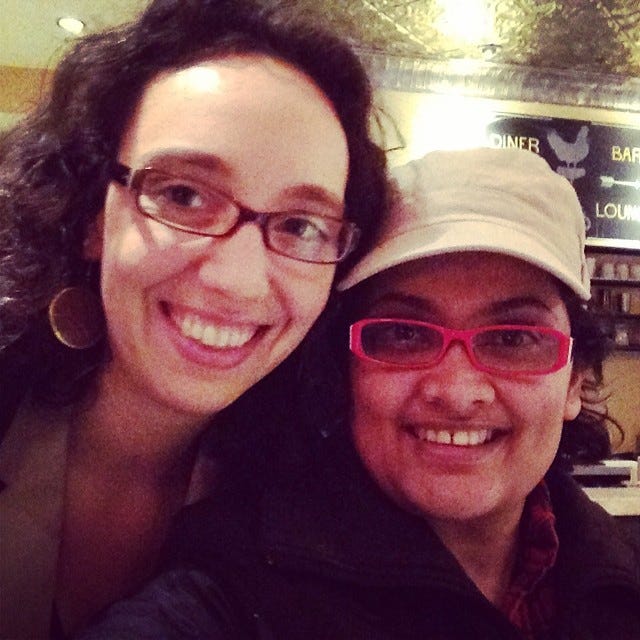
Thankfully, I did not have to worry much about that loss because by that time, the Defense of Marriage Act (DOMA) was also struck down by the same Supreme Court, and my same-sex U.S. citizen partner could finally sponsor me for paperwork as her spouse. The government had no real questions on the bonafides of our marriage after centuries of discriminating against same-sex couples. We paid the entire green card application fees again and waited patiently. I was licensed as an attorney in the District of Columbia, despite not having any status at the time. It was not until August 1, 2014, that I became a legal conditional U.S. resident. The interviewer at U.S. Citizenship and Immigration Services (USCIS) opened my case file on her computer, snapped her fingers, waved her wand, and within minutes of walking through the door, I was a conditional legal resident by virtue of my real relationship to a U.S. citizen. It almost felt like the last fifteen years never happened. The next week, I found myself in Canada, and two weeks later, I was back in Fiji, catching up on everything I had missed out on. It took a lot of cajoling to bring me back to the U.S.
Unfortunately, the story doesn’t end there. I was without legal status in the U.S. for close to fifteen years. I faced many obstacles in accessing higher education, some of which students no longer need to deal with as much. I was undocumented after high school, at a time when we did not have many undocumented students in academia and no one spoke about it due to stigma, shame and fear. I didn’t even know I could apply to college given my immigration status and felt too scared and ashamed to ask anyone. Every move felt like a risk, and there were times I could not see the light at the end of the tunnel. My family struggled a lot to pay out of state tuition and put me through community college and university, as well as graduate school.
I worked for the family cleaning business, which is how I paid much of my tuition, since we could not take out loans, and my mother helped tremendously in putting me through law school, but I had no real economic opportunities or way out of poverty. I never learned how to drive, and never obtained a driver’s license, so I had to become an expert at public transportation options. I did not have a social security number, credit history, or access to health care till I was put into removal proceedings, another irony. It was difficult getting medication without an ID, and I almost died of pneumonia twice. I suffered from post traumatic stress due to migration, and depression for many years. I was exploited by many employers and non-profit organizations who used and abused my services without remuneration. I was also threatened with deportation for a while, which was a very stressful time for my family. My family spent thousands of dollars on paperwork for us, and was scammed by shitty notarios and bad immigration lawyers until I was in law school, and was able to fight my own removal case.
My family also received a lot of hate-mail, and I was stalked by some unfortunate people. Given all this, integration into the U.S. was really difficult as I felt like I did not belong here because I had no rights in a legal system that was a farce for most people of color, and I found most Americans to be full of hatred and contempt for anything and anyone not like them. When nativist forces in the United States say that immigrants are not like them, they are right, and thank goodness for that.
At the end of this long and arduous journey, I don’t think I can ever begin to measure or come to terms with everything I lost in immigrating to the United States. I just hope my parents think it was worth their time and efforts, and that they feel they have a better life here than they would have had elsewhere. I often wonder whether I would have made different life choices, and felt differently about immigrating if I had not been undocumented in the U.S. I did not make the choice to come here, to live here, or to even stay here without status. I feel that the love I have in my life now, through my wonderful and supportive partner and my mother, keeps me here,but there is little else that binds me to this place.
My experiences with the immigration process drove me towards helping others with their own legalization process, to turn the American nightmare into an achievable dream for them. I have a lot of empathy towards people who leave everything they know to live and work in the United States because I understand very deeply that few people leave their home willingly and without compulsion of some sort.
Currently, I serve as an attorney for the U.C. Berkeley Undocumented Student Program Project, in partnership with the East Bay Community Law Center, which is a clinic of U.C. Berkeley’s Law School. My primary job is to serve undocumented students at the university and their families, and ensure that they have a much easier time immigrating and accessing higher education that I did as a young, bewildered teenager in the U.S.