
Education Without School
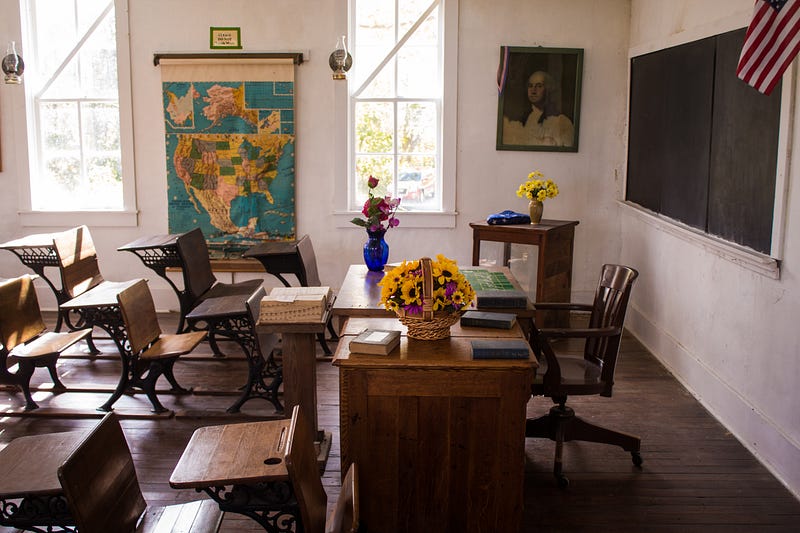
Due to the Covid-19 outbreak, many schools have gone to a “learning from home” model. What will this mean for our society and our current students when we’re able to get back to regular schooling?
Education, for the purpose of this article, is an institute. To be clear, learning and education are not synonymous — learning occurs despite the institute — however, education’s aim is to make learning more effective for both the learner and society.
Education’s Goal Is…
…debatable. One school of thought is self-actualization, setting up the conditions so a learner can realize their personal capabilities by maximizing their potential. The idea here is that they’ll use these capabilities to make society better.
Another school of thought is that education is meant to train our workforce and provide the skills necessary to do so.
While the differences may seem subtle, training for the workforce would follow the common ideology of approaching, for example, college or university, by, “Major in what you can get a job in and minor in what you love.” Self-actualization ideology would frown upon this notion.
Shifting Education (Temporarily) Due to the Outbreak
Having clarified education’s goal, we can now look at our current state of schooling, where schools from kindergarten to post-secondary have closed their doors and turned to online or alternate learning methods, with varying degrees of teacher involvement.
As mentioned earlier, learning occurs regardless of education. It’s an innate process. However, one could learn what can be considered negative traits. The role of education is to ensure that learning is positive, accelerated, and to some extent fits the needs of society.
Teachers play a vital role in education.
Filling the gaps
Classroom management is a major component of a teacher’s duty. Can they instruct 30 students at one time, motivating each one of them, while attempting to shrink the academic gaps between students, while at the same time challenging the overachievers? On top of that, can they manage the social dynamics at play through various stages of a student’s life, from childhood to adolescence?
There are major gaps between students at any school. Teachers are on the front lines of shrinking these. These gaps occur for various reasons, from socio-economic, to cultural, to intrinsic motivation, to name only a few. However, perhaps the biggest gap they fill is the one at home.
Parents have completed schooling to various degrees and they have the capability to teach their children what they know. However, their breadth of subject-specific knowledge and their training on teaching for the most part lacks. On top of that, the majority are busy using the skills they acquired from school to contribute to society. While some households may have a parent stay home during the day, plenty of others have parents holding down multiple jobs in order to financially support their children. Teachers help fill gaps here by caring for children during typical work hours and extending themselves afterwards by coaching or engaging in other extra-curricular activities. And of course, they pass down knowledge or offer a way to obtain knowledge in a fashion that is otherwise not offered in the learner’s home.
So What’s Going To Happen in Education Due to the Shift To Online Learning?
First and foremost, the gaps between learners are going to widen.
Some students will engage in online-instruction because they’re motivated to, either intrinsically or due to the involvement of their parents or role models. Others won’t, simply because a parent or teacher won’t motivate them to do so, or because their household obligations during this crisis involve caring for siblings or other loved ones. So, inevitably, the gaps between students will grow.
Learning progression will also become stunted.
Intrinsic motivation, along with an ideal home learning environment and access to an involved instructor, is the only thing that can counter this. Some students may thrive in this situation, perhaps even accelerate as they’re able to break free from some of the shackles placed on them in school as they engage with self-directed learning. However, acceleration will likely be rare.
It’s a moral dilemma for educators in regard to how to instruct and challenge students during thess times. Student and teacher well-being is the top priority. Instruction, during this time, should only be thought of as a way to maintain a routine, teacher to student connection, and ensure subject level skills don’t diminish during this effectively indefinite change of class instruction.
In a sense, teachers’ roles are to still help ease the burden on parents, who suddenly have to attempt to care for their children while they work from home, or worse, have to continue to leave the home for work and hope their children, who are being cared for by older siblings or family members, engage in something productive and educational for at least a portion of their day. Offering online and alternative instruction can and will ease this burden, however, for the above-mentioned reasons, it’s unlikely students will progress academically and even socially as they would if at school with their teachers.
What does this mean for the future?
This all depends on how long this lasts and the steps we take to re-instate schooling.
A great fear is that widening gaps between students may hurt social mobility. Unless we take the time to educate each current student to the same degree as other generations, there’s going to be some likely negative effects on the workforce over the next 20 years.
Some solutions could include adding an additional year of schooling to our system, which typically consists of 13 years in North America (at least a year of kindergarten to grade 12). We could also look at simply getting rid of grade levels determined by age and address each student based on their academic level — an idea that’s been thought of as progressive well before our current situation. The hope is that high school graduates are just as qualified as the years past.
Again, it’s too soon to speculate on solutions. Frankly, it may be unwise to mention it. Our world has bigger immediate needs.
However, with schools shutting their doors across the world, education systems have been examined by all under a different critical lens. Television producer Shonda Rhimes’ recent tweet declaring that teachers should “make a billion dollars a week” went viral after she spent less than two hours attempting to homeschool her children. Generally, educators have been looked upon fondly during this crisis.
As the dust settles from this historic period of time, perhaps further emphasis and care will be placed on education as educators look to play a major role in picking up the pieces and engage students, enabling them to realize their full potential and use their capabilities to influence our new world in the most positive manner.