
Edith Stein — Philosophy’s Saint
She wrote on the contents of consciousness, and showed how philosophy and spirituality are compatible
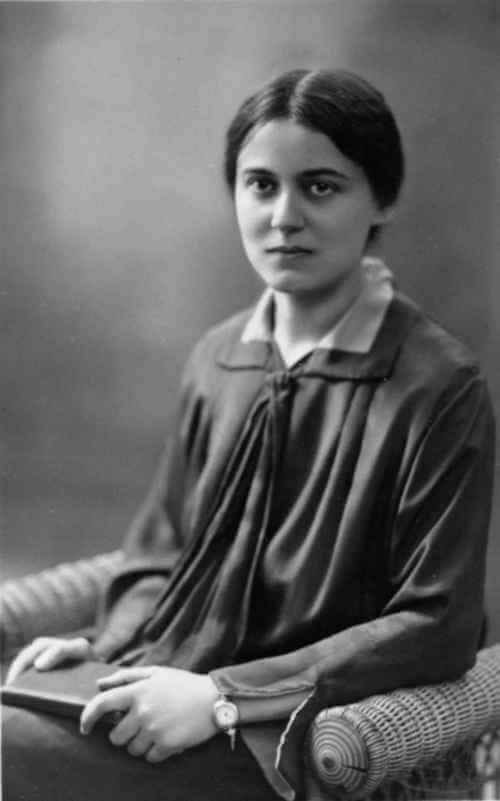
Edith Stein (1891–1942) is another forgotten philosopher. In her life, and in the years since, she has been sidelined by prejudices against women and against religious people. Stein was born into a practicing Jewish family, but she converted to Catholicism and eventually became a nun. Her conversion was after, but not incompatible with, her philosophical career, in which she studied the philosophy of emotions, especially empathy.
She studied under Max Scheler, and her PhD thesis advisor was Edmund Husserl, for whom she later worked as his teaching assistant. Despite fulfilling all of the professional qualifications, Stein was refused habilitation (a postdoctoral certification required to be a professor in the German system) in 1919 because she was a woman. Despite the support of Martin Heidegger, she was again denied habilitation, in 1931 by the University of Göttingen, again, because she was a woman. She did land a teaching German Institute for Scientific Pedagogy, where she taught for several years and worked on her philosophy.
Stein’s Philosophy
Stein applied Husserl’s phenomenological method of the epoché (bracketing off of assumptions) to understand consciousness and human empathy. Her philosophy of the person centers on the distinction between the internal psychological/spiritual world and the external natural world. Her conception of this distinction is very different from Descartes’ complete separation of mental and material substances. Stein saw the psychological and natural worlds are intertwined, each with their own sets of causality. Experiences of the natural world affect the psychological world, but the latter world has its own set of causality.
When we observe our psychological world, we see a stream of consciousness that flows along in an undivided and indivisible continuum. Within consciousness, we see not only mechanical causation (for example, light hitting the eye) but also experiential or psychic causality. Unlike mechanical causality, which has a mediating event connecting a cause to an effect in a one-way relation (see Aristotle’s efficient cause), experiential causality interconnects two events that changes both and affects the course of consciousness. This different operation of causality within our psychological world means several things. A mechanistic view of determinism does not sum up the mind and the flow of consciousness because experiences of the external, natural world do not wholly cause consciousness. Experiential causality also is present and affects the flow of consciousness. Individuals are affected by, but not determined by, external events. They are also affected by internal events. The psychological world is one of incessant occurring and incessant effecting, subject to laws of psychic causality, but the effects of these causes cannot be exactly predicted. We can only observe the occurrences and effects by using the phenomenological method.
Stein’s application of the phenomenological epoché led her to discover “life-feelings” (German: Lebensgefühle), which are experiential states in a person’s consciousness. Life-feelings affect what a person perceives, thinks, feels, and wills and determine how the person experiences conscious states and bodily awareness. Stein’s examples of life-feelings include weariness, freshness, vigor, and irritability, which affect one’s feeling toward the world and influence the whole course of one’s experiences. In her example of weariness, she points out what we have all experienced, that when we feel weary, it affects all of our sensations, deadening colors, sounds, and so on.
She said that life-feelings are experiential causality, and she compares them to mechanical causality. It is as inconceivable that weariness would enliven our stream of consciousness as it is that throwing a ball downward would cause it to rise upward. Mechanical causality has external effects on us, but experiential causality has internal effects not wholly determined by the external world. Stein defends human free will and personal agency by observing that we can control life-feelings, at least to a degree. By engaging with and controlling our life-feelings, we effect our self and our experiences of the world. When we feel weariness, we can choose how much attention we pay to it and, to a degree, how much we let it affect us.
Scheler had said that we intuitively feel that some values are higher than others, and Stein builds on this idea. Stein identifies five levels of feelings. The first four are sensory, common (bodily life-feelings that affect us), moods (spiritual life-feelings that affect us but objectively connect with the external world), and emotions that are intentional states (feelings directed at an object). For example, I can be looking at a tree in the sunshine, have the sensory feelings of the light reflecting off shimmering leaves, and a cheerful mood starts to take hold of me, but my (common) feeling of bodily weariness deadens my cheerful mood, and about that I feel disappointed. We can’t make moral judgments about the first four types of feelings, but we can and should make rational judgments about emotions. This is because emotions are intentional states anchored in the “I.” We can consider whether someone is keeping his or her emotions within an appropriate hierarchy of values. Stein’s idea is similar to John Stuart Mill’s idea that some pleasures are higher than others because they have greater long-term benefit for someone. Stein’s fifth type of feeling is sentiments, the attitudes we direct toward other people. In sentiments, she includes love and hatred (like Scheler) and other feelings like gratitude and vindictiveness. Sentiments are emotions that have conscious intention toward another person and always are correlated to personal values. Sentiments are subject to moral judgments in the same way emotions are.
Stein’s Unfair Fate
After reading the autobiography of Theresa of Avila, Stein converted to Catholicism in 1921 and became a Carmelite nun. Her order encouraged her to continue writing philosophy. They also encouraged her to teach instead of joining a convent, which she did at several institutions until 1933, when the Nazis banned people of Jewish heritage from teaching positions.
After the Nazis banned her from teaching, Stein joined a Carmelite convent. As social conditions in Germany worsened under the Nazi regime, in 1938 her order moved her to a convent in the Netherlands. This kept her safe only for a few years, however. Because Stein was born Jewish, the Nazi occupiers arrested her at her convent in 1942 and shipped her to Auschwitz concentration camp, where they murdered her.
Pope John Paul II beatified Stein in 1987 and canonized her in 1998. Years earlier, in 1954, Pope John Paul II, then known as Karol Wojtyła, earned a PhD with his thesis on the moral philosophy of Max Scheler.