
Edit with Me: Structure as Shortcut
How I used chiasm to solve a missing piece

The last we talked about Enchantress, I was stuck on how to update the plot to match a new idea I had. The good news is that edit went well. The good news that looks like bad news at first is making those changes made it clear the next two scenes were wrong, too. They needed scrapped.
It’s good news because I never much liked them anyway. They felt cheap, and plot-device-y, for lack of a better word. So to have my new plot make it clear these scenes were wrong was basically proof I did the last step right.
It created, of course, the problem of what to write instead. Skipping between the first meeting of Celeste and Marie-Louise and the ball that happens at the next major plot point is not an option. Time has to pass first.
Thankfully, though, I wasn’t stuck for long. While I’m doing a lot of re-writing, I already have a complete draft to work from. And I knew that this book, like Beauty and the Beast, would use something called chiastic structure.
Chiastic Structure
This is a fancy term for an ancient storytelling technique: beginnings and endings mirror each other, and the meaning is in the middle, rather than at the climactic moment. This kind of structure is found as far back as Genesis, and is used both as a poetic device (Ask not what your country can do for you, but what you can do for your country), and as a literary device (where the whole story turns in a circle).
Chiasm in Enchantress
From the moment I conceived of this story in 2017, I had two structural ideas that I haven’t departed from: 1. the major beats of the story would introduce the magical objects from Beauty and the Beast; 2. the whole structure would be chiastic.
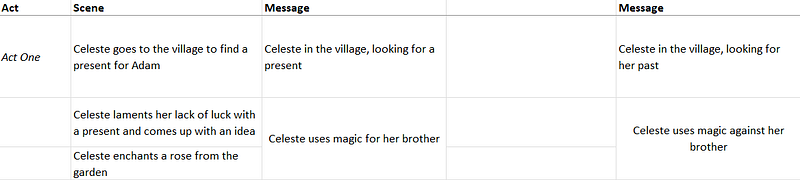
Early in my process, I had an entire spreadsheet dedicated to ensuring the first and second halves of each other mirror each other. I have the act, scene, and message working beginning to middle on the left of the page, and the message, scene, and act working end to middle on the right. (My screenshot intentionally cuts off the specific scenes at the end.)
Keeping it updated in a 100,000-word book is more difficult than a 90-minute movie, though, so I’ve stopped being as much of a stickler for a perfect chiasm. I’m all about making structure work for you, rather than bending your idea to a structure.
However.
The ball scene is Pinch Point 1, and the scenes I’m missing are the two or so scenes before this. Before I put any work at all into thinking about what the new scenes should be, I opened my document to Pinch Point 2. Then I looked at the two scenes after Pinch 2, to see how I could potentially mirror them in the first half.
I knew I needed them to solve “why isn’t Marie-Louise at the ball?” and to get time passing, and that’s it.
This is what I found:
- Pinch Point 2: Magic works intentionally
- Next scene: Celeste, the duke, and the tailor discuss her wedding dress
- Next scene: Celeste’s mother works on wedding details and insults Marie-Louise
Therefore:
- Pinch Point 1: Magic works unintentionally
- Previous scene: Celeste puts on her ballgown (and prepares for the ball)
- Previous scene: Celeste’s mother accompanies her to a gown fitting, where Celeste tries to get information about Marie-Louise and fails
There’s slightly more to what I wrote than that, but essentially I used what I’d already written as a jumping off point.
How to Use Chiasm to Solve Plot
I’ve been working on this book for a very long time, so the above step was fairly intuitive for me. But how can you use it in your own writing? I personally use it to take what is known to solve what is unknown.
In this case, I took what I knew about the second half to solve the first half, but more usually, you can solve the second half by looking at the first. Then I use the following questions:
- How can I show a scene that is similar to the one opposite to it? Can I pull through a motif or action?
- How can I show that things have changed on the other side of the midpoint? Does a different person do the same thing? Does the action itself get reversed?
One of the things I love about chiasm is it helps with two common problems in writing: dropped subplots and pacing. If you mention something in the first half, using chiasm intentionally means you’ll pick it back up in the second half. Similarly, if you get the pacing right in one half, you’ll do the same in the second half. Subplots will be dropped and picked up again in a similar order, so we don’t feel left hanging.
It’s also a brilliant way to intentionally show character change — the same situation, the same character, a different choice.
Have you ever used chiastic structure? Might you?

If you like my work and would like to read more of it, consider joining Medium with my referral link to get full access to every article on Medium. Using my referral link doesn’t cost you anything, but half of the fee goes directly to supporting me each month.