
Eddie Cochran’s Nightmare British Tour
When things do go wrong — Three Steps To Heaven
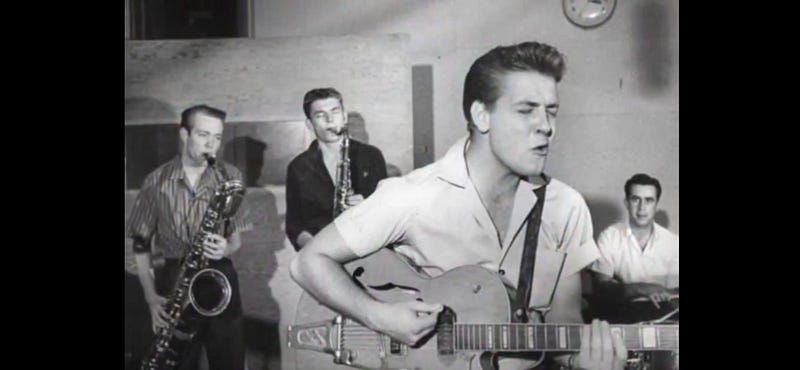
Eddie Cochran was killed in a car accident in England 61 years ago on 17 April 1960. The previous year, his friend, Buddy Holly, died when he changed his travel plans, and the same fate awaited Eddie. Life can be a bummer when things do go wrong.
Step One: ‘Three Steps To Heaven’ would be the last single Eddie recorded at Gold Star Recording Studios, LA. Ironically, his backing musicians on that session were Sonny Curtis and Jerry Allison, former members of Buddy Holly’s Crickets. Other tracks cut that day were, ‘Cut Across Shorty’ and ‘Cherished Memories’, a song penned by Sharon Sheeley, Eddie’s girlfriend.
This was 8 January 1960. The next day Eddie would fly to the UK for a three month tour.
Eddie’s own career had stalled, a bit like Holly’s had a year earlier. Even so, he had appeared in three movies, ‘The Girl Can’t Help It’ (1956), ‘Untamed Youth’ (1957), and ‘Go, Johnny, Go’ (1959) and was a regular performer on a Californian country music TV show, ‘Town Hall Party’.
Cochran was an astounding and prolific session player, an innovator in the studio, and was experimenting with multi-track recording and over-dubbing. He was a proficient bass player, an excellent drummer, introducing poly-rhythmic beats, more complex rhythms, and great guitar riffs to his newly-written songs.
He was only twenty-one, had been in the recording business for five years, but still hadn’t had a number one hit.
Although the hits had dried up, he had recently launched a single, a Ray Charles song, ‘Hallelujah I Love Her So’ that was climbing the Top 40 chart in the UK, where he was hugely popular.
There was talk of a fourth movie when he’d finished his tour, and he had a couple of good songs awaiting release. His star appeared to be in the ascendancy. He was on the verge of greatness, so what could possibly go wrong? It seems … everything.
Step Two: In England, Eddie found it was the harder-edged R&B style of music the fans craved, in stark contrast to America where a tamer brand of pop was the fashion. Fabian, Frankie Avalon, Paul Anka and Bobby Darin were top dog in the United States, but in the UK, rockabilly ruled. Rock and roll was still King.
Unlike the 1958 Buddy Holly tour, where his band were a small part of a larger Variety show, this line-up was crammed full of young British rock and rollers: Adam Faith, Joe Brown and Billy Fury, all yet to make their mark. In time all would become household names in the UK, surpassing Eddie in having greater chart success.
There was another American on the tour, Gene Vincent. In 1956 he had scored three Top 30 hits in the UK, including his huge hit, ‘Be Bop A Lula’, but had done nothing since. He was supposed to headline, but it soon became clear Eddie was the star and main attraction, so things were switched around.
At the rehearsal rooms in London, Eddie met the other acts. Big Jim Sullivan, a session musician who would later play on fifty-five number one UK hits, had this to say about Eddie:
“He seemed a really nice guy. Leather trousers, orange shirt, black waistcoat — and make-up! He showed Brian [Bennett] a few things on drums — never heard anything like it. Then he picked up the bass — wow! And of course on guitar he was superb. I asked him about Chet Atkins, and the first thing he taught me was Birth Of The Blues, Chet Atkins style, with all these nice jazz chords. He was a good flat-top picker as well. Good enough to make our eyes pop!”
Whilst touring, Eddie and Gene appeared on the TV show ‘Boy Meets Girl’, and on the radio programme, ‘Saturday Club’.
Step Three: Dark days ahead. Whoever booked that tour didn’t take into account what being in Britain for ten weeks in midwinter would be like. Eddie had given up the warmth and sun of California to endure temperatures barely above freezing, and he was homesick.
On a visit to the seaside town of Blackpool, he had his fortune read by Gypsy Rose Lee, a celebrated English palmist. According to Big Jim Sullivan, Eddie was drinking heavily and becoming more depressed.
He telephoned his mother in LA every day and pleaded with his girlfriend Sharon Sheeley to fly over to be with him, which she did. In Manchester, Eddie asked her to go out and buy Buddy Holly records for him to listen to back at the hotel. He’d listen to Holly’s records for hours and told her he would soon be with him.
A step too far: Guitarist Big Jim Sullivan later said he’d agreed to take Eddie, Sharon and Gene in his car and drive them to Heathrow Airport, as he lived nearby. However, he missed the last Bristol gig, having to dash off to London to back British singer Marty Wilde at the Palladium.
On 16 April during the final show at the Bristol Hippodrome, Eddie tried all evening to arrange a lift with other members of the tour, but there was no room for him and his two companions in any of the cars travelling to London.
He hired a cab for the three of them for the 120 mile trip. British motorways were in their infancy and none yet joined the south-west to London, leaving the vehicle to a difficult journey on poor roads.
In the early hours, the cab driver took a wrong turn and then tried to make up time, driving recklessly.
Three times Eddie asked him to slow down, and he did, for a while, but then began speeding up again. In Chippenham, he lost control, the cab hit a kerb and crashed into a concrete lamp post. Eddie died from his injuries. Sharon and Gene were seriously injured.
Sharon Sheeley later said they had bought tickets for a rail journey the next morning, but Gene Vincent insisted on leaving that night because his leg was hurting, something that had plagued him ever since he’d been injured in a serious motor-bike accident in 1955.
Eddie Cochran’s ‘Three Steps To Heaven’ reached No 1 in the UK charts on 23 June 1960.
Sting, Led Zeppelin, Jimi Hendrix, The Beatles, The Beach Boys, The Sex Pistols, The Who, Marc Bolan and Brian Setzer all covered his songs and cite Eddie as a major influence on their music.


