
Economies of Scale of Co-living — a landlord perspective
This article summarises our published paper Yiu, Cheung & Xiong (2023). For details, please download the full paper.

What is Co-living? How does it differ from Co-housing and Sub-divided Units?
Several models of shared living space exist, including co-housing, co-living and sub-divided units:
Co-housing is like a dormitory where tenants share both private and communal living spaces. — lowest level of privacy of shared space;
Co-living is defined as a housing arrangement in which individual tenants have a private self-contained housing space (a house, a flat, or a bedroom) but share a range of communal facilities with other tenants, such as shared living areas, dining spaces, gardens, etc. — medium level of privacy of shared space; and
Sub-divided units, on the other hand, are more common in high-density cities such as Hong Kong, and they are independent housing sub-units without sharing any space except the main entrance and the corridor leading to the units. — highest level of privacy of shared space.
Why Co-living?
It is widely recognized that people tend to cluster in cities for employment opportunities, vibrancy, and social capital. However, as housing prices and rents in cities continue to rise rapidly, outpacing wage growth (Maalsen, 2019), younger generations face significant barriers to homeownership, and the complex regulations governing the private rental sector can discourage renting. In cities where housing prices and rents are unaffordable, such as New Zealand (Hargreaves, 2003), co-living is becoming an increasingly attractive and viable option.
However, co-living has two major drawbacks: smaller living areas and less privacy in housing (de Macedo, Ornstein & Elali, 2022). According to the consumer substitution theory, tenants tend to consume less floor space in order to live closer to city centers and pay higher unit rents (Leung & Yiu, 2022). In densely populated high-rise cities such as Hong Kong and Seoul, where housing units are generally small apartments, subdivided units are more common than co-living spaces. Each subdivided unit can be self-contained, with an independent pantry and toilet, and without sharing facilities with co-tenants (Leung & Yiu, 2019). However, the conversion costs for such units tend to make their rents much higher. In contrast, in low-rise cities with mostly single-family homes, such as Germany and New Zealand, converting houses into co-living spaces are more financially viable, as these homes are large enough to accommodate a higher number of flatmates. The conversion cost is minimal as the facilities, such as the kitchen and toilet, are shared communal facilities.

Other Benefits of Co-living for Renters
Co-living offers not only practical and financial benefits (of lower rents) but also social advantages. It provides an immediate way to become part of a community and the potential to establish social connections. Despite changing dynamics and the increasing economic pressure to share accommodation and housing costs with others, the social value of shared housing remains significant (Maalsen, 2019). People who are financially disadvantaged in the housing market may find that co-living provides opportunities to develop close relationships outside of their family networks.
An Example of the Economies of Scale of Co-living Space
For example, in the sample, a whole house with three bedrooms was rented a $639.6 per week to a tenant on average. But then, if the house is converted into a co-living space, with the three rooms rented to three flatmates, the listing rent was reduced to $227.6 each. The total rental income can still be increased by 7%.
Conversion Costs Determine Economies of Scale of Co-living Space
On the other hand, converting a house into five self-contained subdivided units can result in enormous conversion costs. This conversion requires the construction of an independent pantry and toilet for each room, which often involves re-routing pipes, raising the floor level, and other similar procedures. All these changes require approval or consent from the relevant authorities, or else the resulting housing units would be considered illegal or informal. Although the rent of subdivided units can be higher than that of co-living spaces, the risks associated with the upfront intensive capital investment and regulatory approval can be insurmountable. This probably explains why subdivided units are typically found in informal housing markets, while co-living spaces are more common in formal housing markets.
Economies of Scale versus Privacy Discount of Co-living Spaces
Tenants may sacrifice some privacy in exchange for a rental discount and closer social connections with their flatmates in a co-living arrangement. On the other hand, landlords may experience a decrease in rental income for a small-scale co-living setup, but they can benefit from economies of scale by increasing the number of co-living renters sharing the space.
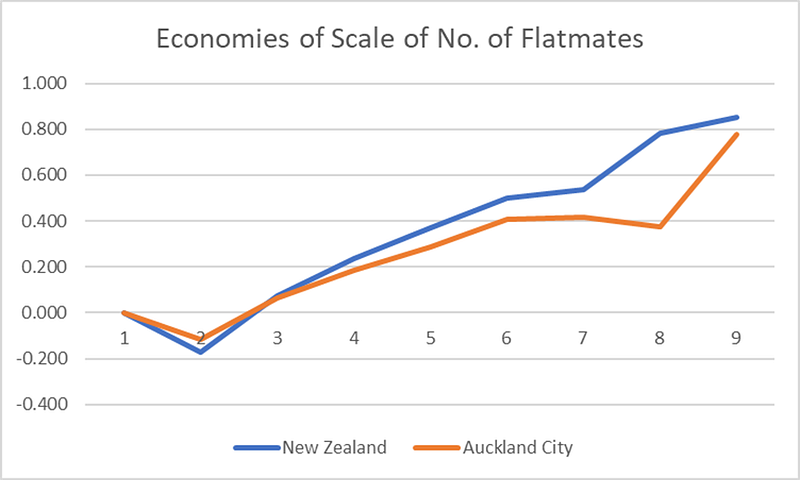
Figure 3 shows that the rental discount for a co-living space with two tenants is about 17% of the total rent compared to leasing it as a single-family home. This likely reflects the reduced privacy in co-living spaces. However, one significant benefit of subletting as co-living spaces is the economies of scale effect. With six flatmates, the total rental income can increase by almost 50% by converting a house into a co-living space. This explains why co-living has become a popular option in the sharing economy.
References
de Macedo, P.F., Ornstein, S.W. & Elali, G.A. (2022). Privacy and housing: research perspectives based on a systematic literature review. Journal of Housing and the Built Environment, 37, 653–683. https://doi.org/10.1007/s10901-022- 09939-z
Hargreaves, B. (2003). Determinants of Housing Tenure Choice in New Zealand. Pacific Rim Property Research Journal, 9(3), 203–223. https://www.tandfonline.com/doi/abs/10.1080/14445921.2003.11104140
Leung, K.M. & Yiu, C.Y. (2019). Rent determinants of sub-divided units in Hong Kong, Journal of Housing and the Built Environment, 34, 133–151. https://doi.org/10.1007/s10901-018-9607-4
Leung, K.M. & Yiu, C.Y. (2022). How do the poor survive in an unaffordable city? — An empirical study of informal housing households living in Hong Kong, International Journal of Urban Sciences, 26, 398–419. https://doi.org/10.1080/12265934.2022.2036627
Maalsen, S. (2019). I cannot afford to live alone in this city and I enjoy the company of others: Why people are share housing in Sydney? Australian Geographer, 50(3), 315–332.
Yiu, C.Y., Cheung, K.S. and Xiong, C. (2023). Economies of Scale of Co-living — an empirical study of the New Zealand Rental Housing Markets, Pacific Rim Property Research Journal, 28(1), 1–19., Available at SSRN: https://ssrn.com/abstract=4345418 or http://dx.doi.org/10.2139/ssrn.4345418