
Ecological Footprint, Earth Overshoot Day and the Happy Planet Index
Excerpt of the ‘Ecological Design Dimension’ of Gaia Education’s online course in ‘Design for Sustainability’
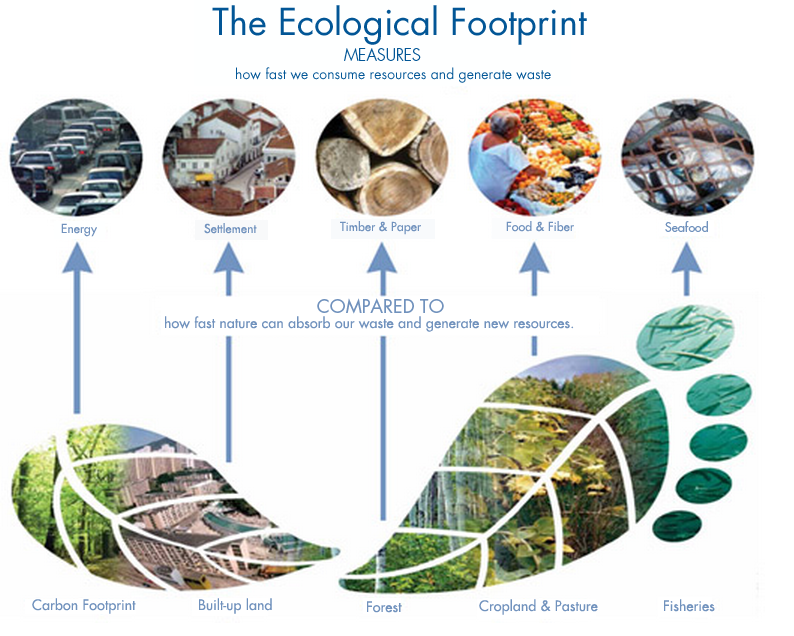
Our Carbon Footprint is a significant part of our more general Ecological Footprint. We have already mentioned this measure before. Our ecological footprint can be defined as “the impact of human activities measured in terms of the area of biologically productive land and water required to produce the goods consumed and to assimilate the wastes generated” (WWF, 2015).
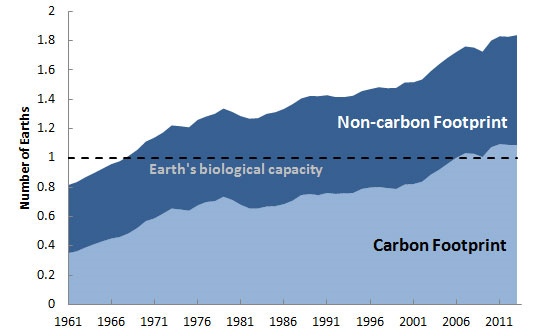
The graphs below show how much of the increase in humanity’s ecological footprint is due to an increase in our carbon footprint since the 1960s; the second graph also illustrates the other contributions to our ecological footprint besides carbon.
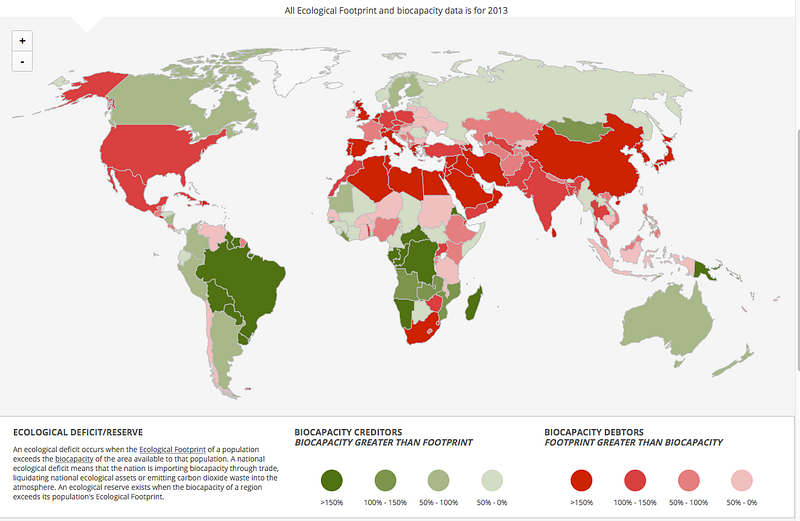
For more information on ecological footprinting and comparisons of different ecological footprints by country please take a closer look at the website of the Footprint Network. Some countries exceed their biocapacity constraints. That means they are borrowing resources from future generations within their own country and also importing such borrowed resources from other countries.
There are very few countries in the world that live within their biocapacity, and these are primarily those countries with vast open spaces with substantial biomass, such as, Canada and Brazil (see map below). On a planetary scale humanity has gone into overshoot in the late 1960s. Overshoot in this context means that we started living of the capital rather than the interest of what the bioproductivity of the planet provide to regeneration each year.
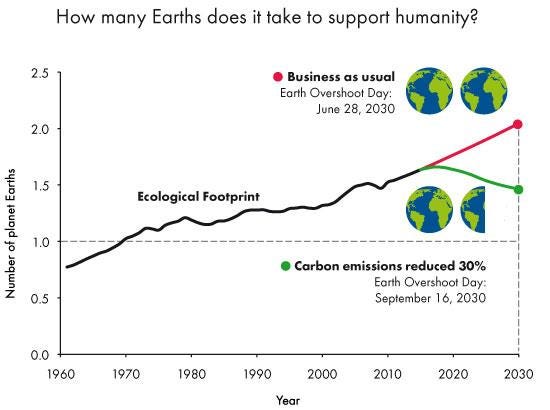
Earth Overshoot Day 2015 landed on August, 13th. Earth Overshoot Day is the day when, as a planet, we collectively reach the limit of how much resources we can use this year without jeopardising the planet’s ability to replenish those resources for the future. By living of the capital rather than the interest we are decreasing the Earth’s biological productivity each year and therefore reach Earth Overshoot Day earlier and earlier.
At current global rates of consumption and waste production, humanity’s collective impact by December 31st will have required the equivalent bioproductivity of 1.6 planets like Earth to meet global demand. In other words, it now takes the Earth one year and six months to regenerate what we use in a year. Here is a short video (4:30mins) explaining the concepts of ecological footprint and earth overshoot day. If you want to calculate your own footprint, please follow this link. We will revisit the issue of our ecological footprint in the Economics Dimension.
The Happy Planet Index (HPI), developed by the New Economics Foundation, is the leading global measure of sustainable well-being. The HPI measures what matters: the extent to which countries deliver long, happy, sustainable lives for the people that live in them. The Index uses global data on life expectancy, experienced well-being and Ecological Footprint to calculate this. The index is an efficiency measure, it ranks countries on how many long and happy lives they produce per unit of environmental input.
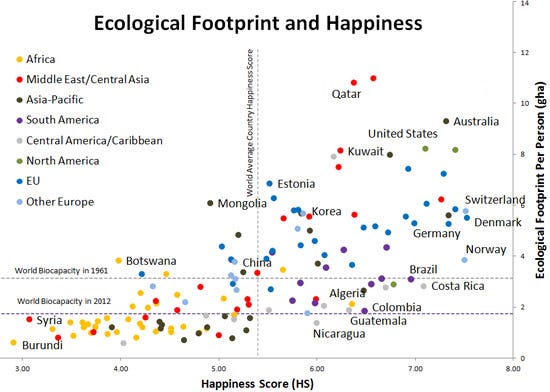
There is usually a high correlation between countries with a high ecological footprint and a high human development index, which are predominantly in the first world, whilst the third world is generally beset with declining biocapacity and low human development index. However, there are some countries, both in the first and third world, exhibit high human development indices and relatively low ecological footprints. It is these latter countries that are leading the way towards living within biocapacity means. The graph below illustrates these contrasts. Here is a short video (2mins) explaining the Happy Planet Index.
… [this is an excerpt from the ‘Ecological Design Dimension’ of Gaia Education’s online course in ‘Design for Sustainability’. Your can enroll in this course at any time. The next installment of the ‘Ecological Dimension’ will start in early January 2018. The material in this dimension was co-authored by Lisa Shaw, Michael Shaw, Ezio Gorio, and Daniel Christian Wahl, author of ‘Designing Regenerative Cultures’ and Head of Innovation and (Programme) Design at Gaia Education.]