
Eclectic Thoughts: Our perceptual limits from Evolution
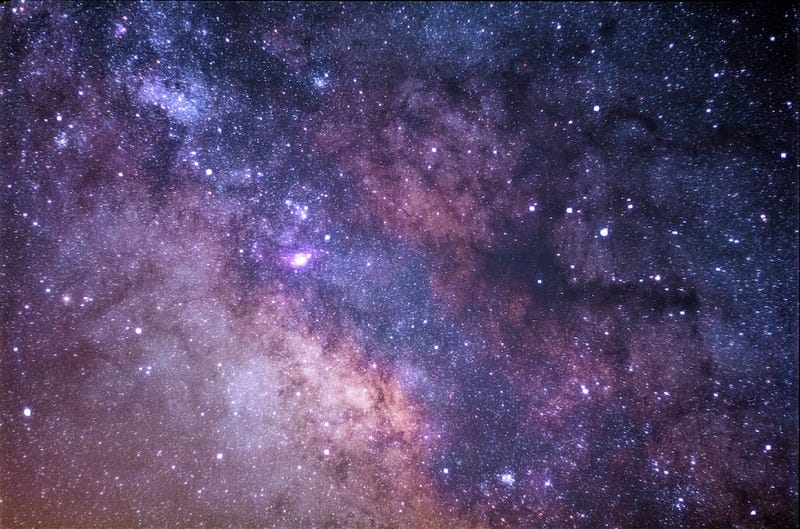
Everything you see is not all there is…..
Evolutionary limitations of human vision and the curse of determinism
The eye and vision are amazing products of evolution. As with anything with evolution, the guiding principle is Survival Value
We see in one and only one of 7 electromagnetic wave spectrums i.e. visible light. However, we need to build and train our scientific apparatus to see in all seven spectrums to even begin to understand the universe, its creation, and its historic journey. Most of what scientists, physicists, and astronomers observe to understand, measure, and detect the length and breadth of our universe occur in seeing in other than visible light spectrum — from long wavelengths to short wavelengths, they are radio waves, microwaves, infrared, ultraviolet, x-rays, and gamma rays ( also least to most energetic).
We are always seeing in the past and never instantaneously. This is true whether you are looking at somehow sitting across from you ( Perhaps a nanosecond in the past) or whether you are looking at the sun (8 minutes in the past) or the nearest star (4 years in the past). This is because as fast as the speed of light is, it is still finite. As you go farther in the distance, you invariably go farther back in time. So, tonight, sitting in your backyard, you might observe a star whose light left it when the dinosaurs were still roaming the earth 65 million years ago. With powerful telescopes, astronomers observe light from celestial bodies so far away that their light left them much before the earth was formed over 4 billion years ago. How fantastic is a vision in its complete spectrum?
“Eternity is awfully long time, especially towards the end” — Woody Allen
Evolution did not prepare us to understand infinity, randomness, exponential growth, or probability. In our formative evolutionary development, we did not have a need for understanding infinity (we lived for 30–40 years in the same geography and within a limited tribe or village of a handful of people). There was no survival value to contemplating how big our universe is or how far the farthest reaches of its boundaries are.
We did not understand randomness either — evolution prepared us to draw out patterns for survival, and social norms reinforced determinism or the hand of a designer or creator with a plan.
We certainly did not need probabilistic evaluation. If you stopped to contemplate whether the rustling of the grass a few feet away was a lion or just due to wind, you might be extinguished from the gene pool in a heartbeat. So, heuristics reigned supreme and timely action was necessary to survive.
Exponential growth and compound interest concepts were of no use through most of Homo sapiens’ history on earth, and natural evolution did not invoke any intuition for these concepts.
Yet not understanding probability, exponential growth, or for that matter, randomness is a great handicap in our modern life — whether it is in the context of investing or medicine, normal risk assessment requires an understanding of these concepts. Yet, nature did not prepare us for it, and we are notoriously bad at it.


