
Eckhart Tolle’s Lesser-Known Trick For Breaking Bad Habits
Finally, a realistic way to end your addictions

Tell me, are any of these scenarios familiar to you?
- You wake up in the middle of the night. Not thinking, you automatically go straight to the fridge and take out a slice of chocolate cake and start eating. After devouring half a slice of cake you catch yourself: “Wait, I’m supposed to be eating healthy”
- You’re in the middle of some important work on your laptop. Not thinking, you automatically switch tabs to your favourite social media site and begin to scroll. After scrolling for 15 minutes you catch yourself “Wait, I’m supposed to be working. What happened? How did I get here?”
- You wake up in the morning feeling groggy. Not thinking, you automatically pull out your smartphone and open up your favourite porn site. As soon as you “finish”, you catch yourself “Wait, I’m supposed to be cutting back on porn. What happened?”
Addictions and compulsive behaviour are crafty little things. Overtime, your brain develops pathways, not only to indulging in bad habits, but also to all of the actions that led up to engaging in those bad habits.
A lot of people will take their bad habits with them all the way to their graves. Smokers, over-eaters, gamblers. A lot of people never find a way to stop. Is this going to be you?
Spiritual teacher and self-help author Eckhart Tolle explains to us precisely how we can stop our addictive bad habits in their tracks.
- Do not try to use willpower to stop yourself indulging in bad habits when you feel an urge. Willpower is a very limited force in dealing with addictions and will ultimately end in failure.
“Willpower would be to hold an urge down (…) when you hold things down, often after a while an explosion happens. It’s like a boiling kettle, you can’t hold it for that long” — Eckhart Tolle
2. Embrace these urges as an opportunity to practise. When you feel an urge to eat junk food, for example, this is an opportunity. This is your chance to change your brain patterns in a new direction. It’s “a spiritual practise specially designed for you”.
“Every time an impulse like that comes, this is your special spiritual practise. So instead of wanting to get rid of it, welcome it when an impulse of that kind comes. (…) this is a spiritual practise specially designed for you. This is an opportunity for practising”. — Eckhart Tolle
3. Don’t fight the urge, just observe it. Don’t try to ignore the urge, or distract yourself or use willpower to hold it down. Simply become present, and observe the sensation in your mind and body. Breathe in, breathe out, and observe the urge inside you.
“You say: I’m going to obeserve you. You shine the light of consciousness, the light of awareness, on this impulse”.
4. Delay acting on the urge for 3 minutes. Don’t tell yourself: “I’m not going to eat that chocolate cake in the fridge!”. Instead, say to yourself: “I will eat the chocolate cake in the fridge, but first I will wait for 3 minutes”. Sit still and observe the urge for a 3 full minutes (use the stopwatch on your smartphone) and wait.
After 3 minutes have passed, the urge may still be there inside you. So start the timer again and observe it for another 3 minutes.
“Let’s say you wanted to go to the TV and turn it on. You feel the impulse. You can say: ‘Oh! Here’s my next spiritual practise. I’m now going to delay turning on the show on this TV for 3 minutes’. And during those 3 minutes, you observe the impulse in you” — Eckhart Tolle
You may find that after this delay, the urge inside you has softened or even disappeared completely. Or perhaps the urge remains, but your mental state has cleared up somewhat.
Sometimes, even after this delay, you will still find it impossible not to indulge in your bad habit. That’s ok. At least you’ve begun training your brain to act differently around your bad habit.
5. Observe the rationalisations than enter your mind. When you get the urge to engage in bad habits, your brain will invent reasons as to why it’s perfectly fine to do so.
Here are some examples of typical rationalisations that those with a food addiction will face:
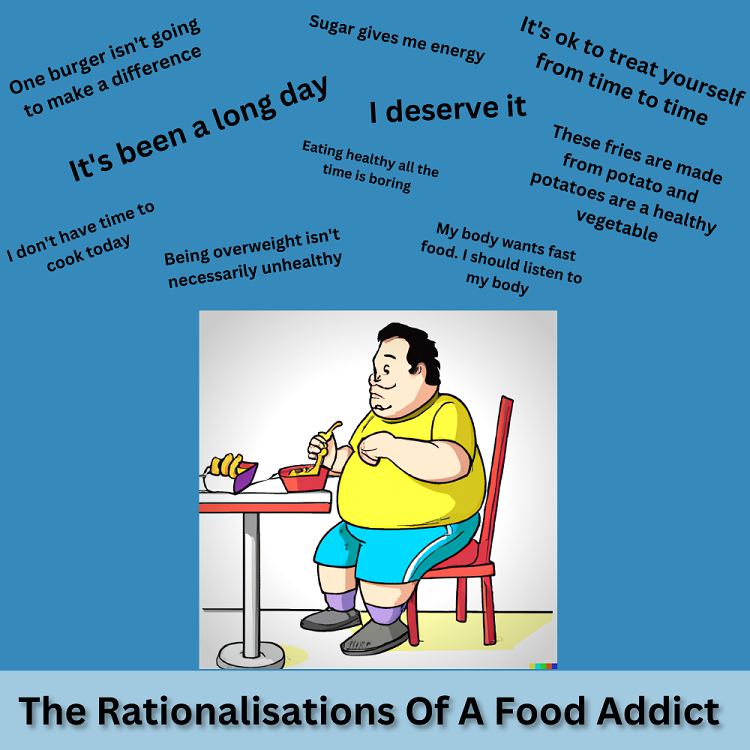
As you observe your addictive urge for 3 full minutes, also observe the rationalisations that come into your mind. As these thoughts appear, watch them and recognise them for what they are: lies.
“(These urges)can also dangerously invade your mind. A thought comes into your head as to why you should give in to this impulse. There too, you need to be present enough so that you do not believe in every thought that comes into your head”. — Eckhart Tolle
One of these rationalisations is likely to be “Why am I sitting here doing nothing for 3 minutes, this is silly!”. You can also observe this rationalisation just like the others.
Eckhart Tolle’s process should become your new habit. Every single time you feel like eating junk food, gambling, watching TV or doing anything you know will have negative consequences, introduce this time-delay.
After a while, you may find that this time-delay get’s longer and longer. 4 minutes, 5 minutes, 6 minutes, 10 minutes. And gradually, you may find that your urge to engage in your bad habit weakens.
This is not a quick fix. But following Eckhart Tolle’s process will gradually change the neural pathways inside your brain. Over the course of weeks and months, it’s likely that your addictive urges will weaken.
So try it.
No, actually try it. Write it down. Remember it. And implement it. Use the wisdom of one of the greatest spiritual teachers in the world to break your self-sabotaging bad habits for good.
This is your chance to change. Take it.
Hold on. Do you consider yourself a creative? Looking for a side-hustle? Medium is perfect way to make some extra cash. Become a member here for a mere $5.