
Eckhart Tolle and the snake oil of modern spirituality
I am not my thoughts, I thought…
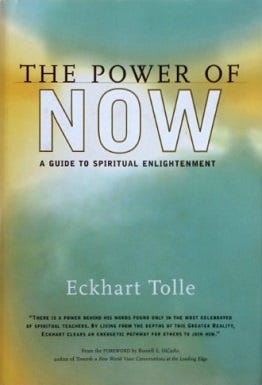
Here’s an apparently not so obvious statement: people who are enlightened don’t write New York Times best sellers. If enlightenment could be made into a commodity that would sell by the millions, we’d all be enlightened. Yet, spirituality sells. Eckhart Tolle’s ‘The Power of Now’ was published in 1997, and has become a landmark in modern self-help spirituality. By 2009 it had sold three million copies in North America alone. Readers include celebrities from Oprah to Paris Hilton to Katy Perry. Yet it is a book transparently riddled with inane category errors, bizarrely irrational statements and vague spiritual wish-wash. How has he made himself so successful?
The basic premise of the book is the admirable foundation of what we now call mindfulness: attend to the present moment, to your present conscious awareness, and find that there is a kind of peace to just being. Great, the problem is I said that in a sentence, yet to sell it you have to write an entire book, convince people you had such a profound enlightenment experience you have generated from it an entire philosophy. To do this Eckhart Tolle goes on, in sentences so indecipherably incoherent (…The pain-body consists of trapped life-energy that has split off from your total energy field and has temporarily become autonomous through the unnatural process of mind identification…), to articulate something like what is known as ‘non-duality’, a somewhat catch all term for modern self styled spiritual gurus who claim to have achieved deliverance through the realisation that consciousness, not mind, is all there really is to what you are.
Eckhart Tolle is more difficult to pin down than other spiritual teachers, part of the problem with trying to criticise him is he really isn’t saying a lot. The summary of the entire book doesn’t really go beyond the single observation of attending to the present, what he actually thinks of the meaning of events, things in the world or of experience is frustratingly hard to find. Every sentence is vague and banal — “Don’t let the fear rise up into your mind. Use the power of the Now. Fear cannot prevail against it. If there is truly nothing that you can do to change you’re here and now, and you can’t remove yourself from the situation, then accept your here and now totally by dropping all inner resistance.” Is that really anything your Mum wouldn’t say to you when you’re anxious about the dentist or something? You can’t change anything so just relax? And what about responsibility? What about the use of fear to stimulate the fact that you can change things in the world? Such a philosophy is lazy, it involves the renouncement of the world of things as meaningful and your role in it as an actual agent.
This is when we get to the most flagrantly ridiculous category error of Tolle’s philosophy — you are not your thoughts or your mind. He says “to realise that you are not your thoughts is when you begin to awaken to spirituality”. Forgive me, but such a statement is a thought. Ponder for a moment the ridiculousness of this sentence that summarises such a view — I am not my thoughts, I thought. Ponder for a moment the fact the Tolle claims that situations aren’t the problem, but your thoughts about it, then proceeds to write five books containing his unending rambling thoughts about it.
This is the core of the error of such philosophies. If you are teaching renouncement of the meaningful world of things, you can’t go teaching such a philosophy as a person in the world of things. Where is morality? Where is the meaning of experience? Why is there the world that there is? No questions are answered here, none of the human’s search for meaning or transcendence is solved by banal self help spiritual platitudes sold to entitled rich people who want to believe that all the problems of the world are just caused by people not attending to the present enough.
Whatever enlightenment is, every religious tradition has come to the conclusion that it is at the end of a long dark path of sacrifice and moral fulfilment. Hope, joy, and love are not cliched statements of spirituality but what it means to act out self-transcendence in a real, moral, meaningful world of things. The irony of the entire philosophy is that it claims removal from suffering involves seeking an observation of inner happiness, but it is still fundamentally selfish. You notice that you are not your thoughts so that you can feel better. The idea that you are not you ignores the fact that everyone reading the book wants to feel happier, who is it that wants to feel happier? Why else would it sell? It’s dependant on a readership of LA style spiritualists who want a kind of ‘optimisation’ of their life, it’s hard to imagine Tolle standing in a hospital in famine torn Africa telling parents watching their children suffer to use the ‘power of now’. His philosophy is morally complacent and at its core ironically narcissistic.
Certain intuitions or observations in modern spirituality about the givenness of consciousness, the apparent goodness and peace of mere existence are enough for such gurus such as Tolle or Rupert Spira to sell their philosophies in books and retreats and youtube videos for year after year, but whatever shining thing enlightenment might be, they don’t have it, and you can’t sell it.


