avatarJ. Andrew Shelley

Free AI web copilot to create summaries, insights and extended knowledge, download it at here

5501

Abstract

euro-linguistic-programming">neurolinguistic programming</a>, NLP. He uses these in his wildly popular <a href="https://mindisthemaster.com/tony-robbins-seminar/">seminars</a>, <a href="https://fortune.com/2014/10/30/tony-robbins-best-advice-executive-coach/#">CEO coaching</a>, and his <a href="/swlh/i-bought-a-year-of-tony-robbins-performance-coaching-and-heres-what-it-s-like-6c2a2f24f198">canned</a> programs. Tony’s core message is that <a href="https://www.tonyrobbins.com/leadership-impact/nlp-techniques/"><i>we can change the way we think</i></a><i> </i>in order to modify our behavior so that we can remake our world.</p><p id="936e">I’m sure Scott Adams would point out the unique technique used by <i>Reframe Your Brain</i>: short, often surprising juxtapositions that challenge the way we look at the world. His approach is a little different than those who have gone before, but it fits in a long tradition.</p><h1 id="7e43">The broader positioning of the book</h1><p id="09e8"><i>Reframe the Brain</i> illustrates the mindsets that divide America.</p><p id="69f7">The confusing thing about Scott Adams is that he built his fame <a href="https://hbr.org/2013/11/scott-adams">championing</a> the Little Guy vs. the Big Corporation. All sorts of groups who believe they back the little guy — the Democratic party, unions, government agencies, and even the Agile community (a story for another day) — thought he was on their side for years.</p><p id="dc4c">To their surprise, Scott was NOT on their side. He was against all big organizations — corporations, government, political — and dubious of anyone who says people can work together for the greater good. It took them years to figure that out.</p><p id="0236">In February when Scott declared, “<i>The best advice I have for White people is to get the hell away from Black people, get the f*ck away. Because this can’t be fixed. You just have to escape,</i>” he revealed some underlying racism by modern standards and found himself cancelled within days.</p><div id="372d" class="link-block"> <a href="https://americanbutterfly.medium.com/while-my-mom-was-dying-scott-adams-killed-his-public-self-b142dfab8a2f"> <div> <div> <h2>While Mom Was Dying, Scott Adams Suicided</h2> <div><h3>Are we always surprised by the end?</h3></div> <div><p>americanbutterfly.medium.com</p></div> </div> <div> <div style="background-image: url(https://miro.readmedium.com/v2/resize:fit:320/1*eSNbuOSXgY72FcPzdkgFGQ.jpeg)"></div> </div> </div> </a> </div><p id="2c85">Aided by the cancellation, Scott soon learned that his subscribers were possibly even more conservative, libertarian, and Republican than he had suspected. In his livestreams post-cancellation he now openly bashes Democrats. It gets him easy laughs.</p><p id="e454" type="7">Reframe Your Brain illustrates the American divide</p><p id="c653">Whether Scott deeply loves the Republican party or not, he loves the idea that Republicans are free-thinking, freedom-loving individuals who band together for mutual defense.</p><p id="6684">He also loves (and understands) the concepts that divide America in 2023.</p><p id="a475"><b>The American Divide:</b> <b>Opportunity vs. Outcome</b> Today Americans are commonly taught in kindergarten to be kind, in grade school to be fair, and in high school to fight against injustice.</p><p id="0ff6">Scott challenges this simple idea of kindness, fairness, and justice. Let’s look more deeply at his reframe.</p><blockquote id="df37"><p><b><i>Usual frame: </i></b><i>Fairness is a desirable social goal. <b>Reframe: </b>Fairness is the enemy of success.</i></p></blockquote><p id="5ec7">This reframe questions the very idea of <b>fairness</b> that inspires the debate around college admissions, CEO pay, reparations, corporate influence in elections, and so forth. It causes us to question whether <b>success</b> might be more important than fairness.</p><p id="1327"><i>Impact: When Americans disagree about societal goals (fairness vs. personal success), we are unlikely to agree upon policies.</i></p><p id="adc5"><b>The American Divide: Victim vs. Author </b>In recent decades Americans have come to honor victimhood. Some say we even celebrate it.</p><p id="f669">My Dad, an old-school fellow, tried to teach <b>personal responsibility</b>. In his day, you needed to win. If you couldn’t win directly, you had to find a stand-in: the gunfighter Shane, lawyer Atticus Finch, or tribute Katniss Everdeen. Winners could author their lives and write society’s history.</p><p id="0119">Scott is fighting for that old world mindset. He believes true victims deserve justice but feels certain that justice requires personal effort.</p><blockquote id="2eb3"><p><b><i>Usual frame: </i></b><i>You are the product of your experiences and genes. <b>Reframe: </b>You are the author of your experience.</i></p></blockquote><p id="48e5">This reframe harkens back to the Horatio Alger <a href="https://www.rollingstone.com/culture/culture-features/american-dream-myth-horatio-alger-lie-bootstrapped-excerpt-1234695926/"><b>stories</b></a> that our grandparents revered. No matter our disadvantages, we must work our way to success, using whatever gifts we have.</p><p id="4250"><i>Impact: Americans struggle to integrate competing concepts. In a perfect world, society might assist the vic

Options

tims of horrible disadvantage but still expect them to author their own destinies. Those are tough concepts to merge together.</i></p><p id="ae22"><b>The American Divide: the Individual vs. the System </b>At the core of the debates over the past decade is the notion of the importance of the system relative to that of the individual.</p><p id="db79">The way history was taught to me, Alexander the Great may as well have personally defeated 100,000 Persian soldiers. The 6'2" George Washington won the American Revolution on his own. The advantages of their birth, the armies that surrounded them, and the circumstances about them counted for only a little. They authored their own success.</p><p id="7efa">That<b> individual</b> lens is comforting when applied to the beggar knocking on our car window. It is easy to think that any failure to accumulate wealth has nothing to do with the financial or medical <b>systems</b> arrayed against the destitute.</p><p id="283f">To be fair, Scott admits that there have been unfair systemic barriers in the past and maybe even some today. Still, he champions the belief that in 2023 we have to shift towards a focus on individual responsibility and away from ideas of shared social responsibility.</p><blockquote id="7fc1"><p><b><i>Usual frame: </i></b><i>I deserve to be treated well by others. <b>Reframe: </b>You get what you give, on average. No one deserves anything.</i></p></blockquote><p id="3e87">This reframe can be used to refuse compensation for society’s sins of the past or to devalue the importance of change in biased systems.</p><p id="74c9"><i>Impact: Americans ignore the bad behaviors of past generations. They certainly don’t try to fix them.</i></p><figure id="2fa5"><img src="https://cdn-images-1.readmedium.com/v2/resize:fit:800/0*LbsQ3b2oXl28SSrn.png"><figcaption>Author’s screen capture of Scott Adams’ latest book cover, <a href="https://www.amazon.com/Reframe-Your-Brain-Interface-Happiness/dp/B0CGC8LSS1">Reframe Your Brain</a>. Cropped by author.</figcaption></figure><h2 id="600c">So What?</h2><p id="158a">A few days after his book launch, Scott Adams gleefully joked that his way of viewing the world would be immortalized in AI. The esteemed <a href="https://readmultiplex.com">Brian Roemmele</a> had tweeted as much.</p><figure id="0234"><img src="https://cdn-images-1.readmedium.com/v2/resize:fit:800/0*n_TIZDZnXSoisU3Q.png"><figcaption>Author screen capture from <a href="https://twitter.com/BrianRoemmele/status/1695473528274059299?s=20">X</a>, @BrianRoemmele</figcaption></figure><p id="3bf5">I look at statements like these as a bit of a joke among bright folks fabulous at marketing themselves.</p><p id="b839">However, in a world where there is too much information to always distinguish between truth and lie…</p><p id="c19b">Where 30% of Americans <a href="https://www.monmouth.edu/polling-institute/reports/monmouthpoll_US_062023/">believe</a> that the 2020 election was decided by voter fraud…</p><p id="2c23">Where 55% of Americans are <a href="https://www.monmouth.edu/polling-institute/reports/monmouthpoll_US_062023/">very concerned</a> about losing their fundamental rights and freedoms…</p><p id="f719"><b>How we frame our thoughts can be more important than the facts. Scott gets that right, and AI might end up understanding us better than we do.</b></p><p id="89fd"><i>Conversation is quite welcome. Claps are deeply appreciated.</i></p><p id="533b">Read the story of Scott Adams’ career suicide:</p><div id="af75" class="link-block"> <a href="https://americanbutterfly.medium.com/while-my-mom-was-dying-scott-adams-killed-his-public-self-b142dfab8a2f"> <div> <div> <h2>While Mom Was Dying, Scott Adams Suicided</h2> <div><h3>Are we always surprised by the end?</h3></div> <div><p>americanbutterfly.medium.com</p></div> </div> <div> <div style="background-image: url(https://miro.readmedium.com/v2/resize:fit:320/1*eSNbuOSXgY72FcPzdkgFGQ.jpeg)"></div> </div> </div> </a> </div><p id="fe62"><i>Read the follow-up story:</i></p><div id="df40" class="link-block"> <a href="https://americanbutterfly.medium.com/day-75-where-is-racist-scott-adams-now-e270c766327e"> <div> <div> <h2>Day 75: Where Is Scott Adams Now?</h2> <div><h3>He’s doubling down: getting away from people he can’t trust</h3></div> <div><p>americanbutterfly.medium.com</p></div> </div> <div> <div style="background-image: url(https://miro.readmedium.com/v2/resize:fit:320/1*klWxIu-tdX3Lx0Go2FRp9Q.jpeg)"></div> </div> </div> </a> </div><p id="78bf"><i>J. Andrew Shelley has spent years in startups that did nice stuff. Some stalling. Some selling. One for over half a billion dollars. Building relationships but none making him rich. He now distills work and life into worthwhile stories.</i></p><p id="7d2a"><i>Please <a href="https://americanbutterfly.medium.com/subscribe">subscribe to read J. Andrew Shelley’s stories</a>. Check out the book <a href="https://www.amazon.com/American-Butterfly-Lessons-Learned-Culture/dp/1735497401/">American Butterfly</a>, too. It tells the story of America’s Culture War through the lens of a Southern family suffering great loss.</i></p></article></body>

Echoes of Discord: Scott Adams Reframes the American Brain

Our problems are in our heads

Last week Scott Adams independently published his book, Reframe Your Brain. It had been cancelled in February by Penguin Random House.

It’s an easy read. If a knock-knock joke and a haiku had a baby in the Self-Help aisle, it would look like a Scott Adams’ reframe.

Usual frame: Your job is what your boss says it is. Reframe: Your job is to get a better job.

In the days before the release, Scott stirred up his followers. He suggested Amazon, a company owned by the corporatist Democrat, Jeff Bezos, might cancel him, too. The waiting period imposed on all books by Amazon, usually a few days, sometimes more, felt to Scott as nefarious as Kafka’s Trial.
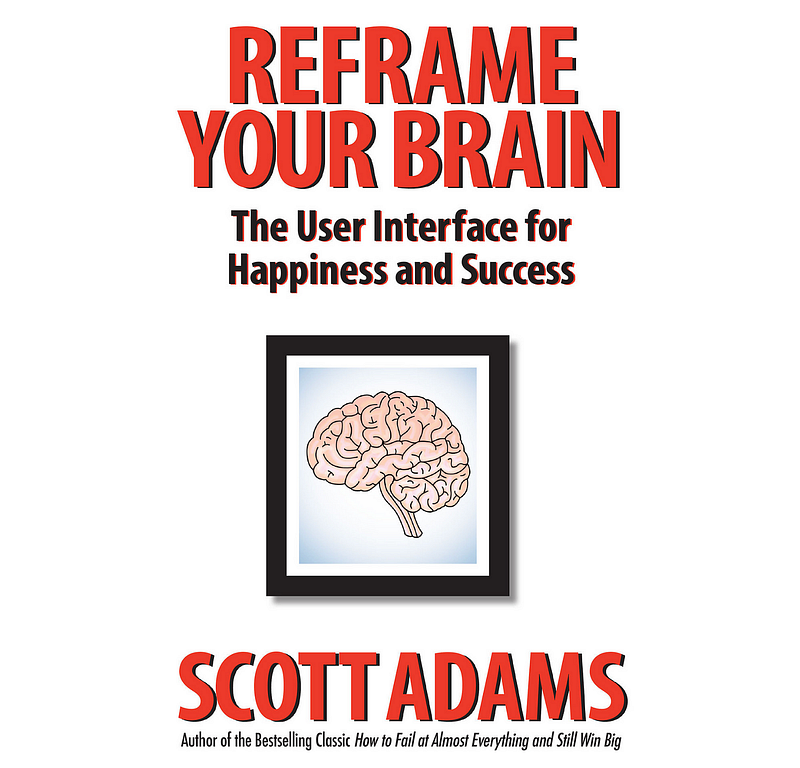
Author’s screen capture of Scott Adams’ latest book cover, Reframe Your Brain.

The day Reframe Your Brain became available, Scott shared that readers were already thanking him for its wisdom making their lives better. He was honored that reviewers considered it one of the best self-help books ever. He was certain that the book would change the world.

On X, posters agreed with all that Scott said, many going farther.
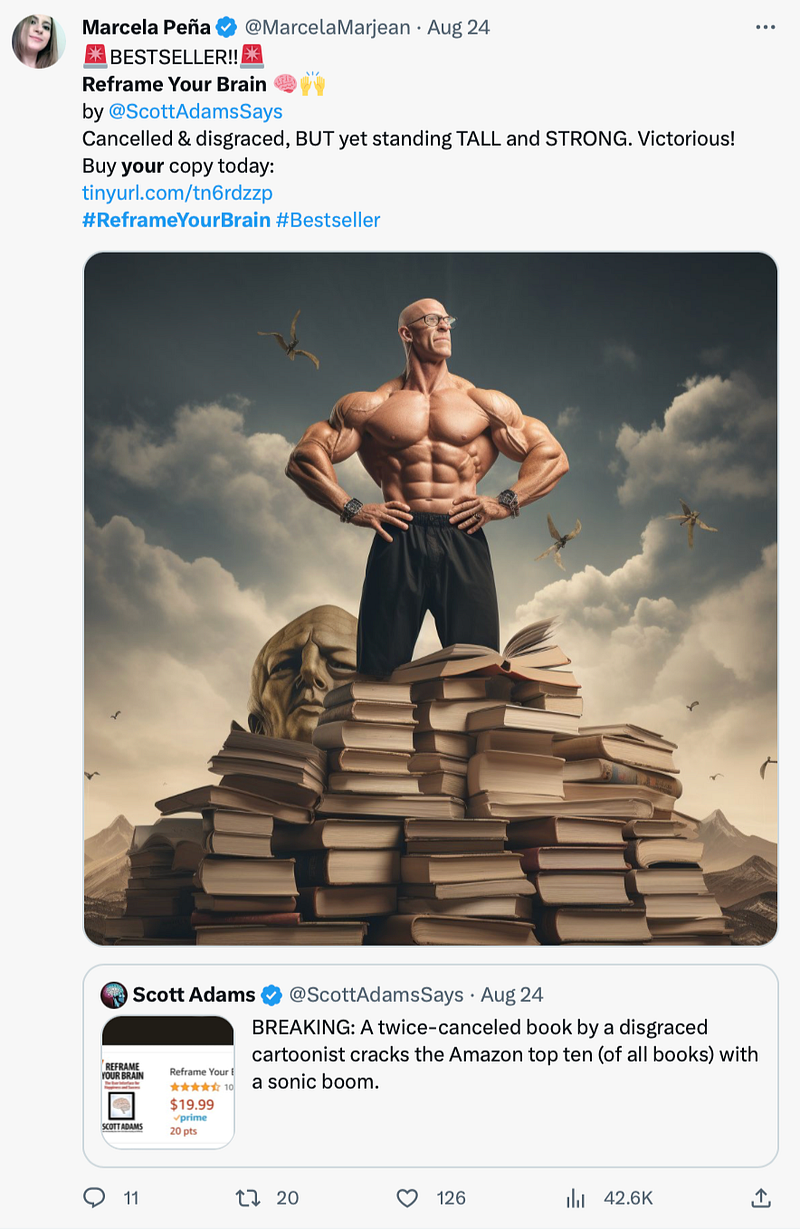
Author screen capture from X, @MarcelaMarjean

Though the release was over-the-top, the book is thoughtful, easily digestible, and worth the time of those who enjoy the self-help genre.

For everyone else, Reframe Your Brain is intriguing for a different reason. It illustrates the discord in the American divide.

At a time when we are gifted with more information than ever, what matters most is not fact, nor fiction. Our personal guidestar is our mindset, the way we frame the world in our very own brains.

The book’s core messages

Like any self-help guru, Scott Adams is here to share the secrets that made him successful. Good hypnotists, successful cartoonists, and great marketers are experts at suggestion. They help people BELIEVE, and that is what Scott is here to do.

Hypnotism has a long history, going back hundreds of years. It was originally used by clergymen, physicians, neurologists, psychologists, and others involved in the healing arts. — SCEH, Society for Clinical and Experimental Hypnotism

The core message of Reframe Your Brain is simple: you can change your world by rapidly retraining your brain. A brain reframe can make a poor person rich. An unhappy person can become happy.

The book describes dozens of reframes. Many appear obviously correct because they are nuggets we have long accepted.

Usual frame: Things should be fair. (me) Reframe: Life isn’t fair. (Mom)

Others may require mental gymnastics that a Buddhist master would respect.

Usual frame: Fairness is a desirable social goal. Reframe: Fairness is the enemy of success.

Scott teaches that there is a lot of chance in our competitive world. Good fortune and bad. Ultimately, though, happiness and success are up to our own choices and efforts and the way that we look at our problems.

Scott’s self-help predecessors

Scott’s root message is remarkably similar to those delivered by his forefathers of American self-help. Each one used language appropriate for their time and audience, but the core self-help golden nugget has not changed drastically in one hundred years.

Note the word: Think

Napolean Hill built his fame with Think and Grow Rich! The book was originally published in 1937. An updated version released in 2005 remains the #95 Best Selling Book on Amazon, #8 in Motivational Self Help.

Note the goal: How to win

A year earlier in 1936, Dale Carnegie had published his winner: How to Win Friends and Influence People. A 1998 edition remains the #80 Best Selling Book on Amazon with 112,000 reviews averaging 4.7 stars.

Note the process: Change the way we think

Tony Robbins has built a half-billion dollar fortune applying indirect hypnosis and neurolinguistic programming, NLP. He uses these in his wildly popular seminars, CEO coaching, and his canned programs. Tony’s core message is that we can change the way we think in order to modify our behavior so that we can remake our world.

I’m sure Scott Adams would point out the unique technique used by Reframe Your Brain: short, often surprising juxtapositions that challenge the way we look at the world. His approach is a little different than those who have gone before, but it fits in a long tradition.

The broader positioning of the book

Reframe the Brain illustrates the mindsets that divide America.

The confusing thing about Scott Adams is that he built his fame championing the Little Guy vs. the Big Corporation. All sorts of groups who believe they back the little guy — the Democratic party, unions, government agencies, and even the Agile community (a story for another day) — thought he was on their side for years.

To their surprise, Scott was NOT on their side. He was against all big organizations — corporations, government, political — and dubious of anyone who says people can work together for the greater good. It took them years to figure that out.

In February when Scott declared, “The best advice I have for White people is to get the hell away from Black people, get the f*ck away. Because this can’t be fixed. You just have to escape,” he revealed some underlying racism by modern standards and found himself cancelled within days.

Aided by the cancellation, Scott soon learned that his subscribers were possibly even more conservative, libertarian, and Republican than he had suspected. In his livestreams post-cancellation he now openly bashes Democrats. It gets him easy laughs.

Reframe Your Brain illustrates the American divide

Whether Scott deeply loves the Republican party or not, he loves the idea that Republicans are free-thinking, freedom-loving individuals who band together for mutual defense.

He also loves (and understands) the concepts that divide America in 2023.

The American Divide: Opportunity vs. Outcome Today Americans are commonly taught in kindergarten to be kind, in grade school to be fair, and in high school to fight against injustice.

Scott challenges this simple idea of kindness, fairness, and justice. Let’s look more deeply at his reframe.

Usual frame: Fairness is a desirable social goal. Reframe: Fairness is the enemy of success.

This reframe questions the very idea of fairness that inspires the debate around college admissions, CEO pay, reparations, corporate influence in elections, and so forth. It causes us to question whether success might be more important than fairness.

Impact: When Americans disagree about societal goals (fairness vs. personal success), we are unlikely to agree upon policies.

The American Divide: Victim vs. Author In recent decades Americans have come to honor victimhood. Some say we even celebrate it.

My Dad, an old-school fellow, tried to teach personal responsibility. In his day, you needed to win. If you couldn’t win directly, you had to find a stand-in: the gunfighter Shane, lawyer Atticus Finch, or tribute Katniss Everdeen. Winners could author their lives and write society’s history.

Scott is fighting for that old world mindset. He believes true victims deserve justice but feels certain that justice requires personal effort.

Usual frame: You are the product of your experiences and genes. Reframe: You are the author of your experience.

This reframe harkens back to the Horatio Alger stories that our grandparents revered. No matter our disadvantages, we must work our way to success, using whatever gifts we have.

Impact: Americans struggle to integrate competing concepts. In a perfect world, society might assist the victims of horrible disadvantage but still expect them to author their own destinies. Those are tough concepts to merge together.

The American Divide: the Individual vs. the System At the core of the debates over the past decade is the notion of the importance of the system relative to that of the individual.

The way history was taught to me, Alexander the Great may as well have personally defeated 100,000 Persian soldiers. The 6'2" George Washington won the American Revolution on his own. The advantages of their birth, the armies that surrounded them, and the circumstances about them counted for only a little. They authored their own success.

That individual lens is comforting when applied to the beggar knocking on our car window. It is easy to think that any failure to accumulate wealth has nothing to do with the financial or medical systems arrayed against the destitute.

To be fair, Scott admits that there have been unfair systemic barriers in the past and maybe even some today. Still, he champions the belief that in 2023 we have to shift towards a focus on individual responsibility and away from ideas of shared social responsibility.

Usual frame: I deserve to be treated well by others. Reframe: You get what you give, on average. No one deserves anything.

This reframe can be used to refuse compensation for society’s sins of the past or to devalue the importance of change in biased systems.

Impact: Americans ignore the bad behaviors of past generations. They certainly don’t try to fix them.
Author’s screen capture of Scott Adams’ latest book cover, Reframe Your Brain. Cropped by author.

So What?

A few days after his book launch, Scott Adams gleefully joked that his way of viewing the world would be immortalized in AI. The esteemed Brian Roemmele had tweeted as much.
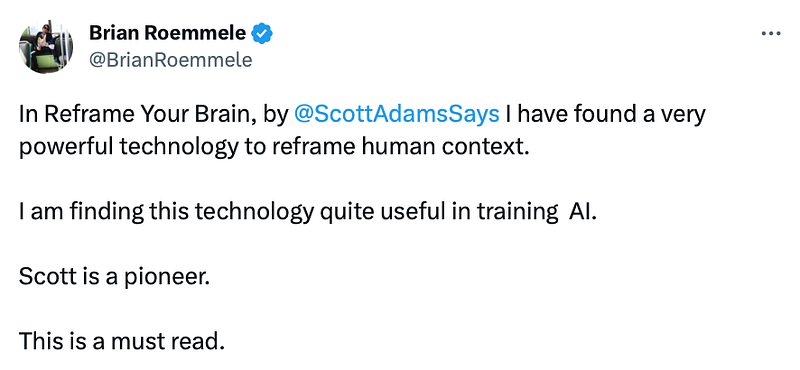
Author screen capture from X, @BrianRoemmele

I look at statements like these as a bit of a joke among bright folks fabulous at marketing themselves.

However, in a world where there is too much information to always distinguish between truth and lie…

Where 30% of Americans believe that the 2020 election was decided by voter fraud…

Where 55% of Americans are very concerned about losing their fundamental rights and freedoms…

How we frame our thoughts can be more important than the facts. Scott gets that right, and AI might end up understanding us better than we do.

Conversation is quite welcome. Claps are deeply appreciated.

Read the story of Scott Adams’ career suicide:

Read the follow-up story:

J. Andrew Shelley has spent years in startups that did nice stuff. Some stalling. Some selling. One for over half a billion dollars. Building relationships but none making him rich. He now distills work and life into worthwhile stories.

Please subscribe to read J. Andrew Shelley’s stories. Check out the book American Butterfly, too. It tells the story of America’s Culture War through the lens of a Southern family suffering great loss.

American Divide
Culture
Racism
Scottadamssays
Reframe
Recommended from ReadMedium