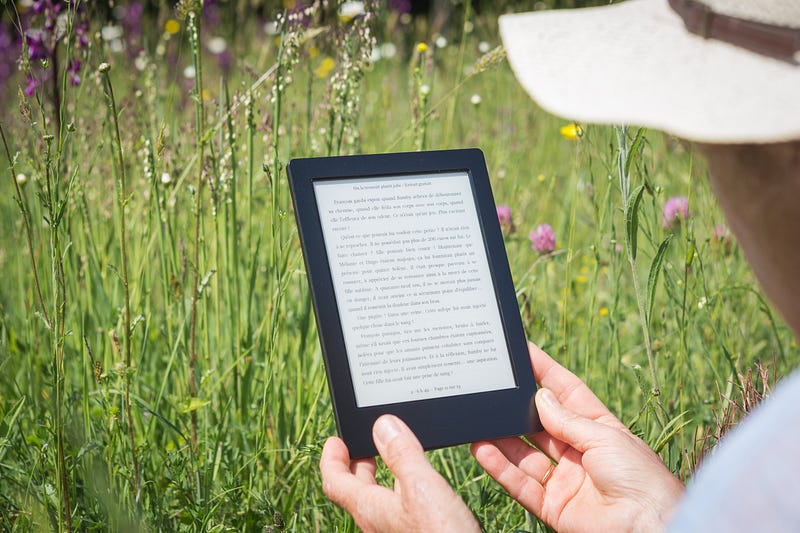
Ebooks Are Better Than Paper Books: 5 Reasons You’ve Likely Never Considered
I have at least one convo a month with someone who proudly claims “I only read real books.” I tell them that I love my Kindle, but I never really want to get into the specific reasons why. Basically, I don’t want to argue in public. Real-book-readers—those hardcore old-school bibliophiles—they’re a passionate bunch. They love the smell of paper. I still don’t want to argue, but here is my written response to everyone who only reads on paper.
Ebooks are better than physical books, and here are 5 reasons to support that claim.
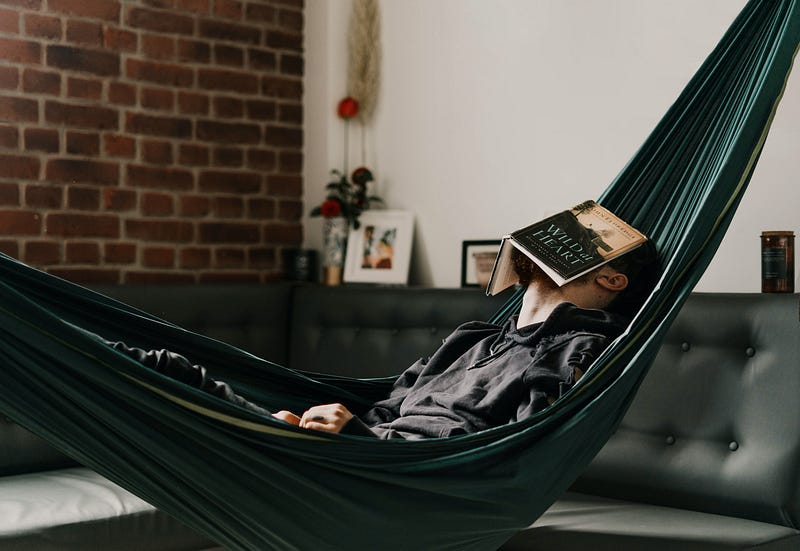
1. You can read in a hammock while holding a drink.
So this one depends on your hand size, but I’m a fairly average-sized guy (5'11'’ & 185 lbs.), and one of my hands can pretty easily hold a Kindle, and advance the book to the next page when I’m ready. (I use my middle finger or thumb depending on which hand the book is in.) I realized early on in my Kindle reading days, that this was an incredible, yet unheralded feature.
I bought my first Kindle for a big backpacking adventure in South America. I read while swaying in countless hammocks over those 5 months. I would often have a coffee or beer nearby depending on the time of day. I discovered on this trip that reading on a Kindle allowed me to read my book while I sipped my hot morning coffee—all while I was engulfed in a flimsy hammock. You can’t even hold a coffee while reading a paperback book in a bed. Turning the page of a hardcover or paperback is a two-hand job.
If you opened this article to defend your reasons for why you love paper books (I LOVE THE FRIGGIN’ SMELL, OKAY!), then you’re probably rolling your eyes at this first reason, but I swear it’s an incredibly useful feature. 10 years on from the start of that first trip to South America, I now live in Mexico, and reading in a hammock is still a weekly occurrence. Whenever it happens, I’m glad my book is on a Kindle and not a two-handed heavy pile of paper.
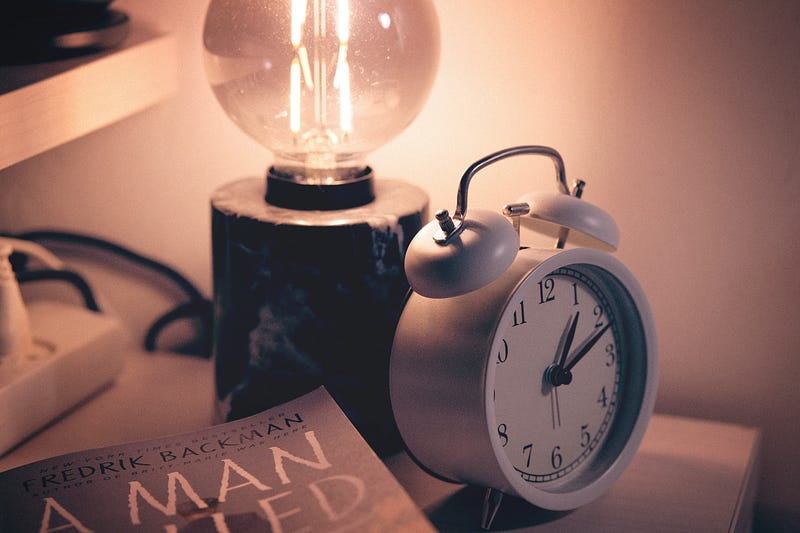
2. Reading in bed or on an airplane.
I feel passionate about this reason. This reason caused a number of small squabbles with my last partner. She read paper books, and as you now know, I prefer my Kindle. At night, after finishing whatever movie or show we were watching, I would always read to wind my brain down. I love falling asleep while reading, dropping the Kindle on my chest a few times before finally succumbing to the dream state.
That gradual reduction in light, the gradual winding down of your brain to easily drift into sleep while reading is much more difficult if a lamp is required to read. When my partner was caught up in a new book and also wanted to read at night, she would have to turn on her nightstand lamp. This would illuminate the room far more than it was during the previous two-hour movie. My brain would think we’re gearing back up for action.
I would gently ask if she could use her phone’s flashlight. She didn’t like doing that, but she recognized that the light bothered me, so she would usually be kind and either cut it short or just skip reading altogether, turning the lamp off with a slight “harumph.” We would both go to bed a bit frustrated. Eventually, we got her a specific book light.
This same thing occurs on every red-eye flight. Those on the flight with a Kindle disturb no one. Those on the flight who prefer reading paper have to turn on a spotlight from above, illuminating their entire area. Whenever I’m seated next to someone on an overnight flight who pulls out a paper book I think, “Oh no. I wish this person was a Kindle reader.” Your personal light pollution is far less invasive on fellow passengers when you choose to read from a backlit Kindle.
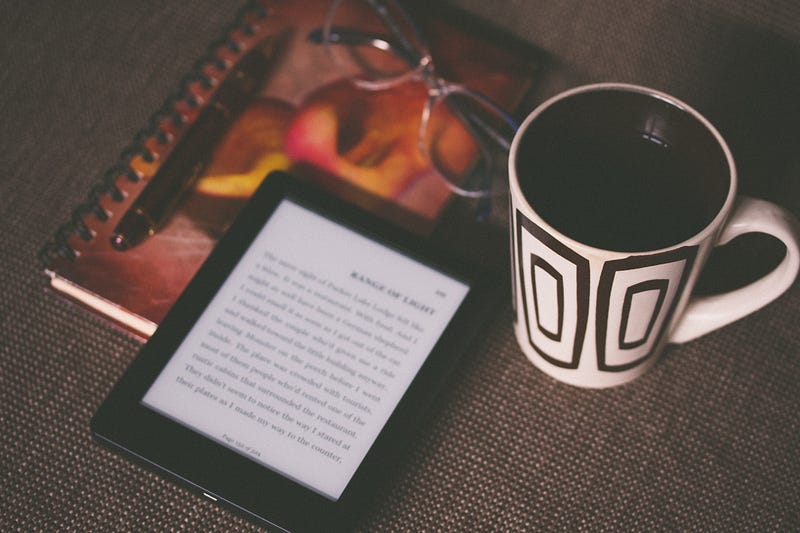
3. The size of a Kindle makes it much more portable.
I often put my Kindle in the front pocket of my shorts. I often put my Kindle in my colorful little fanny pack. I often put my Kindle in my shoulder sling bag. It is incredibly light and easy to take with me when I’m leaving the house on a brief errand or adventure. I often take my kindle with me even if it’s just for the seven-minute window between ordering food and having it arrive.
I, like many readers, have a romantic image of traveling around with a bent paperback copy of “On The Road” stuffed into the left butt pocket of some worn out bluejeans. But, that doesn’t work for most books. Most books are too big to easily fit into a pocket or a crowded fanny pack. Have you read Shantaram? Have you read 1Q84? Have you read Infinite Jest?
There are countless amazing books that simply don’t fit into a pocket. All of these longer masterpieces are the same size on a Kindle, and you can easily bring them with you wherever you go, without feeling like you put a brick in your bag.
4. You can rent ebooks for free, and buying them is often cheaper.
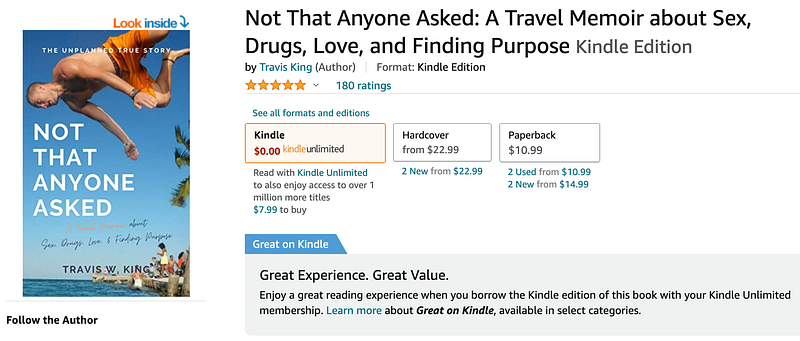
Ebooks are widely considered to be the cheaper alternative to paper books. That was largely how they were presented when they first became popularized. The example above, which is a screenshot of my travel memoir, is a representative use case for a self-published book.
My ebook sells for $7.99 and my paperback sells for $14.99. (Note: Both sales net me close to the same return as the author—just under $5 USD). Basically, it’s almost double the price to pay for that sweet smell of paper. To have a physical thing you can put on a shelf, like a taxidermied badger that you conquered.
LOOK YONDER AT MY BOOKSHELF, I DEFEATED THOSE WORDS!
This difference in price actually does not always apply to more well-known, traditionally published books. This is for two main reasons. 1. The resale paperback market is flush with every mass-produced, popular title, and 2. Kindles are more widely used these days (for many of the reasons discussed here) and it turns out that most readers will pay the same amount for the books they want to read, regardless of the form they prefer.
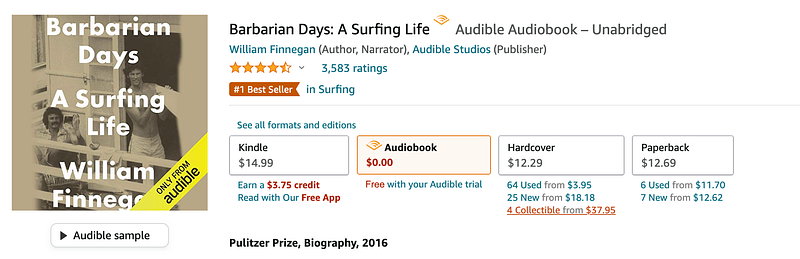
For example, Barbarian Days by William Finnegan (one of my all-time favorite books) is essentially the same price in paperback and Kindle. The Kindle list price is even a couple of dollars more, but with shipping, it’s likely very similar. The cheapest options are actually the used paperback and hardcover versions, because of the secondary resale book market.
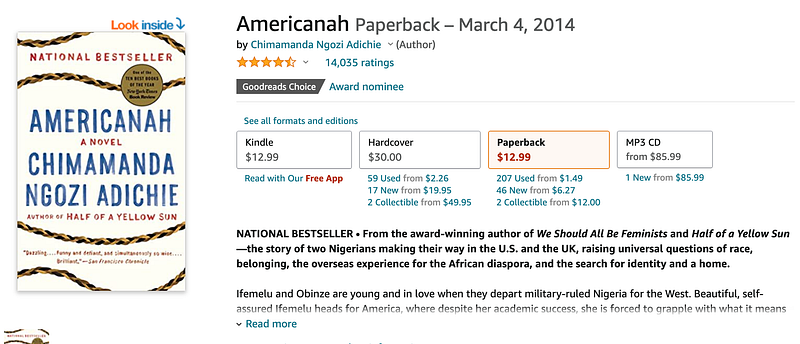
Another example is Chimamanda Ngozi Adichie’s incredible book, Americanah. The paperback and Kindle are again the exact same price. Looking up a number of my favorite books from the past few years, this seems to be true about most traditionally published, successful books. If there is demand, the paperback and ebook net out at around the same price for readers.
For other self-published and less famous (read: soon-to-be-famous) books like mine, the ebook is still generally much cheaper. Fortunately for me, I have a life hack for reading that has saved me a few thousand dollars over the last ten years.
I simply rent books from my home library back in Milwaukee onto my Kindle from anywhere on earth.
If you didn’t know this was even an option, let me repeat—I RENT EBOOKS FOR FREE ONTO MY KINDLE. If you don’t have a physical library down the street, this option allows you to treat the internet + your Kindle + your library card like you’re at a library full of available books.
I can read any ebook title my library holds, for free, from anywhere in the world. Sometimes I have to wait for a title to become available, just like at a brick-and-mortar library, but I can always find something I’m excited to read.
If you’re a big reader, go ask your neighborhood librarian to help you set this up. If you’re at all like me, it’ll change your life. I read far more than I would if I had to shell out $15 for every book I was told to check out. Last year alone I read over thirty titles.
5. Paper books create a lot of waste.
After absorbing the last four points, if you still feel certain that you’re a diehard-physical-book-reader, that’s alright. I do hope that this post has at least made you slightly more open to the idea of ebooks. But maybe it’s too late for some. I get the sense from many with this passionate pro-paper-book opinion, that it’s mostly based on some nebulous feeling of that’s how I’ve always done it. Physical books are familiar. They’re a bit nostalgic.
It took me years to convince my baby boomer father that good beer now comes in cans. He grew up only associating cheap, bad beer with cans. That is no longer the case within the microbrew boom. It turns out that this transition for many craft brewers to canning instead of bottling is partially based on benefits to the environment. So, as a last-ditch effort, I’m hoping that bringing in the fate of our planet might be the little push over the fence you need towards using an ebook.
I know beer bottles, like paper books, have this historic fondness for many—but as Dylan said best—the times, they are a changing.
Let’s do some math.
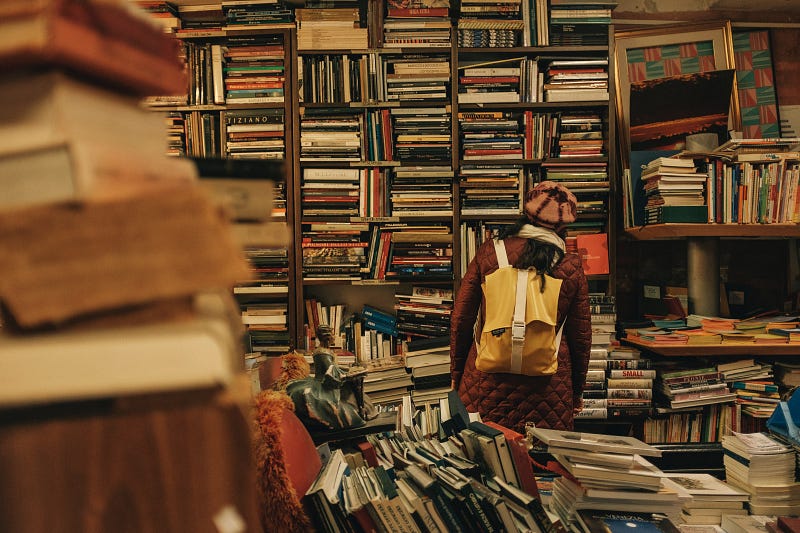
If on average, you read two books a month, and you live 60 years of your adult life on that program, that means you’ll read 1440 books. Nice work future you! If those are all made out of a stack of paper, that’s a few big trees. If you scale that impact by your neighbors, your city, or your state, we’re talking about entire forests.
According to Statista, book sales are holding steady at 650 million units per year. 650 million books is a whole lot of trees. Producing a Kindle still requires natural resources, but if one Kindle becomes hundreds of books over the course of a dozen years, it’s undeniably less impactful on our planet. I’m not trying to say you can’t be an environmentalist if you prefer paper books, I’m just asking you to consider the impact of the book industry overall, and your participation in it.
Note: I just used a kleenex, and I still think I’m an environmentalist. I’m not one to shame people for using a papertowl or for driving their car, and I’m not tyring to make you feel bad if you love physical books. My memoir sells as both a paperback and hardcover, so I’m really not trying to point a finger in any direction. I’m just asking you to consider the environment as apart of your decision.
I know it feels familiar and comforting to hold a paper book in your hand. I know the smell of paper books is enchanting. But, along with the four reasons above, changing to an ebook will also reduce your carbon footprint. Maybe I should just get to work on developing a book-scented incent. That way everyone wins, including mother earth.