
Ebla, Syria — An Ancient City, Site of Earliest Dictionaries
Site of the oldest dictionary
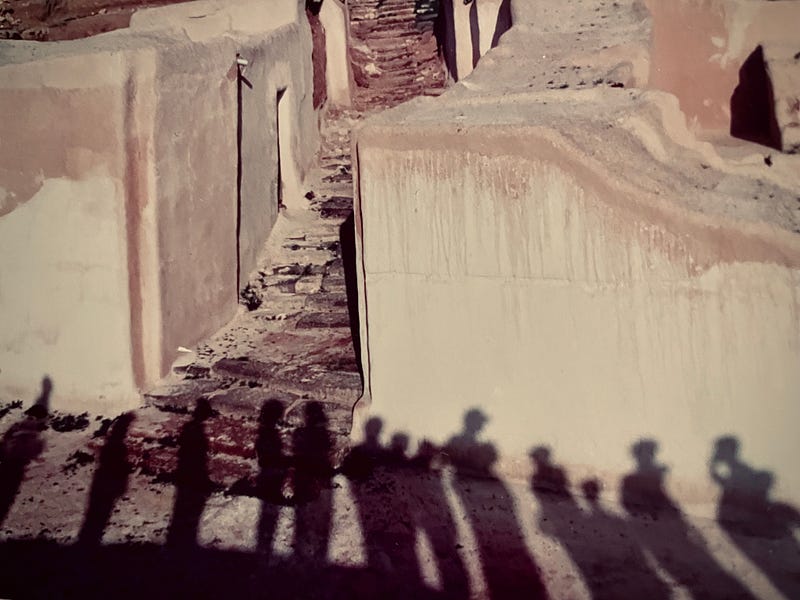
When we were living and teaching at the American Community School in Amman, Jordan, we often drove north to explore the countryside of Syria. One spring break from school, a group of us rented a bus and toured northern Syria.
What an amazing trip. We visited several fascinating sites. The photo above shows the shadows of our tour group viewing the remains of the ancient city of Ebla. Wow. It doesn’t look like much now but what an incredible history.
Ebla is located 53 km southwest of Aleppo. It dominated Mesopotamia, Syria, and Lebanon from 2600–2240 BC. It also had diplomatic relations with Egypt and Iran.
The tell (the mound) was excavated starting in 1964 by archeologists from the University of Rome. In 1975 Ebla’s archives were discovered dating to the 3rd millennium BC. As many as 1,800 complete tablets were found along with thousands of fragments of additional tablets. The clay tablets had been stored on shelves. When “Palace G” burned, the tablets were baked as if they had been in a kiln. As the shelves they were stored on collapsed, the order of the tablets was preserved.
The tablets were written in Sumerian and in a phonetic representation of the locally spoken Ebla language. The tablets included royal ordinances, edicts, and treaties. They also included hymns and proverbs. The lexical texts were used for training scribes. Along with the dictionaries were syllabaries of Sumerian words and their pronunciations in Ebla.
The agricultural land around Ebla was used to grow wheat, barley, figs, grapes, and flax. Cattle, sheep, goats, and pigs were also raised. Cloth and olive oil were the main exports.
The city was destroyed in the fire around 2240 BC. It was partially rebuilt after that, with the final destruction in the 1600s BC.
Additional Information and Information Sources:
Ebla ancient city, Syria: https://www.britannica.com/place/Ebla


