
Eating Lentils on New Year’s Eve: An Earthy Exploration of a Holiday Custom
Cultural habits, artistry, alchemy and the deeper associations of…
poop.
Excuse my first article of 2024 being so… crude. We’re going to explore excrement, and it’s going to be interesting, but I can’t help being a little embarrassed. I’m moving outside of cultural norms, and only for the sake of curiosity. Especially for new followers, I beg your indulgence.
It’s an Italian custom — no doubt fading fast — to eat lentils on New Year’s Eve.
Why?
Lentils are a legume that look a little like coins, being flat and round. They pass through the digestive system relatively unmolested by the organs and chemical processes. Therefore, one’s first bowel movement of the new year resembles a ‘pot of coins’ or pot of gold (depending, I suppose, on the type of lentils). The association of feces and gold, ostensibly the least and most valuable of substances, is not as unusual as you might think.
Inventive though they are, the Italians are not alone in equating excreta with money. Some time ago I lived next to older neighbors of German extraction. They made a trip to Germany and came back with various trinkets, including a strange plaque that hung on the wall, showing a young boy seated on a toilet, with a penny below him.
As my gaze lingered on the peculiar bit of cultural iconography a little too long, they decided to inform me that I was looking at a geldscheisser — a ‘gold shitter’. I thought it was a strange souvenir to take back from the Fatherland, but who was I to judge?
Indeed, it is not the case that we always speak of feces as a means of deprecating something. True, we can complain that someone is a shithead, or disregard something as bullshit. Yet we also sometimes use the word ‘shit’ to describe something of almost sublime value. I remember playing with a musician friend who exclaimed, “That’s the shit!” when the band was playing especially well. Cannabis smokers will often comment, “this is really good shit.”
Children often think that babies are excreted by the mother, an idea that is not really more mechanically improbable from a naive standpoint than the actual route of delivery — at least there is a precedence for defecation delivering a large package. Whatever their feelings towards their younger siblings, the association with feces is not necessarily a negative one, as children are often proud of and attached to their excrement, and sometimes try to play with it. Freud seemed to think that sculptors and painters were really playing with their poop, although I don’t give much credit that idea.
It is not only children, and not only in the birth process, that feces is associated with gold. In his book on alchemy, Johannes Fabricius includes an image of Zeus, in the form of an eagle, ‘fertilizing’ a woman by ‘gilding’ her — the eagle expels gold from above onto her.
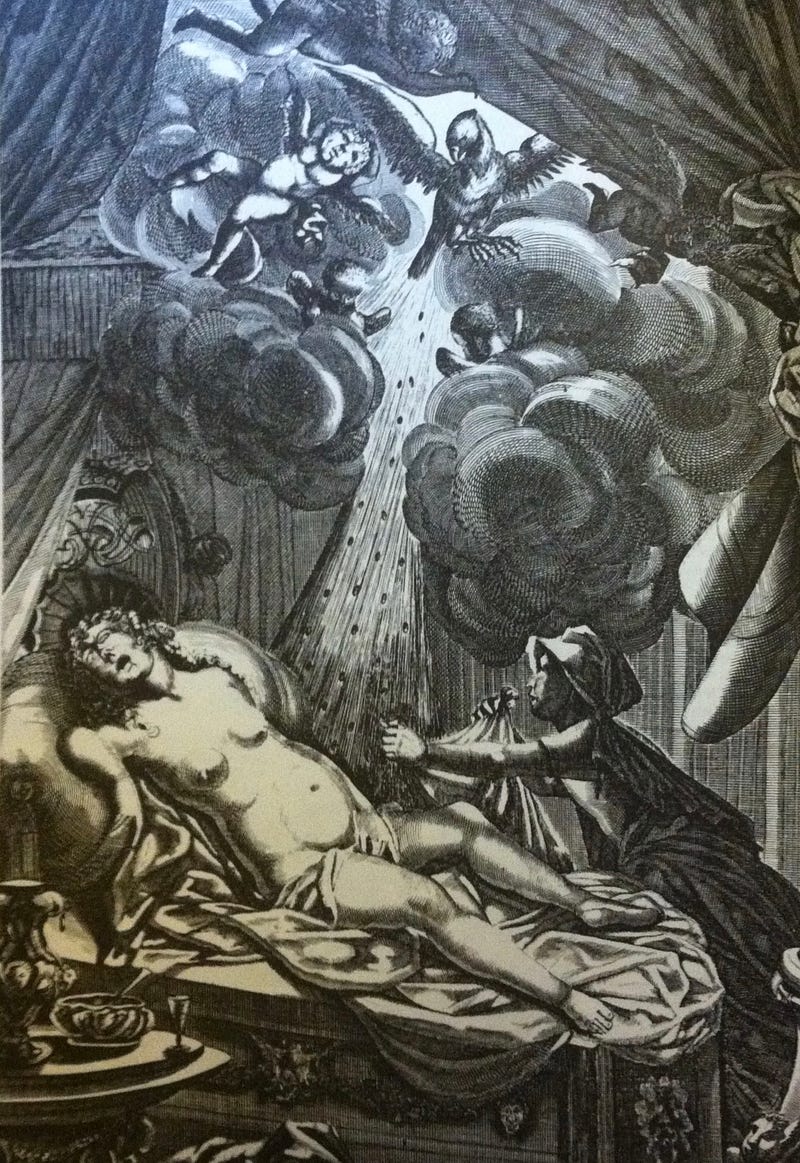
Despite this rather shocking image, the ‘fertilizing’ power of feces is not unusual in and of itself, as animal dung is frequently used as a fertilizer. Thus something of great value (food, flowers) is produced by the transformation of that which otherwise has the lowest value (dung).
The transformative process often involves the least pleasant aspects of life, and none more so than death itself. The value found in the darkest places is represented in Western mythology by the god of the underworld, Hades/Pluto. While souls go down into the underworld upon death, we also take some of our greatest treasures out of the earth, mining jewels and gold, and thus Pluto is the god of wealth.
In astrology, via his home sign of Scorpio, Pluto rules both the lower intestines and the genitalia, the organs of excretion and reproduction. It is a source of some confusion to children that perhaps lingers on into adulthood that our ‘secret’ areas, while having very different functions, are located in close proximity within the same geographic neighborhood of our bodies.
We don’t like to talk about excrement, although we may ‘talk shit’ all day long. It’s as though something so low cannot have value and therefore should not even be mentioned. But as I’ve shown, there is a legacy of associations that linger on into the present day, if only as obscure holiday customs.
By the way, there’s a Spanish tradition of eating grapes on New Year’s Eve, and I have no idea why. ;)