
Reasonable Responses to Unreasonable People (insufferable bigots, transphobes, racists, abusers, narcissists, the cat you forgot to feed…)
Stop participating, start asserting
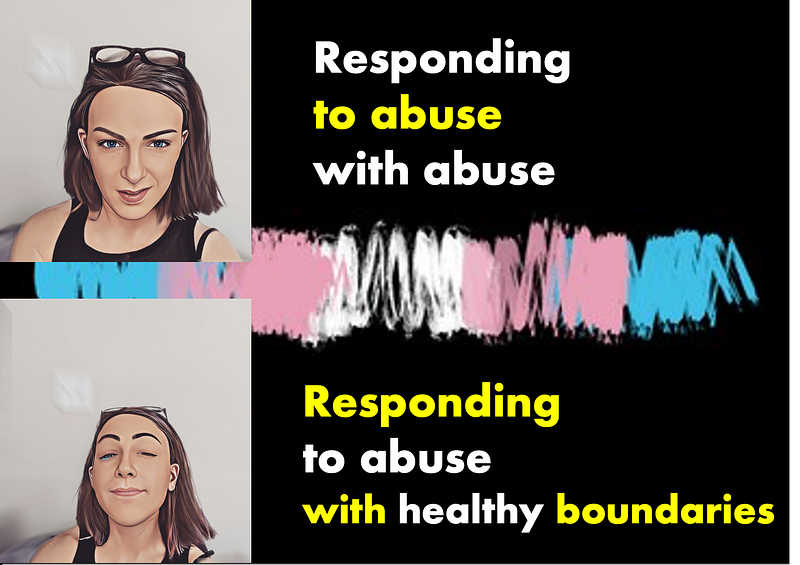
I’ve learned a lot from therapists, professors, life coaches, and everyday women speaking from their experience of survival, hope and recovery.
As the trans daughter of two abusive narcissists/sex addicts who raised me in an offshoot of a cult in the deep South (good lord that’s a mouthful)…
I can speak from my own experience, too.
And the biggest lesson I’ve learned is that boundaries are not something someone else gives to us. Boundaries are what we give to ourselves.
THEY’RE MY FAVORITE KIND OF PRESENT
If a person’s action’s contribute to me having a harmful experience— whether it be intentional or not — I don’t need to react in kind. Instead, I can choose to RESPOND (not react) with healthy limits and healthy boundaries.
Because while we can’t control what we feel and experience like flipping a switch or selecting from a menu, we can choose from a menu of options based on the terms available to us.
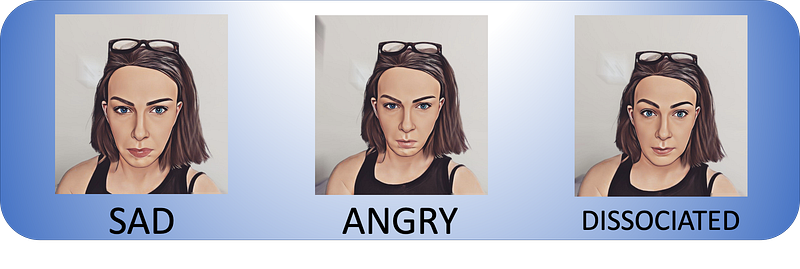
Some of the responses available to us will be healthy. Some of them would contribute to the other person having just as harmful or abusive an experience as us.
And while it might be tempting to then say but they’re the bad guy, they deserve it — no one deserves to be diminished, harmed, or abused at any time. Not you, and not the people who hurt you.
I GUESS I COULD JUST SCREAM AND FLAIL
What we need instead are boundaries that protect our emotional sobriety as much as our safety. Just because someone is hurting you doesn’t mean you have to hurt them back.
Or as we say in recovery circles, just because someone holds out the other end of the rope doesn’t mean you have to take it.
WHAT DO WE DO INSTEAD?
Here are some of the phrases I’ve found helpful when I need to express boundaries firmly but directly when I am experiencing unreasonable harm from another person.
NOTE: By “unreasonable harm,” I mean the sort a person experiences from a narcissist or abuser. Those people are beyond reason. Appealing to their empathy will fall on deaf ears. Even those with good intentions are merely benevolent abusers who deny the abusive impact of their actions.
PHRASES AND BOUNDARIES
BIG GUNS
Boom (cribbed from Lisa Romano)
I’m sorry to hear you feel that way, but you’re entitled to your own way of seeing things. I accept your faulty perception of me. I have no right or desire to try to change how you see things. I will just accept that’s how you feel about it. I am not responsible for your feelings.
Boom (cribbed from my dog)
If you have come here merely to contribute to our experiences of abuse — and then deny we are experiencing abuse when you treat us like this — then I need for you to leave.
Boom (cribbed from my cats)
Please rephrase nicely and tread lightly. You tread upon my very existence.
QUICK HITS
->That’s not what I said.
->What would you like for me to do with that information?
->I’m not here to have that kind of conversation with you or anyone else.
->Your response is unacceptable. Please rephrase nicely.
->That hurts me. What do you want for me to do with that?
->Why are you saying it like that??
->That’s not who I am.
->I’m not YOU.
->No, I didn’t. No, I don’t.
->If that’s all you have to say, I need to leave the conversation.
FINAL THOUGHTS
The hard part — and my god is this hard — is that these boundaries are NOT magic bullets to control the other person.
While these are very likely to stop them in their tracks, you can’t control another person’s feelings, behaviors, beliefs, or experiences. Just as they cannot control yours.
If the person will not listen, if they refuse to even acknowledge the harmful impact of their behavior toward you, then boundaries are not what you beg them to give you. They are not what you desperately try to justify and hope will one day deserve.
Boundaries are what you give to yourself. Just remember to be kind when you give yourself those boundaries. You deserve kindness on the inside, too.
If you like my work and want to support it, send me a tip or become a subscriber for Queer History on Patreon, Medium, YouTube, or Substack


