
East Meets West in the Skies: The Changhe Z-10 and Its Comparative Analysis with the AH-64 Apache
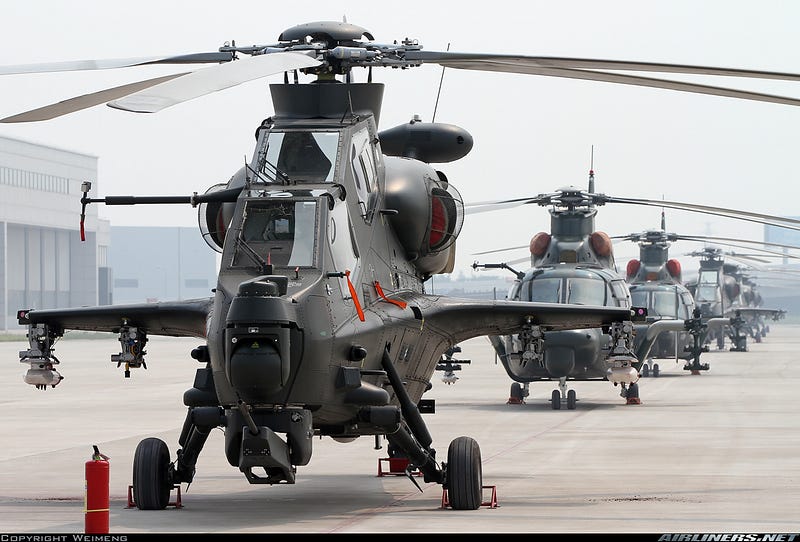
The Changhe Z-10, China’s domestically-produced attack helicopter, has sparked debate over its origins, capabilities, and future prospects, especially when compared to its Western counterpart, the AH-64 Apache. This comparison touches upon various aspects, including design, performance, and global reception, shaping the narrative around the Z-10’s role in modern warfare and China’s defense capabilities.
The Z-10 emerged in 2003, arguably as a response to the U.S. Apache. It features a sloping tandem cockpit, narrowed front end, an underbelly gun, and wing-hanging external pylons, bearing a notable resemblance to the Apache. However, the Z-10 also shows similarities with American designs like Bell’s Invictus, hinting at a hybrid between different helicopter models. This combination of features suggests an attempt to incorporate stealth characteristics, albeit the Z-10’s overall design and performance do not entirely match those of stealth helicopters like the Invictus. The Z-10’s exhaust structures, for instance, seem designed to enhance stealth by reducing its infrared signature, a feature not present in the Apache.
In terms of specifications, the Z-10 and Apache differ in several key areas. The Z-10 has a range of 800 km, compared to the Apache’s 476 km. The Apache, however, surpasses the Z-10 in top speed, reaching up to 365 km/h compared to the Z-10’s 300 km/h. The Z-10 is lighter, weighing 7 tons against the Apache’s 10.4 tons. Both helicopters accommodate a crew of two.
The Z-10’s development involved significant assistance from Western technologies, with contributions from Eurocopter, Pratt & Whitney Canada, and Agusta Westland, among others. This assistance was crucial in areas where China lacked expertise, especially in rotor installation, turboshaft engines, and transmission systems. The program faced legal issues as United Technologies Corporation’s subsidiaries were found guilty of unlawfully transferring U.S. military technology to the Z-10 project.
The Z-10’s operational capabilities are primarily geared towards anti-tank warfare, but it also has limited air-to-air combat ability. It can be armed with anti-tank missiles, rocket pods, and carries an under-nose turret for a cannon. Recent upgrades have focused on improving its stealth aspects and engine power, though the original engines (WZ-9 turboshaft) were deemed underpowered, affecting its payload capacity and overall performance. These performance issues have impacted its international marketability, as evidenced by Pakistan’s decision to opt for another model over the Z-10 due to its engine limitations.
In summary, the Changhe Z-10, while sharing certain design aspects with the AH-64 Apache, presents a unique blend of various helicopter designs. Its development has been influenced by both indigenous efforts and foreign assistance, leading to a helicopter that is somewhat a mix between existing models. Although the Z-10 has been integrated into the Chinese military, its performance and capabilities, particularly in comparison to the Apache, suggest that it is not yet a direct competitor in terms of global military helicopter standards. This situation reflects China’s ongoing journey in developing its indigenous military technology and the challenges it faces in competing with established Western designs.