
Earth Is Losing Its Shine Due to Warming of the Pacific Ocean
Our planet reflects less sunlight than it did in 1998. This means it’s heating up.
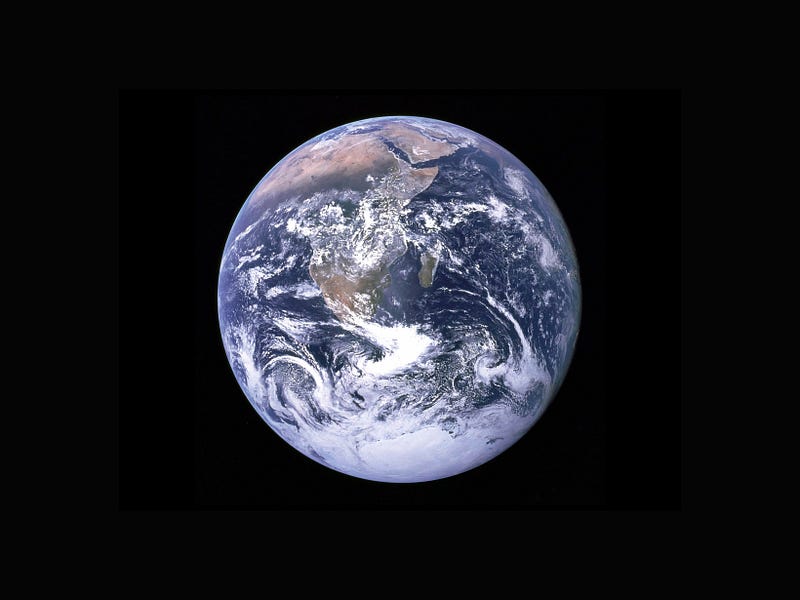
Researchers at Big Bear Solar Observatory in California and at the Instituto de Astrofísica de Canarias (IAC), Spain measured Earth’s reflectance (also called albedo) during the period 1998–2017 and found a decrease that affects the climate in a significant way.
“The reflectance of the Earth is a fundamental climate parameter,” state the authors of the paper published in the journal Geophysical Research Letters on August 29, 2021. The word albedo comes from the Latin albus, which means “white.” The reason for this origin lies in the ability of lighter objects to reflect more light (and thus stay cooler) than darker ones. In other words, reflectance measures the “whiteness” of, in this case, our planet.
The connection between Earth’s reflectance and climate is clear, albeit complicated. In the words of the authors:
“Changes in climate arise from the simultaneous evolution of the solar intensity, the Earth’s albedo, and greenhouse insulation.”
For example, certain molecules, such as sulfur dioxide expelled by volcanic eruptions, can dwell in the upper layer of the atmosphere and enhance reflectivity, cooling down the planet. Or, given that ice reflects sunlight much better than water (85% versus only about 7%), warming oceans are melting the remaining ice caps. This creates a vicious cycle: the more these melt, the higher the surface of warming waters — the source of the melting.
The researchers measured the planet’s albedo by looking at the earthshine, which is the dull glow on the dark area of the lunar face at which we gaze at night. As the authors explain in the “Plain language summary” of their paper, what was measured was “the sunlight reflected from Earth to the dark part of the lunar face and back to the nighttime observer, yielding an instantaneous large-scale reflectance of the Earth. In these relative measurements, we also observe the sunlit, bright part of the lunar face.”
What was found over the 20-year period during which telescopes arduously collected data was that the Earth’s reflectance has decreased. This corresponds to a radiative increase of 0.5 W/m². This might not sound like a lot, but if you add up the energy accumulating at this rate over a surface of 2.5 acres during 24 hours, it is about the daily energy consumption of a person in Germany (120 kWh).
The researchers compared their relative measurements obtained by looking at the brightness of the moon with absolute numbers acquired via satellite, as part of the Clouds and the Earth’s Radiant Energy System (CERES) project, which confirmed the downward trend in reflectance. In fact, the CERES decrease is twice that found via earthshine.
This dimming of our planet’s surface is attributed to the warming of surface waters in the eastern part of the Pacific. This is connected to the diminished formation of low-lying clouds, which reflect about half of the sunlight they receive — much more than water surfaces. Fewer clouds mean warmer waters and a less reflective Earth. Any variations in the incoming flux of energy coming from the Sun over the 20-year period were ruled out, suggesting that the causes are internal.
Given the tremendous impact of the changes in our planet’s reflectance on climate and the robustness of calculating it using relative measurements of the earthshine, the authors hope that their work “will encourage a resumption and revitalization of earthshine observations with new automated telescopes, DSCOVR-type observations, cubesat missions, or even a lunar observatory.”
© Gianina Buda, PhD 2021
The original paper can be accessed here.
Thank you for reading! If you wish to support me, please clap, comment, or share this article. And if you are interested in becoming a Medium member, you can use my link (I will receive a portion of your membership at no extra cost for you).
More of my work you might like: