
Will Smith Reminds Us Violence is an Option
In our enlightened world, we pretend not to condone violence. But the truth is a little more nuanced.
When I was a middle school student, I came to class sporting fresh stitches above my right eyebrow. A day earlier, I got sucker punched by a neighbor when I went over to his house to play basketball. He’d gotten involved in the wrong crowd and local gangs, and heard a rumor that I’d made fun of some girl I didn’t even know. He tossed me the basketball then haymakered my face.
Confused, I stumbled backward, touched my face, and laughed. “What was that for?” I asked.
A few years earlier, I’d gotten involved in martial arts because I’d been picked on relentlessly in my tweens, so I could take a punch. But when the crimson streak on my hand and warm gushing sensation on my face registered, I ran off crying. My parents would take me to get stitches, and the following day I wandered the halls, head down and ashamed as word spread throughout my school.
That event forced me to become much more serious in training, and by my senior year in high school, I was competing in bare-fisted, full contact tournaments. Once I turned 18, I joined the military. I learned how to use rifles, pistols, knives, and explosives to render a man nothing more than tiny bits of viscera and flesh. In college, I studied Brazilian Ju Jitsu after losing a match to a roommate whose father was an All American wrestler. Then I went to war. Not once, but twice. Around me, I saw violence as an ever looming option. The question I always wrestled with was “when?” When should I step into the fray and enact violence?
Which brings us to Will Smith.
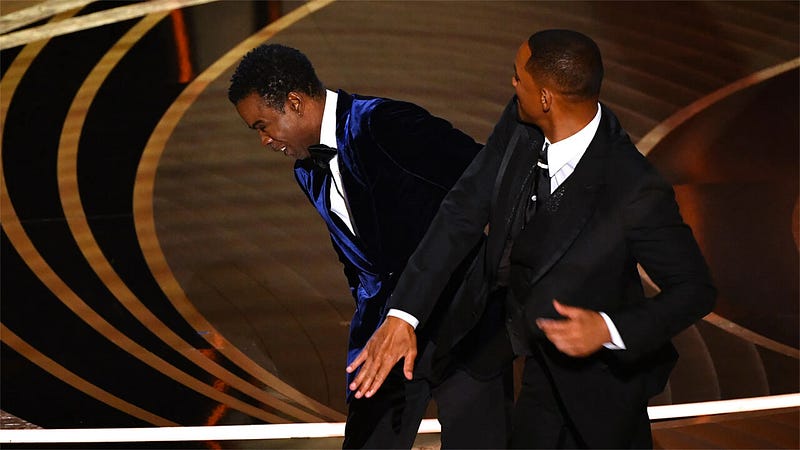
For the unaware — though it’s been plastered everywhere online in recent days — actor Will Smith slapped comedian Chris Rock during the Oscars. Rock made a joke, a staple during the awards ceremony, about Smith’s wife looking like she was auditioning for GI Jane 2. Smith’s wife has a hair loss condition known as alopecia, and he took it as a personal offense, leaving his seat, marching on stage, and slapping the comedian.
People were uncertain whether it was staged until the camera cut to commercial. The aftermath flooded the internet with memes and hot takes. One publication even compiled an entire list of “Will Smith Slap Takes” ranging from violence never being okay, toxic masculinity, elites not suffering consequences, racism, Donald Trump (seriously), Ukraine, and setting back black culture.
I, personally, have no intention of providing another half-baked analysis of the “slap heard round the world” to a chum filled sea surrounded by circling sharks. However, my life carries an unfortunate history of violence, and violence — whether or not we’d like to admit it — is part of the human condition. Regardless of what you think of Smith’s actions (and they were violent), there’s a deeper, nuanced conversation we’re skimming over that is at the base of the conversation ongoing in the public forum.
That conversation subconsciously dances around the fact that violence is always an option.
“It is one thing to study war and another to live the warrior’s life.” — Steven Pressfield
One Saturday morning in my late 20s, I awoke under a green, brown, and white striped duvet cover in my apartment while the sun glinted through my window. Laying there in the solace and quiet, a profound realization spread like an unknowing cancer. I was almost 30 and all I’d known was violence for most of my life. This epiphany shook me to the core, and for several years after, I didn’t touch firearms, knives, or train in martial arts. Instead, I observed the world and got busy experiencing food, the outdoors, recreation, and friendships.
But no matter where I went, violence followed me. Always looming, reminding me, and pressing on the simple reality that when push came to shove, violence was an option. I would observe bar fights and wonder whether to step in. A young man calling a woman a “whore” because she’d rebuffed his advance only to have him intimidate her. A guy at the gym who stole money and played it off, intimidating the other men because of his size. I let them slide. Not my fight anymore, I rationalized.
As children, we learn that violence is never okay. And yet, children — by nature — are violent. Anyone who says differently has never been a parent. Ask any mom or dad about a time their infant hit, struck, bit, or raised an appendage in defiance when they didn’t get what they want. My own children have never seen me lift as much as a finger toward their mother, yet have scratched, bit, or hit me as early as a crawling stage. If we are brutally honest, every adult entertains violent thoughts. We’ve just learned how to control them. But given the right scenario, like Will Smith, violent emotion and passion may erupt and spill to the surface.
It reminds me of a phrase repeated throughout the HBO miniseries, WestWorld: “These violent delights have violent ends.” The phrase originates from Shakespeare’s Romeo and Juliet. In the tragedy, Romeo gushes to Friar Lawerence about Juliet’s beauty. Lawrence then cautions Romeo that his violent (i.e. rash) passions may result in an equally violent end. We all know how the play ends and Lawrence’s words become a prophetic foreshadowing.
The world is a violent place. Nature is especially violent. However, we seem to have this inclination to romanticize it, never once stopping to watch a lion shred a zebra or an insect suck the guts out of a frog it’s paralyzed. The mountain lion doesn’t care that you’re just hiking and have young children. The cliff is indifferent to whether you fall off and break every bone on the way down. Does the Ukrainian think about the Russian soldier having a wife, family, and kids back home as he pulls the trigger in rapid succession? Probably not. He’s trying to survive, just like prey fighting back against predator in the wild.
That’s the part we can’t agree on as a society: when is violence acceptable? When fighting human traffickers? Someone stealing your child? Russian soldiers invading your homeland? Taking out Nazis running concentration camps?
While pacifism has its merits, will it stop a cartel member from skinning your family alive? Or is it the undercover police officer who ends up in a firefight that puts an end to their violent delights?
Author Eric Weiner recounts a moment in a recent OneZero piece in which a woman fleeing Ukraine stands stupefied. She tells a CNN reporter that she can’t believe an invasion could happen in 2022. “We have Teslas and so much amazing technology,” she states.
Weiner’s article is reminiscent of multiple conversations I’ve had with men and women who adhere to a misplaced notion that technology and the Enlightenment have accomplished greater human flourishing. Each generation likes to snub their nose at the previous for being barbaric while they ignore the glaring realities in front of them.
Technology, for all it’s good, has created some of the world’s greatest human suffering. Drone strikes can kill people groups en masse. We have atomic bombs that can destroy the entire world, whereas the Vikings couldn’t accomplish that. Tesla isn’t coming to save you, but a car thief might just use your electric vehicle to run over some innocent bystanders while eluding the police. While we may not condone violence, it is an option, and it’s never been easier to commit genocide, given the rate of our technological sprawl.
The fall of Kabul and subsequent withdrawal from Afghanistan emphasized our savage reality and inability to process violence as an option. In George Packer’s piece in The Atlantic, he interviews a young Afghan woman who’d grown up in Kabul under the watchful eye of American soldiers. He recalls:
…she was sure that Kabul, where she had grown up under American protection, was too big and modern to fall to the Taliban. “Kabul is a city full of younger generations,” she said, “full of girls and boys who can talk, who can fight with their writing, with their speaking.”
Afghanistan has become the world’s largest humanitarian crisis as the country teeters on the edge of famine under the violent return of the Taliban. Their return is a catastrophic human rights violation for women. While I believe in the power of the pen being a writer myself, when the wolves are at the gate, fighting with an essay while they devour your family does little good.
That’s why it’s one thing to wax philosophical in the online forum about violence while signaling deeply held virtues, but quite another when facing a mugger, bully, soldier, the Taliban, terrorist, or domestic abuse. Every person claims to know what they’d do—myself included—but when push comes to shove, perhaps it’s better to dwell on Shakespeare’s words:
“These violent delights have violent ends.”
Pre-orders are now available for my upcoming war memoir, Where Cowards Go to Die, or you can get free writing advice by joining my newsletter.