
Each Star Can Be a Sun and Vice Versa?
No!…And yes!
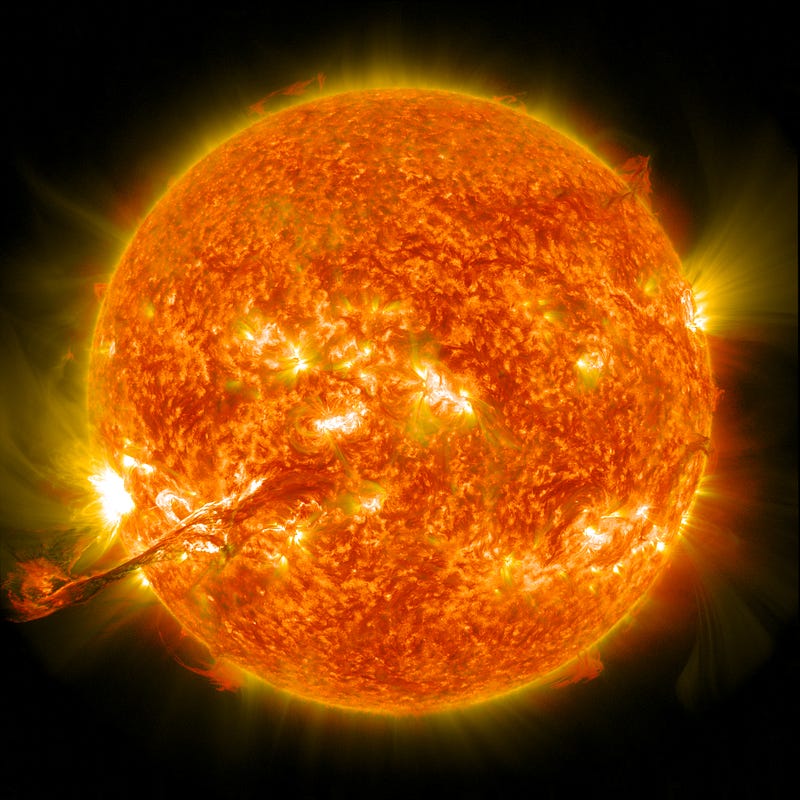
It’s one of these questions that come to your mind once in a while and you think about them for a moment and then they vanish again without really having been answered.
So, on a grey, rainy day I thought I take the chance to shed some light on it. (Pun intended.)
Let’s start with the definitions:
What is a star?
A star is a ball of gas and plasma that is very hot and radiates energy in the form of light and heat.
Stars can be found in every corner of the universe and there are billions of stars in our home galaxy, the Milky Way, alone.
What is a sun?
A sun is a star too. It has all of the aforementioned characteristics.
The name “sun” was first attributed to the star that is closest to Earth, meaning the sun is one specific star.
The solar system
Our sun is surrounded by several planets, their moons, asteroids, comets and dwarf planets. This what we refer to as “solar system”.
Depending on the source, about 30 to over 50 % of all currently known stars exist in solar systems. Sometimes, there are even two or more stars in one system.
All the other stars are alone in their cosmic location, so to speak.
In the science world, there is a debate going on about whether “our” sun should remain the only star to carry this name or whether every star that is part of a solar system that contains habitable planets should be called sun.
The name
There are different names for this particular celestial object.
The ancient Greeks worshipped Helios, the sun-god, and this term lives on in the word “heliocentric” which means that our sun is in the middle of our solar system and the planets are orbiting (circling) around it.
Then, the Romans replaced the word helios with “sol”, which, again, is still used today in terms such as “solar eclipse” or the one I’ve used already, “solar system”.
The arguably most common “sun” dates back to the Old English word “sunne” which in turn originated from a Germanic term. It translates as “heavenly body”. Just like the Greeks, the Germanic people considered the sun to be a god, which makes sense as their would be no life on Earth without the sun.
Long story short
Our sun is definitely a star. Other stars can be defined as suns under certain circumstances, but that’s a matter of perspective.
Sources:


