
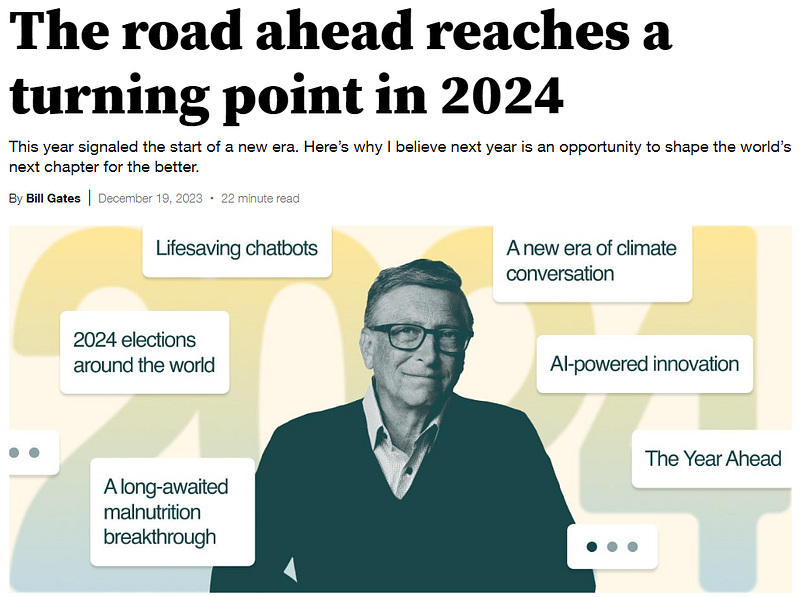
Bill Gates on AI: A Vision of Transformation
Bill Gates has long been a prominent voice on technological change. Through his philanthropic foundation and personal blog posts, he offers unique insights into innovations like AI that are redefining society. Gates balances an enthusiasm for technology’s promise with pragmatism about its challenges. His varied predictions for AI by 2024 give a glimpse into the significant transformations underway.
Jobs and the Workforce
AI will fundamentally reshape jobs and skills, automating some roles while acting as a “copilot” in others. Gates states that “the world has a better sense of what jobs AI will be able to do itself and which ones it will serve as a copilot for,” indicating a redirection in workforce demands.
He does not provide specifics on the proportion of displaced jobs, noting the complexity of factors impacting employment. However, Gates clearly anticipates that AI integration will necessitate retraining and support for impacted workers. This represents a pragmatic outlook on the workforce upheaval AI may spur.
Revolutionizing Healthcare
Gates is particularly enthusiastic about innovations utilizing AI to enhance healthcare. He highlights efforts to apply AI for improving drug development, medical imaging analysis, diagnostic accuracy, treatment personalization and more.
Noting promising work by Microsoft and others, Gates says AI holds “huge promise” in areas like early cancer detection. However, he cautions that many applications require further development, saying “most of it wouldn’t emerge in the next year and some may not leave the lab at all.”
While optimistic on healthcare advances via AI, Gates thus offers a measured assessment of the timeline for real-world implementation. Specific quantification of AI’s near-term impact is lacking.
Education and Learning
In education, Gates sees AI as a tool to dramatically enhance and personalize learning. He references technologies using AI to customize teaching based on individual students’ needs and interests.
Highlighting Khan Academy’s use of AI to tailor instruction, Gates states that “AI could engage students by learning what motivates them and what causes them to lose interest.” He expects rapid improvements in AI-enabled education by 2024.
However, details are not provided on measurable indicators or data tracking the rate of adoption of such technologies. The predictions appear largely theoretical regarding the scale of transformation by the set timeline.
The Necessity of Innovation
Interlaced in Gates’ optimistic perspectives is an acknowledgment of the risks posed by AI in areas like software manipulation, surveillance, and encoding biases. He stresses the imperative of ethical innovation and regulation to govern societal integration.
Gates calls for government investment in research and AI expertise to implement effective policies and incentives guiding development. He also emphasizes industry accountability in engineering AI safely, a prerequisite for unlocking its full potential across sectors.
Conclusion
In summary, Gates outlines a future propelled by an AI revolution touching nearly every domain, enabling humans to achieve more while requiring careful management of attendant risks. The degree and timeline of this transformation is difficult to accurately predict or quantify, however.
By synthesizing Gates’ varied writings, we gain insight into the possibilities from the perspective of an established thought leader. Yet precise forecasting requires ongoing assessment as the AI landscape continuously and rapidly evolves. Despite limitations in definitively gauging AI’s impending impact, Gates makes a case for harnessing its power to usher in a new era of innovation and human achievement.