
In Defense of WeWork
My take on the Hulu doc — from a filmmaker at a WeWork on-demand “hot desk”
Nuance is dead. Not only has it vanished from our politics, but apparently it has disappeared from film, as well. Director Jed Rothstein (The China Hustle) is brilliant, which is why I was so puzzled by his latest, Hulu’s WeWork: Or the Making and Breaking of a $47 Billion Unicorn. If you have ever actually worked at a WeWork, you may be just as confused as I am this morning. Hello from a WeWork “hot desk,” by the way. I am writing from inside an immaculate office space on 25th Street. There’s coffee, lemon water, and a quiet clicking cadre of masked freelancers. Doesn’t seem to be any new-age church service afoot.
Yes, for sure, there are some very strange parts of Adam Neumann’s story — the tracking bracelets, the odd Goop-style wife, the audible on-camera fart. I am not sure you can take a charismatic upstart (is he really that charismatic?), give him a tiny wireless head mic and billions of dollars and expect anything less. But the film is so focused on Messiah-like imagery and painting Neumann as a two-headed capitalist-con and socialist-shyster that it misses one very important and rather fundamental piece of the story: the average person who rents office space from WeWork just likes the cool digs.
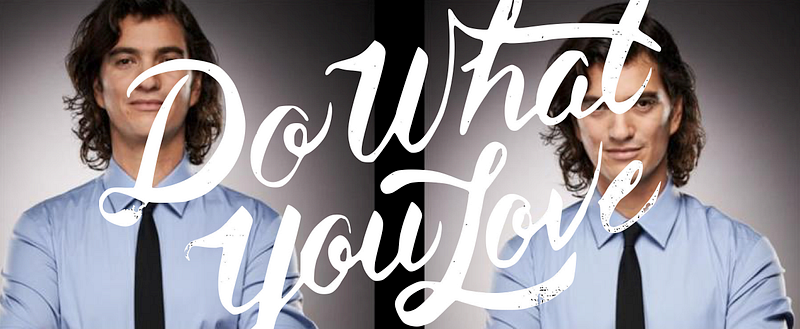
I have rented offices from the company on-and-off for over ten years — from Brooklyn to Los Angeles and back to Manhattan. I’ve popped in in San Fran, Dallas and DC. I’ve expanded and contracted my own film company in those chic conference rooms. But I have never even heard of “WeWork Summer Camp,” the cult-like frat-party-meets-Est-training that is the centerpiece of so much of the film. I would wager to say that most of WeWork’s 600K+ renters/members haven’t either. Most of us barely even talk to each other when we’re there. It certainly isn’t Jonestown. As mantras go, “Do what you love” is pretty innocuous. Since when is encouraging joy in your work evil?
The mythology that renters have all gladly participated in is stylish start-up space. WeWork provides it. You pay rent. It’s month-to-month. There’s wifi. It’s all a pretty easy transaction. As a freelancer, the bonus is that there are other humans around and you don’t have to hunt for an outlet at a random Starbucks (spoiler alert: there are none; they have all been removed). Is WeWork selling connection in a disjointed world? Yes. But they’re selling square-footage, first-and-foremost. Was the math mythical on the back-end? Yep. Were there lies told? For sure. Did 20-somethings have their delusional dreams of skyrocketing stocks dramatically dashed? In fact, they did. But that’s the larger story: capitalism is a big slot machine. Sometimes it pays. Sometimes it doesn’t. You, millennial beer-drinker, are not guaranteed your own trust fund after your first job out of college because you work long hours.
For the actual customers, WeWork is the sharing economy at its best. It’s not the Fyre Festival — the joke of a rich-kid music-fest fraud from Billy McFarland — the subject of not one but two recent documentaries. I have never scanned my card at WeWork and found my desk gone. The couches are not soggy because they were out in the rain. I didn’t wait for a phantom bus on a remote island because an Instagram model told me to. Give me a break. WeWork has been popular because it delivers on its basic brand promise: well-designed office space. The Fyre Festival could barely put up tents or find a plug for a sound system. The comparison peppered through the film is odd at best, slanderous at worst.
Post-pandemic, I am back at WeWork because it continues to deliver. I returned because I would rather work around other people, even if I never speak to them, than sit in my apartment alone. There are great mental-health benefits (call them “spiritual”) in being part of a larger whole, even if that whole is just a crowd of single-LLC-holders on slick laptops. That’s the saddest part of Adam’s story. It is not his six-week free-fall from grace or his inability to shoot a YouTube video. It’s that the guy didn’t realize that he had already provided the “higher purpose” of it all: shared space. There was never any need to wrap it in hand-holding and The Singularity. The product was already profound — individual capitalists splitting the rent on a pretty office. It’s motivating. It’s inspiring. It takes the dread out of Mondays. The rest is, as the saying goes, “a hat on a hat.”
This morning’s disappointment is that the film found no nuance in the story of WeWork and Adam Neumann. He was either Jesus or “a dude selling office space.” The truth, for those of us who have worked inside the glass walls for years on-end, is squarely in the middle. He was a dude selling office space, but the sheer simplicity of the model was transformative for those of us growing companies under its banner. I don’t know Adam — just like I don’t know the CEOs of any of the brands I buy from — but why is it that we tear down those who are dishonest and wacky and let those who are dishonest and dull lurk in the shadows while they all collect salaries 1,000 times their workers? If there is any cult that the WeWork story illuminates, it’s the cult of the golden parachute.
As the Great American Return to Normal takes off post-vaccines (whatever Build Back Better winds up being), it is too bad that this doc is so very cynical about people who bring us together, who spark our creativity, and who challenge us to be closer as human beings. If capitalism is going to survive and truly provide for all, we’re going to have to fix the part of the story the doc glossed over: why our system is one big casino. And we’re going to have to get over the woo-woo of it all and embrace ideas that call us to find common purpose. No, I haven’t drunk the Koolaid. I’m just a guy renting a desk for $29/day.
Julio Vincent Gambuto is a writer/director, based in New York City. He wrote that Medium essay about the pandemic that went around the world to 21M readers. Follow on Twitter for small thoughts, or here for Medium ones, or his website for large ones.


