
Artists Who Used Surveillance Techniques to Create Art
The creative tension between looking and being looked at
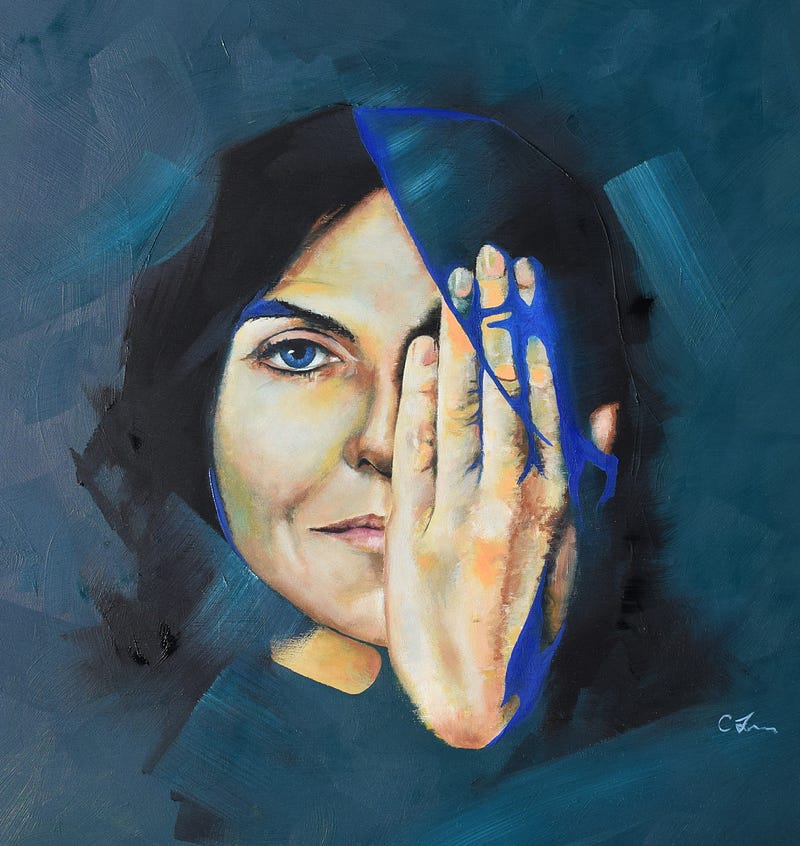
In 1979, the French artist Sophie Calle went to a party in Paris.
There she met a man known as Henri B.
Henri B told her he was about to travel to Venice on holiday. Secretly, Calle followed him.
For two weeks she pursued him around the floating city, recording his day-to-day actions, taking photographs of him in bars and cafes, down side streets, lingering on bridges. She took with her a make-up kit to disguise herself: a blonde wig, hats, gloves and sunglasses. On her Leica camera, she attached a device known as a Squinter: a mirror that allowed her to take photos without aiming at her subject.
As she watched him, she noted down his actions and speculated on his feelings. She produced a detailed diary of observations and reflections. She also wrote down her own sensations as her surveillance heightened. Suite Vénitienne is the artwork that resulted from her pursuit of Henri B.
As the city of Venice opened up to her, Calle concluded that she felt as if she was falling in love. The warren of narrow streets, cafes and bars — as depicted in her fleeting black and white photographs — became “a repository of her desires”, heightening her feelings for Henri B and for the sense of power her surveillance had given her.
The Human Desire to Look
Surveillance in our digital world is embedded in the applications we all use on a daily basis. What is extraordinary — and what Calle bravely confronted, many years before the internet — is how much our desire to look is part of the human condition.
Through social media, we observe and judge, and in return volunteer ourselves to be looked at and judged. In this process, we release extraordinary amounts of personal information into the digital ether and too easily forget who can view it.
Everything we do, everywhere we go, we leave a trace.
In 1981, long before the internet, Calle took a job as a chambermaid at a hotel in Venice. Under the guise of performing her duties, she entered the rooms of guests and examined their possessions, copied out their memos and postcards, looked inside their wardrobes and unzipped their luggage.
To record her process, she took photos of guests’ shoes, their unmade beds and half-used toiletries. She sprayed herself with their perfume. She described the nightwear left out on the beds. Outside the room, she listened at doors, noting down the occupants’ conversations. All these details are recorded in her artwork The Hotel.
Through these fragments of personhood, she spliced together the possible lives of people she would never meet.
Evading Detection
Aaron Brown was 28 years old, 6 feet tall and 160 pounds, with a round face, scruffy brown hair, a thin beard and green eyes.
But Aaron Brown didn’t exist.
In 2013, Curtis Wallen, an artist, invented Aaron Brown in an attempt to evade the clutches of online surveillance. Wallen had become interested in the hundreds of different entities that track and analyse our behaviour online, and wrote:
“At first, my goal was simply to exist as an anonymous user. However, I realized that this meant fundamentally changing my relationship to the Internet. I couldn’t log in to Facebook, I couldn’t send emails as Curtis, I couldn’t use the Internet the way most of us normally do. I simply couldn’t be me if I wanted to stay hidden.” (From The Atlantic)
Parading as the fictitious Aaron Brown, Wallen bought a new laptop, paying for the item in cash. He reformatted the computer’s hard drive, created new emails and social media accounts, and tried his best to blend in, to disappear.
Later, Wallen decided that his invented web-persona needed a face:
“I began to play with the idea of generating a new digital person, complete with the markers of a physical identity. I gathered my roommates and took a series of portraits that fit the requirements for passport photos. I then carefully isolated various features from each one in Photoshop and composited a completely new face: Aaron Brown.” (From The Atlantic)
In order to buy goods and services, Wallen set up a bitcoin account in Aaron Brown’s name. Under Brown’s identity, he ordered a counterfeit driver’s license, a student ID, a boating license, car insurance, an American Indian tribal citizenship card, a social security card scan and a cable bill for proof of residency.
The all-seeing internet had failed to discover that Aaron Brown was a figure of fiction.
Face to Face
In the spring of 2010, the performance artist Marina Abramović sat immobile at a table in the Museum of Modern Art and let visitors stare at her.
One by one museum-goers sat at the table and looked at the artist, who stared back motionless in return. No words were exchanged, just eye contact. The looker and the looked at were evenly matched, completely visible to one another.
The endurance piece lasted for 736 hours and 30 minutes, during which Abramović sat opposite no less than 1,545 sitters.
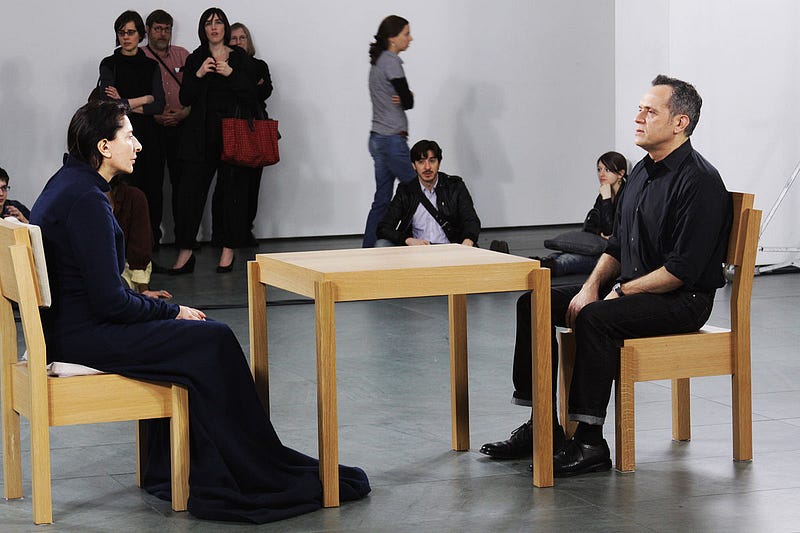

The event took place at the Museum of Modern Art as a major retrospective of her work. Somewhat paradoxically, visitors waiting to take part in the artwork began to grow impatient.
As the piece became more widely known, queues grew longer, so that by the end of the performance, lines were circling around the block. Arguments broke out as people wanted to look at Abramović with increasing desperation. Their patience, it seemed, lacked the stamina of the artist’s ten-week vigil.
Abramović created a unique surveillance event, distinct from the clandestine techniques of real-life surveillance. In a sense she created a paradox: by feigning passivity — by letting herself be looked at without retort — she evoked actions among her audience members that dramatised our instinctive competition between privacy and voyeurism.

If you liked this, you might like my book Great Paintings Explained, an examination of some of art’s most enthralling images.
Would you like to get…
A free guide to the Essential Styles in Western Art History, plus updates and exclusive news about me and my writing? Download here for free.
Join me…
On Instagram for more great paintings on the go!