
Poetry Workshop: Reading Your Poems Aloud
Using your voice to create clarity and rhythm in your work
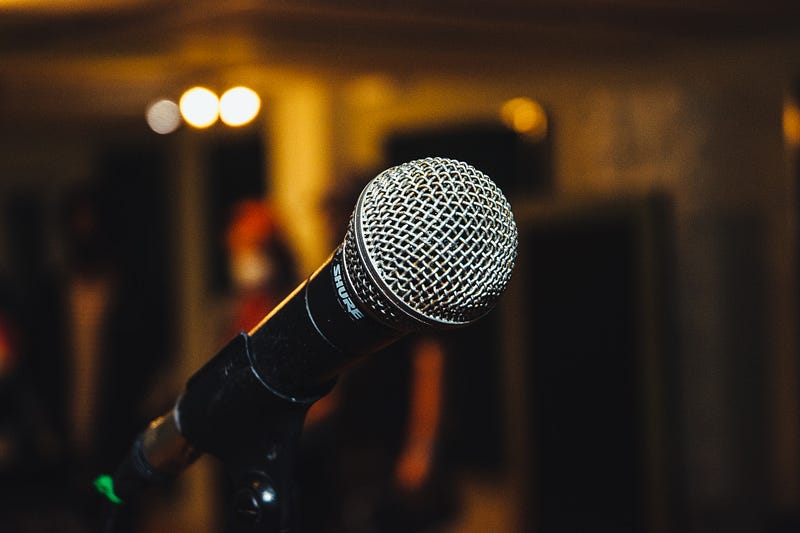
When homo sapiens first began to utter sounds to communicate, language emerged from our bodies as well as our brains. Words were both visceral emanations from our throats and expressions of developing intelligence. From the complex musicality in the production of laughter, to the vital inhale and exhale of breath from the lungs for speech; our bodies function as instruments of rhythm.
Thus, language and rhythm have always been intertwined, and poetry as a form of art and human expression embraces this connection.
Calling for a new beat: Returning rhythm to the roots of contemporary poetry
I sometimes despair of a tendency in some modern poetry to lack a strong awareness of rhythm. Poetry is not just pretty words grouped in short lines on a page. As a distilled, intensified, sometimes abstract form of communication, a powerful poem reaches into our bellies, tugging emotions up from our core. A poem with depth sings to and sears our souls. On a deep subconscious level, we’re responding not merely to the words and ideas, but to the dance of rhythm through the lines and stanzas.
Influenced by jazz, the beat poets of the forties and fifties knew that rhythm was essential to the soul of poetry. Think of Ginsberg’s Supermarket in California or Howl. And although connotations of the term “beat” were multi-layered, one reference was to the beats under a piece of music.
Instinctively, we know things with life force or animation express rhythm — breath in the body, wind in the trees, the ebb and flow of waves on a beach. Absence of rhythm is a kind of death. Do we want that in our poems?
Nowadays, we often think of poetry as a contrived form of language. While I’d prefer to call it heightened rather than contrived, what if we revised this idea, and considered that poetry brings out the ways language is meant to sound at its most natural; when it’s closest in form to the most essential functioning of life force, of our bodies?
Think of the pulse of blood through our jugular vein, the ebb and flow of our breath in sleep or in sex, the deep bass thuds of our heartbeat when we’re afraid; its quick pitter-patter when we’re excited. Consider the innate rhythms and intonations of our own voice, which science now knows is as unique as finger-prints, enabling verification of identity.
Rhythm, like language is a form of communication. Rhythm in our work matters. Learning to hear and feel it more clearly gives you access to a subtle but powerful realm of meaning and communication with the reader.
Poetry workshop: How to use your voice to revise your poetry
As I’ve written poetry all my life, I’ve performed a lot of poems at spoken word events. I also formally studied speech and drama as a child and young teenager, including vocal development and the art of poetry recitation. In my Arts degree, I majored in theatre studies and spent most of two decades working as an actor and theatre director. You could say I’m comfortable with the idea of performing verse and text out loud, on stages and to audiences.
A couple of years ago, I wrote a poem called Sweat/Shop, contrasting the paradox of excesses of Western consumerism with the atrocities of third-world sweatshop labour, through a feminist, postmodernist lens.
Knowing I intended to perform it at spoken word events, I was very attentive to the rhythms of the piece as I composed it. Why? Because just as in music, catchy, compelling rhythms in a poem help draw an audiences’ attention in and keep them engaged. On a subconscious level, they are literally following those beats through to the end of the poem. Here’s an excerpt (the opening verse):
We are bound, she and I, by inevitable threads; by the incessant warp of economy, by the indifferent weft of fate, the thread spins, the world turns
Follow me into the maths of rhythm, just for a moment. Each line contains four stressed syllables, (line 4 includes a longer pause on the comma). I’ve bolded the stressed syllables/words, for you to better see the rhythm. Below are other ways rhythm is created.
1. Rhythm in repetition
I use repetition in the mirrored placement (see lines 2 and 3) of “by the”, followed by two three-syllable words beginning with “in” (incessant / indifferent).
I further reinforce rhythms by the linked ideas of the weaving terms “warp” and “weft” to create strategic emphases of both meaning and beat at the right places, particularly when spoken aloud. I use the word “strategic” because I put a lot of thought into how I laid out my words on the page.
2. Rhythm through alliteration, assonance and sibilance
Most of us are familar with the concept of “alliteration”, but the term is often used a little loosely to cover all types of repetition of sounds for effect in poetry. There are actually three forms of “aural” repetition:
- Alliteration: repetition of the same consonant sound, either at the beginning or into the middle of words eg: “warp / weft”.
- Assonance: the repetition of a vowel sound at the beginning or in the middle of words eg: the short “e” sound in “inevitable threads”
- Sibilance: repetition of the “s” sound: often used, for example, in works about the sea or serpents. (I use sibilance later in the poem).
To return to my verse above, the words add further elements of rhythm through assonance (in this case “i”) and alliteration (in this case “w”). Can you find any others?
Employing any of these devices of repetition brings a musicality to your poetry, and memorability to the lines — harnessing another powerful form of rhythm.
Try reading the verse aloud yourself to hear everything I’m describing.
Development through repetition
My whole process of composing this poem was a cycle of:
- Write a chunk
- Read Aloud
- Revise
- Write a chunk
- Read Aloud
- Revise
Line by line, building verse by verse, over several days, I revised using this technique until I felt it was finished. When I read it at spoken word events, women sometimes come up and spontaneously hug me. In 2018, I was thrilled to have it accepted into Not Very Quiet, a poetry journal featuring the work of international women poets.
You can read it here:
Your Turn: Revision through Reading Aloud
Now, try it on one of your own poems. If this feels silly, know that you’re just carrying on a long tradition and that poetry in many cultures, such as the Ancient Greeks, was originally conceived of as an oral (and aural) art form.
If you’ve not read your poems aloud before due to shyness or self-consciousness, find some time where you can be relatively undisturbed, or if you find yourself revising something in public places (as I often do) like cafes, or libraries or while you’re walking, try popping your earphones in — people will just think you’re on your phone.
You never know, you might even start to enjoy it!
Learn to trust your ears: Hearing what works, what doesn’t
As you read your poem aloud, your ear will naturally sense the emerging rhythms of your poem, and when those rhythms go off-kilter. Your ears will also catch clunky, awkward words or phrasing more efficiently than your eyes, and they’ll hear when your verb tenses are inconsistent. When you catch those awkward or clunky lines, I’ve also written this article detailing further techniques to revise, refine or re-imagine them.
Use this technique to catch and eliminate superfluous words such as “and” “the” and “then”, or to condense a rambly phrase with one too many adjectives — particularly if they disrupt a good rhythm.
Keep your ears alert for opportunities to add emphasis and layers of rhythm through alliteration, assonance and sibilance.
Listen to your work — and learn to be your own discerning audience.
Following the breath: Finding punctuation & line breaks
Notice the places where you pause naturally, or take a breath — they may be clues as to where to place a comma or semi-colon, or break a line or a verse.
Conversely, the places where the sense runs on to create a too-long line can indicate the need for an enjambed line (the continuation of a sentence or clause across a line break).
Keep that pen handy, and revise as you catch elements that don’t sound right or when you “feel” how to make it better.
Movement in your body, momentum in your poem
Get out of your chair and walk around the room, letting the beat of your feet find the rhythms in the poem — and where they falter. On my feet, I discover new phrases that enhance imagery, or add elements of alliteration, assonance or sibilance I hadn’t thought of when sitting and writing.
Sometimes I even record my poems-in-progress — playing them back as I revise. Remember:
- Write a chunk
- Read Aloud
- Revise
- Repeat 1 2 & 3 as often as needed
The art of out-loud revision — ‘It’s a wrap’
That’s the process, poets — how did you go?
Are you making new discoveries about the world of your poems? Can you hear their unique heartbeat, their rhythms more clearly? Are they getting stronger? Bolder? Brighter? I’d love to hear from any of you who try this technique and find it improves your poems.
I passionately believe in the power of reading your poems out loud. Hearing your voice speak your words, as you literally embody your ideas and the inherent rhythms of your poetry will, over time, move you closer to the poet you want to be.
Our bodies and voices, not just our minds, are instruments of creativity, and they love to collaborate. Giving voice to your poems as you write and revise them will translate to discovery of a stronger, more articulate poetic voice on the page — for you, and for your readers.
Follow Melissa Coffey — for thoughtful essays and provocative fiction & poetry
Not a Medium member? Join with my referral link for just $5 a month to access all my stories & so much more. Find your voice & others you’ll want to hear.
More of my poetry (and a reading):


