
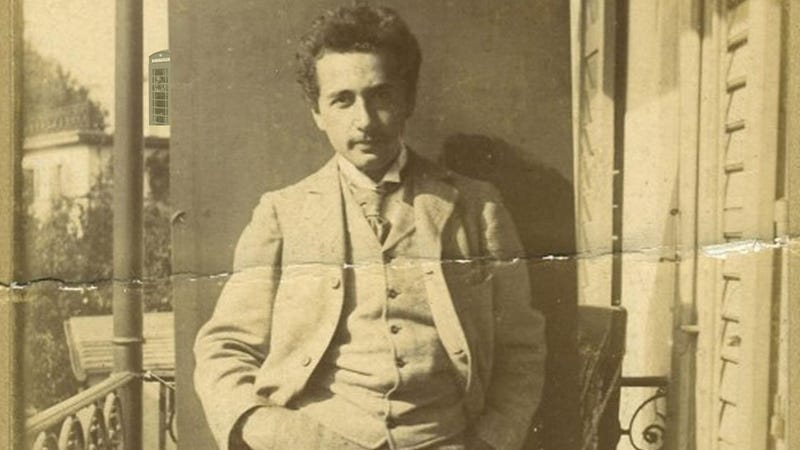
E=mc² reveals Einstein’s creative genius and teaches us forgotten lessons about pursuing innovative ideas
Tapping into your inner genius for your next great idea
No one growing up with Einstein would have guessed he would become the celebrated genius he is today.
Even up until his postgraduate years, his performance was not stellar.
- Early on, he was slow in his verbal development.
- He didn’t finish in the top half of his class in college.
- On his first try, he failed the entrance exam for Zurich Polytechnic and had to retake it.
- His doctoral dissertation was rejected, further delaying him.
- He was rejected when he applied for teaching positions afterward.
Finally, he got a job as a patent clerk at the Swiss patent office.
That’s not to say that Einstein didn’t apply himself or wasn’t smart. He just wasn’t able to distinguish himself.
“He was known as a gifted but wayward student who preferred to skip classes and study alone,” writes swissinfo.
Professor Hans Rudolf Ott, the current head of Zurich Polytechnic’s physics department, says, “He was a free thinker, frequently went off on his own to study newfangled theoretical physics rather than follow the Polytechnic’s course and had some weaknesses in mathematics and the humanities.”
But there are some things we shouldn’t miss from these anecdotal accounts:
- Before you become known, you’re unproven, no matter what level of genius you possess.
- No one will open doors for you before you’ve accomplished anything
- You have to work hard to establish yourself
This saying, “Hard work beats talent when talent doesn’t work hard,” is true. We’ll never know the number of geniuses who could’ve been because they didn’t persist in putting in the work.
Then, finally, at the age of 26, while working at his day job, Einstein wrote three papers that would transform science forever and put his name on the map.
E=mc² , the elegant equation that linked mass and energy, was just the conclusion added in the addendum to his third paper.
We’ve come a long way since then, but here are some forgotten traits that catapulted him to innovation.
1. He pursued his dreams
Dreaming may not seem like the road to innovation, but it played a crucial role in Einstein’s life.
People discount dreams, but that’s where it all starts. Many think it’s easy, but it takes a lot of courage to dream.
The gap between reality and your dream is so huge that it always takes a leap of faith. The bigger the dream, the more courage you need because you feel the constant tension between how things are and what they could be.
The early rejections Einstein encountered would have discouraged most people, leading them to give up or settle, but he was undeterred.
Although he wasn’t above taking a day job, he didn’t see himself as a patent agent for the rest of his life. His dreams propelled him.
Dreams are essential because they fuel the commitment and work you need to put in. Especially when you see little results for your efforts or when it takes a long time to break through.
Wandering to find the path
Additionally, he didn’t know the direction he would take or exactly what problems he wanted to solve initially.
But curiosity led, and he worked on projects that excited him the most, going down the rabbit hole of “newfangled theoretical physics,” which included the much-talked-about subjects of the day: electromagnetism, radioactivity, and modern thoughts on energy, space, time, and motion.
It was still unclear that he would one day figure out the relationship between matter, energy, and time, but he followed his interests and solved the problems he was most passionate about.
This may seem cliche, but follow your interest and pursue it with passion. Your biggest achievements are in your playground.
Addressing the pain point
Next, he connected his interests with important problems in the world.
There was always a need for new scientific discoveries in his field, so he had found a need he could fill. After working on these problems for some time, he chose three to submit as papers in 1905.
The response, however, was not what he expected. Disappointingly, his ideas didn’t initially stir much interest.
There was some skepticism, and he’d received some comments and constructive critiques, but mostly, it went unnoticed.
However, people more familiar with his concepts, like Planck and Lorentz, became early supporters of his work and helped his ideas gain wider acceptance.
Still, it took some time for people to recognize his groundbreaking work, and he continued working at his “day job” until 1909, before his name became known worldwide.
Some takeaways for us
It’s important to find the convergence of your passion with the problems the world needs to solve. In other words, find the pain point.
So many times, we create in a vacuum, working in our little corner with no idea what the world needs. The result is that we don’t create anything useful because of the disconnect.
Sometimes, we have the attitude that we don’t care how what we do is received or if it’s helpful to anyone. We create just for ourselves.
There’s nothing wrong with this if that’s your goal. But Einstein was not insular, even though he did much of his thinking alone.
So, if you lean towards the idea that you are gifted with a purpose to share your gifts, here are ways you can find the intersection where your passion meets the problems of the world:
- Start with your natural passion.
- Imagine the audience your work will interact with. Who are they, and what do they need?
- Make your work public and gauge its impact based on the responses you receive.
- Iterate, update, and improve to better address your audience’s needs.
It’s an ongoing cycle where you improve your work, your sense of the audience, and your reputation.
_Einstein_LCCN2014712247.jpg)
2. He thought differently
It seems obvious, but innovation doesn’t happen on the broad road everyone else is on. Einstein didn’t go down the tried-and-true route. He was interested in the cutting-edge ideas of his time.
Building upon the classical works of Galileo and Newton on motion and new ideas from Faraday, Maxwell, Lorentz, and Planck on electromagnetism, time, and the nature of light was the starting point for his work.
This is the fertile soil for many of Einstein’s groundbreaking concepts.
In essence, innovative work needs fresh ideas at the edge of knowledge. The experimental stage brings new conclusions and changes previously accepted ways of thinking.
Einstein has said, “You cannot solve a problem with the same mind that created it.”
He used thought experiments
Einstein was a visual thinker, which some thought was due to his slow verbal development as a child.
He used visualization to understand and explain abstract concepts on a human scale. And it helped him see the problems from different angles and find unique solutions.
For example, at 16, he visualized what a beam of light would look like if he could travel at that speed.
This thought experiment troubled him because he thought he should see the light beam freeze at that speed according to the traditional view of motion. However, Maxwell’s equation established that the speed of light remains constant relative to you no matter how fast you travel. Einstein concluded that time expands and contracts based on how fast a person moves. This is a core concept in his theory of relativity.
He connected incompatible ideas
Much of Einstein’s research attempted to reconcile relationships between different fields of discovery.
His relativity theories combined concepts of gravity, energy, matter, space, and time into cohesive theories.
His final incomplete work on the unified field theory was an attempt to combine electromagnetism with gravity in one framework.
There’s always a problem connecting two incongruous things, but that’s where new discoveries lie.
Some examples of innovative inventions that combine different things:
- iPhone: combines phone, music player, internet, computer, and camera
- Netflix: combines movie rental with the internet, later streaming
Effectively combining separate things in a way not done before “leapfrogs” everything out there, in the words of Steve Jobs when he introduced the iPhone.
Finally, he simplified and iterated
E=mc² is the best example of this. It was first written as m = L/c² but was later updated for simplicity.
This way of working iteratively is a hallmark of his approach.
While working on his General Theory of relativity, he presented it in a series of lectures, even though it was incomplete. Each week, he would present an updated version as he corrected mistakes he’d found in the previous week.
This iterative approach allows us to not wait until our work is perfect before presenting it. We continually iterate to improve and update the public with better versions. And it creates a feedback loop for us through public responses and helps improve our ideas.
Conclusion
Einstein’s approach allowed him to rapidly produce some of the most innovative work in science.
Nowadays, it’s so much easier to put our work out there and get immediate feedback for improvement. We can do it in a fraction of the time it took someone a few decades ago.
Yet Einstein’s approach remains an effective way if we want to produce fresh new work that will have the greatest impact on our world:
- Dream: Without dreams, you will most likely give up because the road is long and impossible to cross without a leap of faith.
- Learn: At the cutting edge. Don’t rehash the same old materials.
- Play: Follow your passion.
- Connect: Your passion to the pain of the world.
- Go public: With our work.
- Iterate: Keep making it better.
So go out there and pursue your dreams.
“When they write my story They gonna say that I did it for the glory But don’t think that I did it for the fame, yeah I did it for the love of the game, yeah And this is my chance I’m taking All them old records, I’m breaking” ~ The Champion
If you’ve enjoyed this article, subscribe to the monday metro for more like it.