
E is for Excuse (verb)/Excuse (noun)
I was going to have E stand for: Exceptionalism, Emancipation, European, Equality, Equity, Evil, Eugenics, Etc. Etc. Etc. But, in the end, I found that everything I wanted to say came down to Excuses and Excusing. I put my E essay on hold.
I’m glad I equivocated…
Because today, I read an article written by the brilliant Kiese Laymon, titled “There is No Excuse”: University of Mississippi Faculty Members Condemn Proposed “Shrine To White Supremacy.” As a result of his powerful perspective, I came to understand the word “Excuse” in relation to other E words: English and Evacuate, Erected, Evidence, Effect, Enhanced, Evacuated, Expense, Expressed.
Ours is a history of excusing history. Ours, in this context, meaning American history. We made excuses to justify genocide, to justify slavery, to justify expansion a la Manifest Destiny, we made excuses for inequities and atrocities, eliminating that which stood in the way of an empire. We can see how often in human history economic greed and colonial exploitation have been justified by racist theories including exceptionalism.
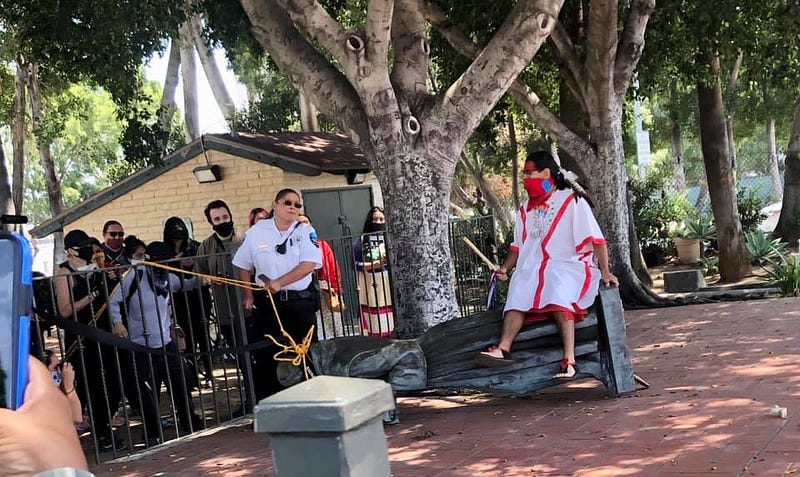
Erasing racism sounds enticing but all too often erasure is a way to evade, an excuse not to educate oneself on critically important events that got us to where we are today. To be clear, removing statues isn’t erasure — it’s a form of engaging and rearranging history — reframing and reclaiming. Certain statues are, in and of themselves, a form of erasure as they “celebrate” an individual or even a group — and they celebrate them in exclusion of those whose necks they stepped on as they rose to that podium or platform.
Eradicating racism, like a cancer, cannot be a superficial act. Its roots run deep. Who knows if it’s even possible. It is, after all, baked into this country’s very founding. But if we stand a chance, if we hope to eliminate the structural racism coursing through virtually every activity in which we participate, we need to stop making excuses.
We need to stop excusing people in the name of politeness, or kindness, or caring, or whatever motivation makes it uncomfortable to hold people — to hold ourselves — accountable for our actions.
We need to stop making excuses for the dead — stop engaging in hypothetical exercises about their intentions when their actions are there for all to see.
Or are we really using the dead to excuse the living?
About the dead, some have asked — would they have seen the error of their ways had they lived long enough? Is there a way for the dead to rise and, in doing so, wake woke? — reappearing in 2020 with a so-called contemporary perspective?
Well, first let’s not give ourselves so much credit for a perspective that is any more “contemporary” than those of other times. In addition to being surrounded by racism, even perpetuating racism ourselves — knowingly and unknowingly — there are definitely racists among us to this day. Proud racists, by the way, if you haven’t stopped to notice. They’re not shy.
So maybe we’re selling the dead short — Or, maybe they would have doubled down on their racism. Perhaps maintaining they weren’t racist at all — just some guys of-a-certain-era exercising their free speech which they wouldn’t define as hate speech.
Can we just excuse the dead and move on?
Yeah —No. Excusing them is an evasion. Are we really holding on to the dead as a way of excusing ourselves? There’s nothing kind or compassionate about being an enabler. We should be examining ourselves, our past, our heritage, our beliefs, our actions — there’s everything to examine. There’s nothing to excuse. It is what it is. Let’s look it in the eye.
We are all a product of our times, but we are also informed by the past — influenced by the past — and if we condone the past we can never condemn racism in the present. We live in a continuum and everything is connected. We don’t get to cut the cord — we need to confront the cord. Call it out for what it is.
These statues, for example, were yesterday’s influencers — yesterday’s abusive influencers. And they have to go. An interview in ArtForum titled Monument Lab asks: What if we reimagined symbols and systems of justice? “Monuments as traditionally conceptualized are thought of as the endpoint of a historical event or period. What if we thought of them as a continuation, as the bridge between what happened and how time falls forward?”
We each get to leave a legacy. We will each make our share of mistakes. But we need to know the difference between a minor mistake, a major mistake, an egregious mistake, and an undeniable pattern of “mistakes.” I believe, on a very gut level, we do know the difference. It’s just not convenient to admit that.
What excuses have you made? What excuses have you heard? Who have you excused? And why? What do you find so shameful that you cannot face it because you’re not sure, if faced, you could excuse even yourself from having played a role in it — whatever it was or still is?
White America. Are we only interested in power? Or are we interested in Empowerment? Because when bad behavior is excused it is a disempowering act — it sets the bar low. It says I don’t expect much from you and I don’t think you can handle the truth. There’s a reason White Fragility has sold a lot of copies. All the excuses and the excusing, going back well over 400 years, in connection with slavery and Black America, but also in connection with the massacre of countless indigenous peoples, inclusive of the indigenous of the U.S. and all the Americas (because let’s not forget US involvement in upholding dictators in Latin America) — all the excuses and the excusing have led to our refusal to witness and own white supremacy, to witness the evils of supremacy’s ways — it has also led to a weakened understanding of how we can turn wrongs into actions in support of rights.
I sometimes wonder if writing an alphabetized collection examining everything from Anti-racism to Zero-tolerance is a contribution to change. Teju Cole’s words come to mind and give me hope: “Writing as writing. Writing as rioting. Writing as righting. On the best days, all three.”
May this be one of these days. And if it’s not, no excuses. I will fail better tomorrow.
As the saying begins:
Ever tried. Ever failed. No matter.
#BlackLivesMatter


