
Día de Muertos — Mexico’s Timeless Celebration of Memories
Header: Explore the fascinating tradition of Día de Muertos, a celebration that brings the past to life, where the memory of loved ones is cherished and shared.
A Rich Heritage of Remembering:
In ancient times, the indigenous people of Mexico held death in great reverence. When someone passed away, they were buried in a petate, a woven mat.
Families would then gather for a special celebration to guide the departed soul on its journey to Mictlán, the land of the dead.
Food that the deceased enjoyed in life was placed by their side, with the belief that they might hunger on their path.
A Day to Welcome Back the Departed:
Día de Muertos, in the indigenous view, marks the temporary return of the spirits of the departed.
They come home to the world of the living, joining their families and partaking in the essence of the offerings placed on altars in their honor.
This isn’t a day to mourn, but rather a day to welcome back the spirits of loved ones. It’s a celebration of life through the presence of the dead.
A Fusion of Traditions:
The origins of Día de Muertos lie in the harmonious blend of Catholic rituals brought by the Spanish conquistadors and the indigenous commemorations of the dead.
The ancient Mexican peoples, including the Mexicas, Mixtecs, Texcocans, Zapotecs, Tlaxcaltecs, and Totonacs, adapted their veneration of the deceased to fit the Christian calendar.
This confluence was symbolized by the alignment of the celebration with the end of the maize harvest, a staple crop of the region.
Two Days of Remembrance:
Día de Muertos takes place on November 1st and 2nd.
November 1st is dedicated to “los muertos chiquitos” or the “little dead,” honoring deceased children, while November 2nd is for the “Fieles Difuntos,” the faithful departed, in remembrance of adults.
Altars of Love and Remembrance:
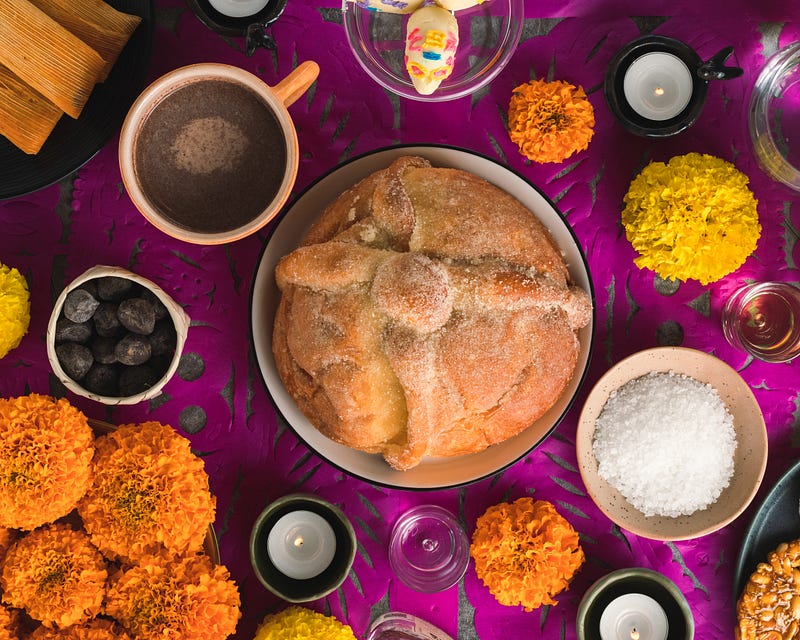
Families across Mexico create ofrendas (offerings) and altares (altars) adorned with marigold flowers, papel picado (cut paper), sugar skulls, pan de muerto (bread of the dead), mole, and the favorite foods of their departed loved ones.
Incense is also used to perfume the area. These offerings represent the path between the world of the living and the world of the dead.
Honoring the Journey of the Souls:
It’s a tradition to decorate the graves with flowers and build altars on the tombstones.
In ancient times, this had great significance, as it was believed to help guide the souls along the right path in the afterlife.
The Path of Marigolds and Candles:
To guide the spirits back to the living world, petals of marigold flowers are scattered, and candles are lit to illuminate the way.
The scent of marigolds and the soft glow of candles are believed to aid the souls on their journey.
Día de Muertos is celebrated all across Mexico, with regional variations adding unique flavors to the tradition.
In the heart of Mexico City, in Tláhuac, lies the village of Mixquic, a place renowned for its dedication to Mexican traditions.
Here, “La Alumbrada” is celebrated on November 2nd, with thousands of candles illuminating decorated graves.
Oaxaca: A Cultural Hub of Celebration:
Oaxaca, one of Mexico’s most culturally rich states, takes Día de Muertos very seriously.
Altars are adorned with white cloth or papel picado and divided into tiers, each with a special meaning. The first represents grandparents and adults, while the others represent different categories of the deceased.
Oaxaca offers a myriad of exhibitions and events during this festive time.
UNESCO’s Recognition:
The United Nations Educational, Scientific and Cultural Organization (UNESCO) acknowledged the cultural importance of Día de Muertos by declaring it a Masterpiece of the Oral and Intangible Heritage of Humanity in 2008.
This recognition highlights the role of the celebration in fostering social cohesion and preserving the cultural and social identity of indigenous communities in Mexico.
A Celebration of Memory:
Día de Muertos is all about celebrating the memories of our loved ones. It varies from state to state, town to town, and family to family, but it shares a common goal: to reunite families and welcome back the departed souls.
In Mexico, Día de Muertos is a heartfelt and joyous tradition that allows people to share cherished memories and remember their loved ones who have passed away. It’s a time when the past and the present come together in a celebration that transcends time.
If you enjoy reading stories like these and want to support me as a writer, consider signing up to become a Medium member. It’s $5 a month, giving you unlimited access to stories on Medium. I’ll earn a small commission if you sign up using my link.