
Dynamic Creatives on Facebook Ads
Getting the creatives right can make a huge difference to the success of your campaigns. Building the right creative isn’t just done in Photoshop or Illustrator though, it’s done through testing. Testing different creative variants against one another is the only way to learn what actually works, and to iteratively improve your creatives over time.
There are a number of different ways to test creatives, some of which are covered in the testing section. The tests described there are more rigorous ways of measuring performance, and may be overkill for brands with smaller budgets.
An often more practical way to test creatives at scale, is to use dynamic creatives.
What are dynamic creatives?
A dynamic creative is a way of building thousands of different ad variants, without building thousands of ads. You can add a number of different assets to each dynamic creative, whether they be images, videos, headlines et cetera, all while only having a single ad in Ads Manager.
Dynamic creatives can be enabled for an ad set, at the ad set level. By turning the dynamic creative setting on at ad set level, you’ll be able to build a dynamic creative within that ad set.

An ad set with dynamic creative enabled will only ever hold one ad. Within this ad, you can add up to:
- 10 images or videos
- 5 primary texts
- 5 headlines
- 5 descriptions
- 5 call to actions
If you make use of all the possible asset variants, your dynamic creative can serve up to 6,250 different ad combinations, all from within a single ad. Given that Facebook only allows you to have 50 ads within a regular ad set, dynamic creatives allow you to run tests at a significantly larger scale than you’d otherwise be able to.
Facebook will then rotate between all of the different creative variants, observing performance and shifting spend towards the best performing combinations. Over time, it will learn which the best combinations are, and shift the majority of your spend and impressions towards them.
Why use dynamic creatives?
If it’s not already clear from the above what the benefits of dynamic creatives are, lets break it down into a little more detail.
Let’s say that you have 10 images, and 5 of each of the text asset fields listed above. You want to test these all against each other to find the best combination. You can’t create 6,250 ads all at once and run them in the same ad set, due to Facebook’s 50 ad per ad set limit.
You could create 6250/50 = 125 different ad sets, with 50 ads in each, but this would be an unfair test. This is because Facebook’s delivery learnings are stored at an ad set level, meaning they wouldn’t be shared across ad sets. Some ad sets would get lucky by gaining initial conversions more quickly than others, allowing them to learn more quickly and giving that ad set’s ads an unfair advantage.
Okay, we get it, you can’t test 6,250 ads at once. But what if we just test the 10 images first, pick a winner, then test the 5 primary texts on the winning image, pick a winner, and so on? This is much more manageable in that it only requires 10+5+5+5+5 = 30 ads, which comes safely under Facebook’s 50 ads per ad set limit.
The issue though, is that you’ll end up with an ad with the best image, the best primary text, the best headline et cetera, and that this is different from the best ad. The best ad is the ad which leads to the best overall results, and it’s not necessarily the ad which is made by stitching together the best individual components.
To see this, let’s consider a simplified example. Say that we run two A/B tests on an ad:
- Test A Here we’re testing two images on an ad, image A and image B. Image B outperforms image A.
- Test B Next, we test two headlines on an ad, headline A and headline B. Headline B outperforms headline B.
Though image B and headline B have just won their respective tests, that doesn’t mean that the best performing ad consists of image B and headline B. It might be that, when run together in the same ad, image B and headline B work badly together.
In the four possible ads we can create from these variants, it could be that the best possible combination is actually image A and headline B.
The reason why our approach of testing each element of an ad separately fails is because it doesn’t account for what are called second order effects. This term refers to the impact that combinations of assets have together.
In order to account for second order effects, we need to be able to test all possible variants of an ad at once. We’ve seen earlier that we can’t do this by creating ad after ad, at least not if the number of possible variants is above 50.
This is where dynamic creatives come in. They allow us to test up to 6,250 combinations of a single ad simultaneously. This means that we’re able to account for second order effects, and find the best possible ad, rather than just the ad with all the best parts.
What are the limits to dynamic creatives?
Dynamic creatives are a great way to run huge ad tests efficiently, but they come with their limitations.
One stems from the fact that I mentioned earlier, which is that each ad set with dynamic creatives enabled is only allowed to have one dynamic creative. This means that you have to throw all of your assets into a single ad.
This can cause problems if not all of your assets of one type will work well with all assets of another type. For example, you might have a set of images which work well with one type of copy, and a set of images which work well with another type of copy.
If you’re using dynamic creatives, you can’t easily specify that you only want certain bits of copy to show with certain images; you have to throw it all in together. This can lead to images being shown with the wrong copy, which can lead to brand safety concerns.
One obvious way around this is to create a different ad set for each theme that your assets have. By using a different ad set for each theme, you can have some control over which assets show alongside which other assets.
The downside of this though is that it involves creating more ad sets than you strictly need. Because Facebook’s learnings are stored at the ad set level, it means that these learnings will be split, and that your ads won’t be served as effectively as they otherwise would be.
Semi-Dynamic Creatives
Facebook have recently introduced a new feature which allows a workaround for this dilemma though. No longer do you have to turn on dynamic creatives at the ad set level in order to add multiple copy variants to an ad.
Now, by default, you can add up to 5 primary texts, headlines, and descriptions for each ad. Let’s call these semi-dynamic creatives.
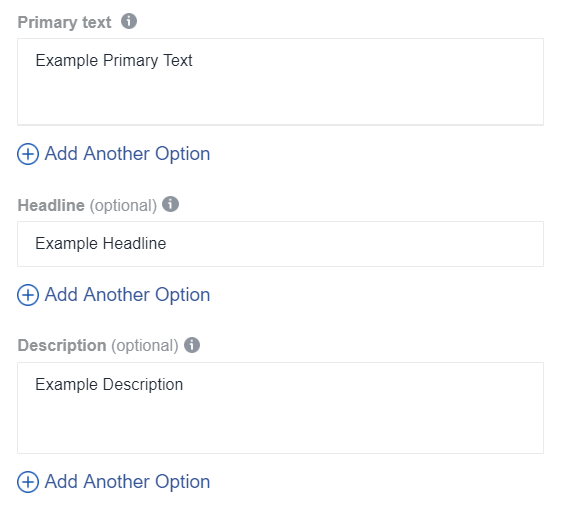
The ability to ad copy variants to semi-dynamic creatives means that you can control what copy gets served on each image or video, all without needing to use regular dynamic creatives.
The downside of semi-dynamic creatives is that if you want to test images or videos as well as copy, you’ll need to create an ad for every image or video that you want to test. This can become unwieldly, and make it more difficult to interpret results.
Using semi-dynamic creatives can also make it very difficult to edit the copy that you’re using. With dynamic creatives, you simply have to edit the copy on one ad. With semi-dynamic creatives, you have to edit the copy on each ad. Facebook doesn’t allow you to edit semi-dynamic creatives in bulk, so this means you have to edit each one manually.
What sort of creative should I use?
If you’re testing creatives (as you always should be), you should be using dynamic or semi-dynamic creatives to help you automate that testing.
If your ad assets fall into tightly grouped themes, which can’t be intermixed, then avoid dynamic creatives. Dynamic creatives are only a good option if all of your assets can work well with each other. If some images, for example, can’t be shown alongside some headlines, then opt for semi-dynamic creatives.
Similarly, if you’re launching a big campaign and need to test more than 10 images or videos simultaneously, go for semi-dynamic creatives. You could use dynamic creatives, start with 10, and then replace the worst performers with your remaining assets, but this biases the test as some images/videos will have been live for longer.
If neither of the above are an issue for you though, use dynamic creatives. They’re easy to set up, easy to manage, and easy to learn from. They’re an effective way to find the best possible ad, from a pool of thousands of combinations.
Originally published at https://mackgrenfell.com.


