
Self | Health
Dying Usually Isn’t As Scary As You Would Think
Our end of life generally doesn’t happen the way we think it would.
I was in a funk all day yesterday, all because of something I saw four months ago. It was a tweet, of all things. I don’t usually get affected by social media as it’s mostly noise. But this one pulled my heart out of my chest.
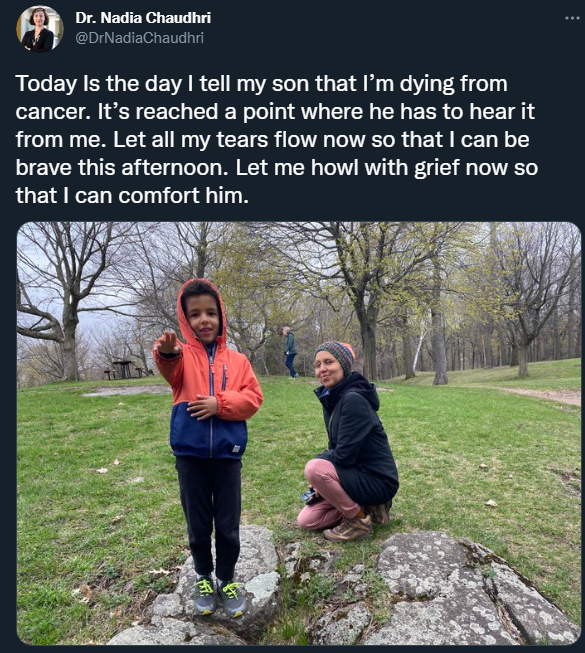
Dr. Chaudhry, a neuroscience professor, was diagnosed with terminal ovarian cancer. She’s documented her journey very publicly. She’s also been remarkably positive at every step, celebrating her life, raising money for underrepresented groups within science, while spending time with her son.
Despite her heroic positivity, I had to stop following her because it always put me in a depressed mood. I was constantly reminded that this beautiful person was being taken away.
Four months later
Yesterday, I checked in and discovered she was admitted to an end-of-life, palliative care unit at the end of August. She’s attached to all sorts of machines. She is smiling from her bed, sending thankful tweets, tweeting about enjoying her sleep. She’s walking the unit floor once a day to raise money for charity until she no longer can.
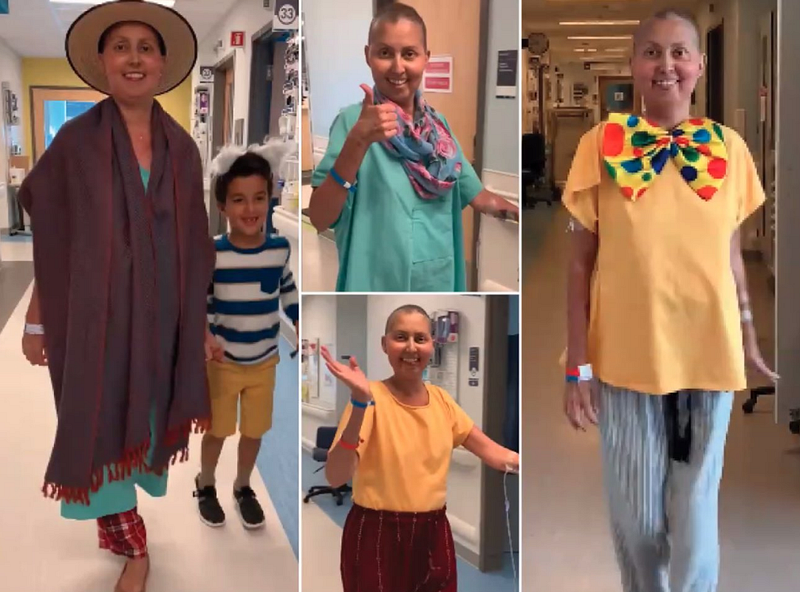
And so began my existential funk: that icky feeling when you spend too much time thinking about death and the possibility of oblivion. I laid in bed, ruminating about how awful it must be, knowing you only have days or minutes to live. The black energy washed all over me.
Until I realized, “Wait, you’ve already experienced dying.” It’s not what most people think.
What it really feels like
I spent a week in the Intensive Care Unit when I was 23. A bacterial infection weakened my stomach lining and stomach acid spilled onto an artery. I lost the majority of the blood in my body and was rushed to the hospital.
One of my last memories was being on a stretcher, seeing the neon lights fly by above me. I went straight into surgery from the ambulance. My last thought, cliche as might sound was, “Is this it? What have I gotten myself into?” I wasn’t sure I’d wake up.
I woke up in the critical care unit. Around me, were rooms with the very sickest people: cancer patients, people in head-on collisions. It was incredibly silent. I could only hear beeps from machines in nearby rooms. I was covered in all sorts of monitors, a tube in my arm, a cardiac monitor. This ward was the final gate before whatever comes after.
I was unspeakably exhausted. It’s the type of fatigue where your body had been pushed to the limits, taken to the brink of death. Lifting my right arm caused my heart to race as if I’d just run a 100-meter dash. There’s no fuel in you. It would take me months to fully recover.
Years later, I was talking to my friend, John, an ER doctor, recounting my brush with death.
I asked him if there was anything a dying patient has said that haunted him. He said there were several things, but most of all, a specific patient being wheeled in, groaning in pain.
The 53-year-old patient was in a drug-induced panic and very sick. He was anxious and moving around too much and fell from his stretcher. He rolled over clutched John’s pants, pleading, “Please don’t let me die. Please don’t let me die.”
Not knowing what to say, John said, “I won’t.”
He didn’t succeed. Days later, the patient passed. Even though the patient caused his own early death through substance abuse, John always held some part of it against himself.
John said, “That patient, begging for his life, is rarely how it happens. Dying people are too out of it, semi-comatose, disoriented, on pain meds. They often don’t even know it’s happening.”
It mostly echoes my experience. Despite knowing I was in grave danger and feeling afraid, it wasn’t terror. Fear has a high energy cost. When you are morbidly sick, you don’t have that energy, much less the adrenaline to feel terror. I feel worse when I sit here now thinking about the prospect of death.
Your fear gets better with time
Ironically, those most afraid of dying are those least likely to die: younger people. Fear of death tends to decline as we age. We gain more experience. Our psychological strength grows. Perhaps we come to terms with our mortality and make various deals with our makers.
It’s as one friend said, “Life is like a trip to Disneyland. You’d hate to leave right after you got there. However, you feel completely different at 8 pm. You’re tired and sore. You’ve done everything and then some.”
Hopefully, you are like me in that you enjoy being alive. I try to treat my body right and want as much time as possible. When my day comes, I want to feel like I’ve punched my ticket and gotten what I paid for.
It’s good to know our time is limited. Yet dwelling on death, letting existential dread flow through you is a waste of valuable time. It’s as Henry Scott-Holland wrote, “Death is nothing at all. It does not count. I have only slipped away into the next room. Nothing has happened.
Everything remains exactly as it was. I am I, and you are you, and the old life that we lived so fondly together is untouched, unchanged. Whatever we were to each other, that we are still.”
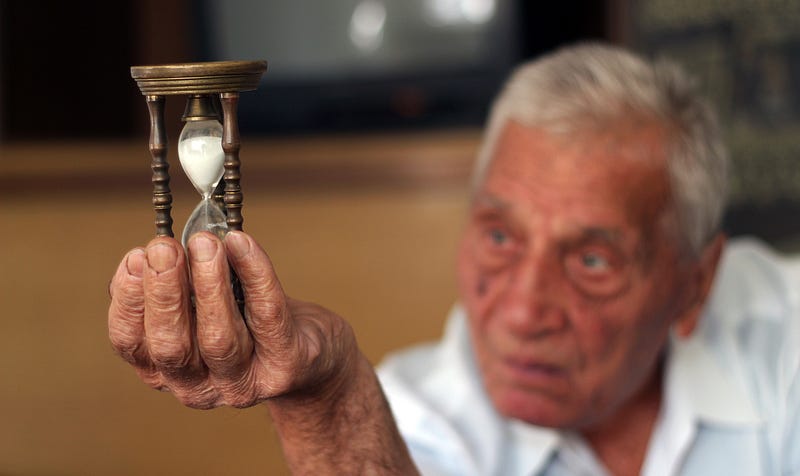
There’s an hourglass ticking for each of us. I don’t see that as a source of fear. I see it as a source of urgency, not just to get things done, but to slow down and appreciate the time I have. I encourage you to do the same.
Enjoy this? Become a Medium Member for full access.


