
CELEBRATION
Durga Puja in Hinduism
A major festival of India
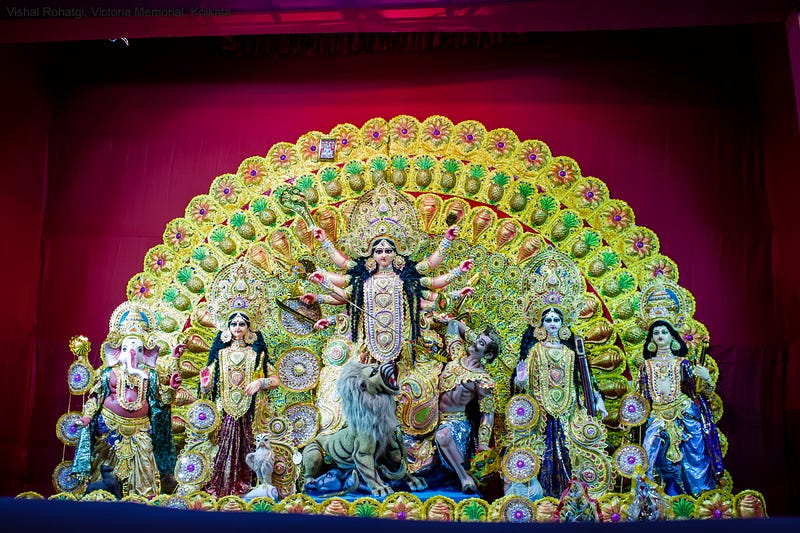
The Significance of Durga Puja
Durga Puja is the grandest festival of Hinduism. Traditionally it is celebrated for ten days, which falls in the Ashvina month per the Hindu Calendar (September-October of the Georgian). Entire India celebrates Durga Puja; it is remarkably very famous in Bihar, Bengal, Assam, and other eastern Indian states. The festival glorifies the victory of Goddess Durga over the demon king Mahishashura. This festival epitomes the triumph of good over evil. It also signifies the harvest festival celebrating the goddess as the feminine power behind life and creation.
Background of Durga Puja
Goddess Durga, also known as Sati, Parvati, Dakshyani, was the daughter of Himalaya and Menka and was married to Lord Shiva. Once she was called upon by all three lords- Brahma (The Creator God in Hinduism), Vishnu (The Preserver God in Hinduism), and Shiva (The Destroyer God in Hinduism) to eradicate the demon Mahishashura for his cruelty and save the world. All three Gods Brahma, Vishnu, and Shiva, denote the life cycle and represent Hinduism’s trinity. The battle continued for ten days, and finally, on the tenth day, Goddess Durga eliminated the demon. Therefore, the celebration is known as Dussehra or Vijayadashami. The festival of Durga Puja is in honor of good over evil and light over darkness.
Rituals of Durga Puja
The first day of the festival is Mahalaya, where the devotees request Goddess Durga to come on to the earth. On this day, the artists make eyes to the Goddess Durga idol in an auspicious ceremony known as Chokkhu Daan. On the sixth day, known as Shasthi, the Goddess idol arrives at the Pandal or Temporary tent from the artists’ place, followed by people dancing on the sound of dhak or traditional drums decorated with feathers and sounds of Shankha or sounds of the Conch. Goddess Durga arrives with her four children, Lakshmi, Saraswati, Ganesha, and Kartikeya. One of the customs is to lit 108 Deepak or Lamp to start the festivities. On seventh (Saptami), eighth (Ashtami), and ninth (Navami) day, Goddess Durga is worshiped along with her children by the devotees. The celebration starts with the recitation of scriptures, prayers, a folk traditional dance known as ‘Dandiya.’ On a ninth day, the worship with Maha Aarti is followed by Havana or fire oblation, denotes the completion of the significant rituals and prayers of Durga Puja. On the last day or the tenth day, women smear Sindoor or Vermillion on the Goddess Durga and each other in a Sindoor Khela ritual, which signified blissful married life to married women. Goddess Durga emerges victorious over Mahishashura on the tenth day, and it ends with the ceremonious by immersing the sculptured idol in the river. The legend behind is that Goddess Durga returns to her marital home at Kailash on the Himalayas, where Lord Shiva resides or the cosmos.
Giveaway to Other Religion
Everyone enjoys and celebrates Durga Puja, irrespective of caste, nationality, or financial status. What makes it joyous and full of positive energy is the folk dance and cultural performances. In Hinduism, delicious food is an essential part of the celebration. The streets of Patna, Bihar, is full of food stall and shops. People from across the world enjoy mouth-watering street foods and delicious sweets. During this festive season, educational institutions such as schools and universities remain closed in most of India’s cities, especially in Patna, Kolkata, Assam, Guwahati, Bhuwneshwar, etc. Nowadays, many people from other religions like Christians, Sikhs, Jains, Buddhists, and Muslims also participate in the festival season. With globalization, people are coming together to learn, grow, enjoy, and merry. In several places in the UK, USA, France, Australia, and other countries, people celebrate the Hindu cultural festival Durga Puja. Durga Puja teaches that good wins over evil, and therefore, we should move to the righteous path.
Conclusion
Durga puja is a significant part of Hindu culture, and it is also a time for a reunion of family, relatives, and friends. It is a festival of cultural values and customs.
Thank you for reading my article. I hope you find it informative about Hindu Culture!