
Dumping My American Doctor For a Mexican Masseur
Why reflexology should replace our annual physical exam
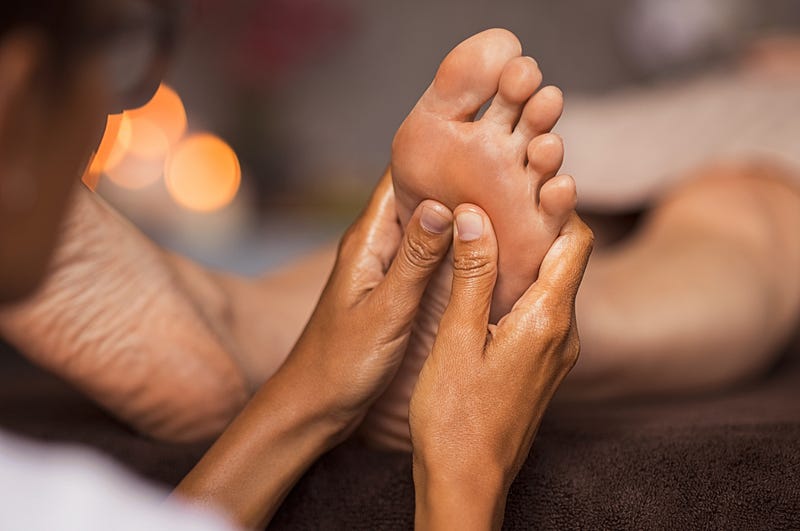
When I mentioned that I had Lyme Disease in 2003 and my joints still suffered, his eyes lit up as if he had won a bet about it.
“Ah, yes,” he said, folding a silky mauve scarf and placing it gently beneath my wiry ankles. “I hear them crunch when you walk.”
I was both offended and amazed.
Were my joints that damaged from a deer tick that infected me over fifteen years ago? And if so, was it possible that a total stranger could hear their cries for help within minutes of meeting me?
The incident that led to my diagnosis occurred on a sultry August night during an intramural basketball game. I was eleven years old when I collapsed on the asphalt. I wasn’t even running when my ankles just gave out. Luckily, the humiliation of tripping-while-standing-perfectly-still overshadowed this defining moment of my childhood which, as it turns out, also marked my chronic prognosis of bench-warmer-itis.
I was put on a round of antibiotics and sent home with a five-page pamphlet of suggested physical therapy. I mustered up two measly attempts before tossing the pamphlet out and never thinking about it again.
I was an overzealous, adventurous kid. Advice to refrain from my frequent tramps through the fern-crested, tick-infested forest in search of imaginary animals and “Indian” arrowheads fell on deaf ears. I didn’t have time or the inhibitory brain cells to be concerned about potential long-term effects like Lyme Disease arthritis, chronic joint inflammation, facial palsy, impaired memory, or heart rhythm irregularities. My Pediatrician certainly didn’t warn me either.
And now I sit here hastily wondering, is that why one side of my lips is lazy? Is that why I can’t remember a movie I watched last week? Still, to this day, my ankles give out if I run too eagerly up the stairs of my favorite bar. But surely, they don’t crunch when I walk. Do they?
I signed up for reflexology, not a psychic reading, but I begrudgingly surrendered to both.
Jorge lives in the secluded jungles of Tulum, Mexico — fifteen minutes on foot from his closest neighbors. He spends most of his days naked, fishing, and foraging for fruit when he’s not attending house calls.
“I have mango trees and I catch fish in the sea and eat coconuts on the beach. I love fast food,” he said wittingly, his effervescence fizzling beneath a champagne linen button-down.
The warm aroma of a handmade, essential oil elixir mingled in the sapphire glow of my apartment. He took a deep breath in, closed his eyes, and placed two fingers on the perimeter of my right heel as if deep-diving for my body’s natural rhythm.
“You fail,” he finally said, half kidding. My pulse is apparently two seconds slower than average. My feet weren’t receiving proper blood circulation, which explains why I wear socks to bed in 80°F Mexican heat. The rhythm of my left foot offered the same consensus.
“Balance is good, but still, same problem. Necesitas flor de ha-MY-kuh,” he said, pronouncing what I would later Google to be Jamaican flowers, or Hibiscus, which helps regulate blood flow.
“The foot is a roadmap,” he explained. “It reveals vital information about coinciding body parts and internal organs. And the big toe is the furthest extremity in which the heart has to deliver blood.”
But when meridian lines are blocked or displaced, energy flow is disrupted causing discomfort, imbalance, and poor circulation. This might be the result of physical factors such as a lack of exercise or inflammation from Lyme Disease leading to cartilage damage. It can also be impacted by internal factors such as stress, fear, or trauma; emotions in which the body reacts as if it’s been exposed to the cold, with a contraction that creates anatomical tension and tightening.
His goal for the session was to manually redirect blood back into my feet through a combination of massage, Tapotement (pounding of muscles), targeted pressure points, and — laborious of all — my own breath.
During the session, he offered ways to improve my diet — introducing more greens for oxygen and red foods for blood — and specific activities to reduce the discomfort in my ankles and shoulders.
By the time he was finished with my first leg, the color of my toes had transformed. Even my nails were blushing. In comparison, my untreated foot looked dehydrated and virtually dead.
I felt the way I always expect to feel at my annual physical exam, as if my health actually matters.
What a concept! I am consistently disappointed. Back in the States, these ten-minute appointments, plus at least 30 in the waiting room, examine our heart rate, blood pressure, weight, and height. We’re asked a few basic questions like, “do you have trouble sleeping” or “do you feel depressed,” and if we answer yes to either, we’re brushed off as being normal or we’re prescribed drugs.
Health problems are met with a quick fix and rarely treated from the inside out.
Physicals neglect to examine our bones and internal organs, so for anyone who isn’t experiencing symptoms or complications, they’re essentially useless. As quoted in the New York Times, “scientific research has shown that annual physical exams — and many of the screening tests that routinely accompany them — are in many ways pointless or (worse) dangerous, because they can lead to unneeded procedures.”
If only there were people trained to use their intuition and sense of touch to truly listen to the human body.
Believe it or not, supersonic hearing isn’t his most impressive ability.
Jorge has detected osteoporosis in a young Californian ballerina’s knee. He even worked on a woman whose energy paths were blocked by what he describes as “tiny black sparkles,” especially around her big toe, which correlates to the head in reflexology. After suggesting that she get examined by a doctor, they found a tumor in her brain.
Listen, I’m a skeptic. I don’t consider myself religious and I know, in the spiritual world of healers, there are frauds. I also know that holistic medicine doesn’t cure cancer, nor can it perform miracles. We’re lucky to have access to modern medicine, but still…
I’m convinced one session with a certified reflexologist can teach you more about your body’s needs than a lifetime of physical exams.
So, at the end of our session, I asked if we could nail in weekly appointments. He agreed under one condition, that I promise to keep up my half of the bargain.
- No alcohol at least two days before a session
- Twenty minutes of swimming, once in the AM and once in the PM
- Sunlight on the soles of my feet (Try managing that at a public pool.)
- A greener diet and significantly more water
- Significantly less screen time
I agreed and I’m afraid to cheat, considering his intuitive nature. He even claims to hear the 5G network in highly developed areas. “It’s a faint buzzing in my ear,” he says, “like the static of a broken TV.”
It’s no wonder he lives in the middle of nowhere.
I’ve had the same doctor since I was eighteen, which means our relationship is ten years in the making.
Referring to me as one of her “patients” is a gross pun of an understatement. I’m still awaiting my results from a futile pee test I took in November after I had told her I was getting frequent UTIs but didn’t currently have symptoms. She didn’t ask any follow-up questions about my diet or sex life. She didn’t offer any advice or empathy. She, surprisingly, didn’t even write me a prescription for Trimethoprim or Sulfamethoxazole.
Instead, she slapped a few keys on her computer and then herded me, like the sheep that I am, down a stuffy, nondescript hallway to a lab, where I pissed bright yellow into a plastic cup and was told I’d only be notified if they found traces of bacteria. As I left — what would become a useless and hefty invoice — the Labtician replied, “Talk to you soon.”
“Thanks,” I smiled, and then muttered, “No, you won’t.”
I pay $2,000 a year for insurance, plus a $15 copay, for a yearly check-up with a woman who wouldn’t flinch if I dropped off the face of the earth.
I know what you’re thinking, “change doctors.” It nags me every time I step foot outside the office, but I’m just so relieved to have my exam over with that I forget all about it by the time I hit the freeway.
We all know the price of healthcare in the United States is absurd, and $170 a month is quite cheap compared to other insurance plans so I shouldn’t complain. But when I heard the hypothetical statistic that flying to Spain for surgery and living in Madrid for two years would be cheaper than having the procedure done in the States, even with health insurance…
Well, that just made me want to vomit. (Don’t tell my doctor, she won’t care.)
And people wonder why, when I broke my hand in Costa Rica, I constructed a make-shift cast with two twigs and a compression wrap instead of going home to the hospital. Considering the only insurance policy I can afford is Catastrophic — which essentially covers just nearly killing myself — I can’t imagine the amount of money I would have dished out on orthopedic appointments, X-rays, CT scans, casts, check-ups, physical therapy…
To compare, my magical masseur tried to charge $12 USD for a two hour, full-body massage therapy session and personalized naturopathy analysis. Even a 100% tip didn’t feel fair.
But it wasn’t his price or health tips that had me hooked — we all know vegetables are good for you. It was the way I felt after he massaged my shoulders and neck that fueled my desperation for a second session.
There was a release that transpired both physically and mentally inside of me.

Multiple times while he worked on my legs, he reminded me to breathe. “Relax,” he kept saying, to which I whispered, “sorry” over and over and over. But still, I kept tensing my thigh muscles.
“Breathe. Let go,” he insisted. “I will hold it up for you.”
He meant it literally but I couldn’t help but think of the symbolic implications. Suddenly, behind closed eyelids, it materialized: all of the instances in my life in which I feel as though I have to hold everything up or else that person, or our relationship, could implode. I seek gross satisfaction and self-worth in solving other people’s problems yet I’m constantly holding my breath, in fear that I’m not a good enough friend, or lover, or sister, or daughter. I find ridiculous reasons at ungodly hours of the night to hold guilt for my shortcomings.
And this psychological burden had manifested into hunching shoulders and a terrible posture.
When I finally stood up from the chair, totally blissed out from the experience, my boyfriend’s jaw dropped. “I can’t describe it,” he said. “I’ve never seen you stand like that. You look…elegant.”
I laughed at his bewilderment and then glanced at my reflection in the mirror. As much as I didn’t want to admit it, he was right.
I was taller.