
Dumbphones: A Smarter Choice?
Is the feature phone still viable in 2023?
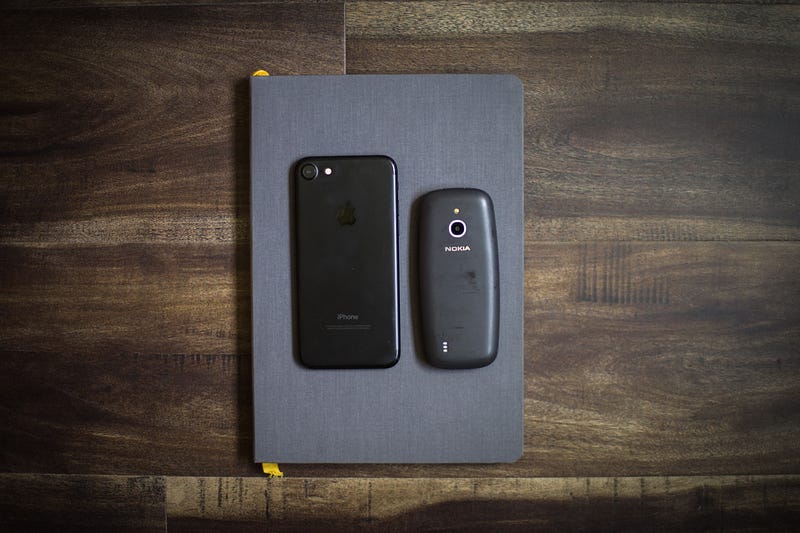
Yesterday’s futuristic tech is today’s obligatory device, whether or not we truly want it to be. Such is seemingly the case with the smartphone.
Since Steve Jobs first unveiled the iPhone in 2007, the smartphone has gone from a luxury accessory to something many of us wouldn’t dare to leave home without. Yet for all the convenience these pocket computers offer, some believe we’d be better off without them.
They might be the minority, but recent years have seen a growing movement of people doing away with smartphones and opting for something more simple — ‘dumbphones’.
WTF Is a Dumbphone?
A dumbphone is a term used to describe basic feature phones with limited functionalities. In other words, the kind of flip phones and candybar-button phones that were popular in the late 90s and early 2000s.
These phones don’t offer much beyond calls and SMS texts. Some may have a few built-in apps like WhatsApp or an MP3 player. If you’re lucky, you might be able to find one with the classic game ‘Snake’ and a low-quality camera. Otherwise, they’re relatively featureless.
What these phones lack in features, they make up for in other ways. Even a cheap dumbphone typically boasts an incredible battery life, dependability, and durability (there’s no touch screen to worry about, after all).
But the real appeal of these devices is often not what they can do but what they can’t.
Why the Hate for Smartphones?
Terms like “internet addiction” may induce eye-rolling amongst some, but not only are such concerns very real, but you might be affected by them yourself.
Studies show that around three-in-ten US adults and half of all young adults now feel “almost constantly” online. And worldwide, the average person now spends a whopping 6 hours and 37 minutes looking at a screen. And yes, the majority of that screen time is spent on smartphones.
The effects of all this screen time are wide-reaching and concerning. A 2017 study found that those who spend more than 6 hours a day looking at a screen were more likely to suffer from moderate to severe depression. Screen time can also have adverse effects on sleep cycles and child development.
Our state of constant connectivity in an online world is also ironically translating into feelings of loneliness and having a real-world impact on friendships and relations. As clinical associate professor and psychoanalyst, Dr. Gail Saltz notes:
“Loneliness has to do with more connected intimate relationships that feel real and close, and screens don’t really provide that… and yet people are replacing time invested in real relationships with screen time,”
The use of social media, in particular, which is where a lot of our screen time is going, has been linked to increased stress, anxiety, and depression.
Of course, addictive algorithms and social media platforms are certainly at least partly to blame. But their great enabler is undeniably the smartphone, keeping users always on, compulsively checking emails, and doom-scrolling feeds in a permanent state of distraction.
Even if you’re one of the lucky ones who has kept their smartphone screen time down, a smartphone may still hamper your productivity and attention span as research shows that Smartphones are distracting even when we’re not using them.
It all begs the question: how did we get to this point in the first place?
An Unseen Problem
The problem with smartphones is that everyone is always on them, so it’s hard to notice how attached you are to them until you try going without one. That was the experience of online creator and entrepreneur Ashton Womack, who tried going for a year without a smartphone. She would later speak of her experience to Fadeke A Degbugi:
“After going without it for a year, I realized maybe I actually really do have a dependency on it. I was spending a lot of time on it back then. But at the time, it seemed normal, because everyone else is doing the same exact thing.”
Like many others, Womack’s concerns regarding being without a smartphone stemmed from a fear of missing out. In particular, she worried about how it would harm the marketing of her business. In actuality, she found that she soon had more time to concentrate on said business.
Anecdotal experiments aside, is a dumbphone a viable alternative long term?
A Worthy Trade-off?
Switching to a dumbphone might sound nice in theory, but is it practical? Certainly, there are plenty of trade-offs to take into account. For instance, a dumbphone doesn’t offer GPS, so you’ll have to plan your trips more carefully beforehand or invest in a classic SAT-NAV. You’ll have to bring a separate camera if you want to take quality pictures too.
No apps also mean no Ubers, food delivery, Spotify, or free international calls via WiFi. You also lose out on the convenience of downloading tickets and using QR codes.
To put it bluntly, going without a smartphone is not only inconvenient, but you risk becoming an inconvenience to others.
Nonetheless, for many, including digital minimalist and creator of the ‘dumbphone finder,’ Jose Briones, the sacrifice is worthwhile:
“Learning to live an ‘inconvenient life’ is difficult. In the beginning, there’s a lot of friction, but it’s rewarding if you adapt it to your lifestyle.”
You may occasionally spot Briones on r/dumbphones, a subreddit where users share their experiences and advice regarding dumbphones. The subreddit has over 20,000 users, and you can find similarly enthusiastic communities on TikTok and the small web.
For those who remain unconvinced yet still pine for a distraction-free experience, there is another alternative to both “smart” and “dumb” phones.
The Light Phone & Other Alternatives
Old-school feature phones are still being made and manufactured to this day. However, they are typically marketed to nostalgic collectors, the elderly, and those who can’t afford anything else, not digital minimalists. Furthermore, many of these phones are a little too minimalist for some. And that’s where products like the Light Phone come in.
Described as “a phone that is designed to be used as little as possible,” the Light Phone is not quite a smartphone nor quite a dumb one. Instead, it’s a device that attempts to offer the best of both worlds.
On the one hand, the Light Phone comes with modern perks like music and podcast streaming and the ability to link to headphones via Bluetooth. But it also disregards many of the time-consuming modern features you’d expect from a modern device. The Light Phone has no browser, social media apps, email services, or other infinite feeds.
However, fewer features come with a price, and the Light Phone will set you back around $299 per unlocked device.
Another option is to ‘dumb down’ the phone you already have by switching off notifications, removing apps from your home screen (or entirely), and opting for a greyscale color scheme. For some, the temptation to remove these self-imposed restrictions is too much. But for others looking to cut down on their screen time, ‘de-fanging’ a smartphone may be a more realistic option.
Finals Thoughts
Is switching to a dumbphone a necessary or practical way to reclaim our attention from devices? That’s a question only individual users can answer. But what can be said for sure is that most tech is less essential and more time-consuming than we believe it to be. And it might be worth considering whether your devices are working for you or against you.
Thanks for reading
If you enjoyed this story, you may be interested in the following articles: