
Drug War History: Opium, Chinese Immigration & The Rise of the “Yellow Peril”
America’s earliest federal drug control efforts were xenophobic, racist, and anti-immigrant efforts politicians tried to pass off as public health policies.
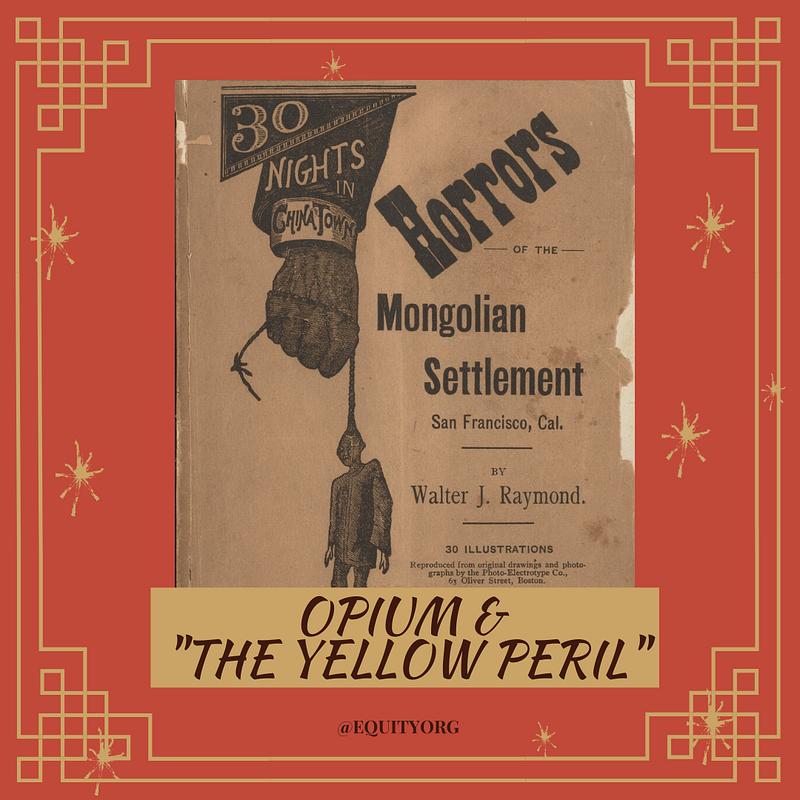
Introducing Part IV of The Equity Organization’s ‘Drug War History’ Series.
The racialization of our country’s drug policies are a feature of the system, not a bug. From the very beginning, one of the explicit goals of American drug enforcement policy has been the demonization of what Harry Anslinger — the grandfather of modern-day drug enforcement — believed to be ”the degenerate races”. An often-overlooked part of this history is the way anti-Chinese sentiment fueled the enactment of America’s first drug control efforts.
The Angell Treaty of 1880, which was enacted in response to the rapid rise of anti-Chinese sentiment during the 1870s, banned Chinese nationals from importing smoking-opium into the United States. Pharmacologically identical, but less potent than other opium derivatives, smoking-opium was — at least at first — largely consumed by Chinese immigrants in California.
Bigoted and xenophobic US officials — confident that opium smoking would solely appeal to “degenerate” Asian immigrants —composed the treaty in such a way that it only prohibited Chinese nationals from importing smoking-opium.
American citizens were still free to partake in the trade.
Predictably, the limitations of this intervention failed to curb the importation of smoking opium. In fact, it had the complete opposite effect. The profit opportunity posed by the ban incentivized greater American involvement in the importation and domestic cultivation of smoking-opium, which in turn helped to introduce smoking opium to new geographies and demographics.
The passage of 1909’s Opium Exclusion Act — which fully banned the import of opium and its derivatives into the United States — was ostensibly an attempt to correct the unintended and counterproductive consequences of the Angell Treaty. However, the data makes it clear that public health concerns were not the chief goal of the legislation; in 1909, American opium consumption had been in steady decline for nearly two decades. In reality, the primary motivation was appeasing racist and xenophobic Anglo-Americans living in the American West (many of who were simultaneously championing a rash of other anti-Chinese ordinances). The enforcement practices of the Opium Act also illustrate its intended objective; enacting greater social over Chinese immigrant communities in the American West. Despite American law enforcement’s awareness that problematic smoking-opium use was largely concentrated in Anglo-American communities, mass raids on Chinese homes and businesses quickly followed the Act’s passage. These efforts succeeded in terrorizing and brutalizing Asian-American communities but had a nuanced — and largely oppositional — impact on US smoking-opium consumption. You see, heightened police activity in Chinatown caused white opium smokers to set up dens in their own neighborhoods. This geographic spread not only made enforcement more expensive and less effective, but the raids—by compelling opium smokers to seek out new non-Chinese consumption locales and purveyors — worked to decrease the social stigma around opioid consumption.
That said, the Opium Exclusion Act did succeed in one of its stated goals. While smoking opium continued to be smuggled in (or produced domestically), the ban made the substance so expensive that it became virtually inaccessible to all but the wealthiest segment of society. And so in the years following the Act’s passage, the US saw an even steeper decline in the number of Americans regularly consumed opium.
Unfortunately—and quite predictably, the inaccessibility of smoking-opium (which, remember, was less potent and addictive than other opium derivatives) did not result in opium consumers abandoning the substance altogether. Most smoking-opium consumed abandoned the pipe only opium only to replace it with the use of more powerful, addictive, and largely legal opiates—namely heroin and morphine.
“It was soon found that it was difficult to enforce that act, and that the smuggling of smoking opium, beginning on the 1st of April 1909, had been growing ever since, in spite of all the efforts of the Government to stop it; and this act is designed to cure the defect in the opium-exclusion act [sic] and to stop that smuggling.” — US Congressional Record, 1913.
The data shows that a dramatic escalation of problematic heroin and morphine use kicked in *less than a year* after the passage of the Opium Exclusion Act.


