Drowning in Music
A life-ring for grieving.
Do you have times of just wanting to wrap up in a blanket?
Within days of losing my spouse — hours, really — I began to listen to music, my grieving process blindsided by a raw need for music. (Ah, the blindsiding was the path.) Live music mostly, though a music-streaming addiction became a theme, too, with music keeping company with every action, from showering to vacuuming.
My spouse was a musician; not a nationally-recognized musician, but one — like many — who made a livelihood from performing at a local level, and teaching. Music schools and programs are filled with such, and while the melomaniacs (music-lovers) of the world tend to gravitate to the international and nationally-recognized acts, there are thousands of musicians who make enough to create and perform their art within their communities.
Communities are enriched with this, and need to nurture and protect their music; you never know who will need this form of art, and when. For me, through those early months of grief, it was life-affirming, sustaining, necessary.
I am grateful, and I owe.
Multiple solitudes to mirror my own
My need for music was deeply connected with what happens on stage between performers. Why, when rendered single, alone in the world, did I have a voracious need to see human beings communicating via art to connect? Being witness to the act of creating music while performing answered some need in me, and jazz, with its nature of co-creating and improvisation, answered this need. (Multiple solitudes on stage and the sum being more than parts.)
Maybe I needed to witness how humans continue on, after snags or accidents, or how they travel emotionally when all is going well, too. There’s a symbiosis and humanity to music.
A corner taken on life’s path
Like a recovering alcoholic, who in hindsight can see a corner taken, I have to recognize that one particular Sunday was a turning point — a point of potentially embarrassing proportion. It was about eight months after my spouse’s passing.
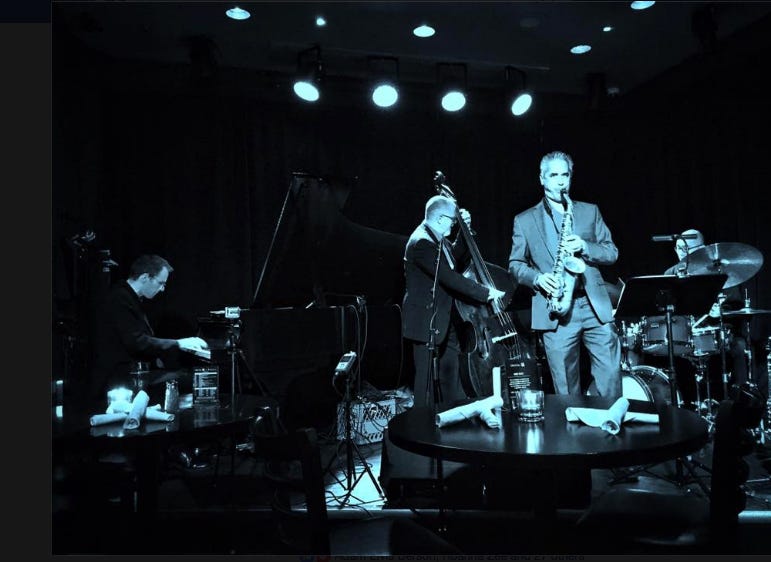
That Sunday, a quartet was playing at a Vancouver jazz supper club, featuring the original music of the sax player. My son and his friend and I went, drove downtown, took in the seasonal Christmas lights. It was a bit too festive for me; I was there for the music. I wore black, the many yards of my floor-length flamenco skirt, a skirt I particularly loved to wear through those winter months: the full circle of the skirt was a blanket. The weighty swish grounded me, held me in place.
I’d thought the supper club would be full. These musicians were some of the city’s finest, and we’d made a reservation. There were several empty tables for the audience, on the wooden floor immediately in front of the band. Just beyond that, there was a semi-circle of more tables, at what most people would consider a reasonable distance from the band. This was where the audience was seated.
The hostess indicated a table one row farther back, and I said no, it was too far away. The musical healing vibes, for me, need to be close. So we took our places at one of the tables right on the dance floor, immediately in front of the band. There is something to seeing the bare ankles of the drummer, the nod of the bassist, the keyboard player peering around the piano lid to see what the peeps are up to, to feel those inter-workings of the musicians.
Drown in music
But when I acknowledge within myself how I would have preferred to be, I still find it terrifying. The truth is that I would have liked to push aside some chairs to find a spot on the dark wall, just feet away from the musicians and the speakers, and I would have liked to sit on that concrete floor, back to the wall, knees pulled up to my chest.
I would have liked to pull the flamenco skirt right up and over my head, and drop my forehead to my knees. And drown in the music.
Drown in the jazz brushes of the drums, the dynamics between loud and soft — very soft — of the piano keys, the gut-thrums of bass, and the sweet saxophone. Could I have gotten away with that, with being fetal, and with drowning ears? Or would they have called in the expert clown and had me removed? Some brave person would have come to me to make gentle, fearful, inquiries, at the least, I’m sure.
Instead, I sat in a proper chair at a proper table, looking like a crazed and aging groupie, a few feet from the band. I should have had the self-discipline to sit at the back of the room, like a “normal” person. There would still be a wall for secret support.
But I didn’t.
I did wrap the heavy fabric of my flamenco skirt over me — no, not over my head! But as a blanket, to still my legs that often, through those months, felt shaky.
Or hide away?
Should I have stayed home, and medicated myself with little pieces of chemical? Hide away? No one would have to witness. Even the sacred DSM suggests bereavement should be medicated. And this may be the necessary path for some. But I had to listen to the music.
Whatever one needs to heal, I believe, do that. Whatever the path one discovers, there will be some — albeit meandering — individual path. There are no shortcuts. And I now know just how odd this path can appear.
Perhaps someday I will be one of those old women who dances by herself to some mysterious notes only she hears in between those the musicians are playing. I am no longer afraid of her. I may need her yet.
Act out
How do we act out and through grief? Would someone really call the alarm if I huddled in a corner? If I let myself thoroughly bliss out as I’d like to? Do I call it “bliss out” or “drown”? Does it make a difference? Will someone — the nice person who I imagine touching my arm, and asking, sotto voce, if I’m all right…do I need for her to call someone? Is there someone I can call? No, he died. There’s no one. Just me here, in the corner…losing my…
What is it, to make space for grief?
If we could be more comfortable with death, with dying, and with grief and mourning, we might accept when a person and their path appear to be a little “off.” No one wants to see what grieving looks like. But none of us like to think of loved ones hiding away, feeling alone and misunderstood either. Maybe, when we see someone behaving in an…interesting…way, we can take a moment, and think Okay! There goes someone with some stuff going on.
And now
I’m happy to report that I no longer have an urge to wrap my skirt over my head and sit on the floor and drown in music. But the experience of wanting and needing just that has opened me to reconsider what in the past I might have seen as “eccentric” behavior. And how what appears to be someone on an edge of madness might, in fact, be a person, healing.
In many other parts of the world, eccentricities are accepted. In the uppermost parts of North America, anything that does not conform is suspect. Maybe we can re-think that.
Acceptance and compassion for others can grow from one’s own pain. Gratitude for music and other forms of art can also grow, as well as gratitude for life itself — not to be taken for granted. Such gifts are hard-won, and worthwhile.
Let’s open to the possibilities, skirt or blanket over head, and all.
A taste of what I was hearing: