
Driving Corsica
Driving with the Joneses #1.
Let’s get introduced. We’re the Joneses. Steve is a retired engineer plagued by motion sickness and utterly obsessed with all moving things from motorcycles to boats. I’m Rada, a retired ER doc. I love to make things up, so I write thrillers, dog books, and medical humor. We live with Guinness, our lively German Shepherd, under the rule of Paxil, the black deaf cat who runs us all.
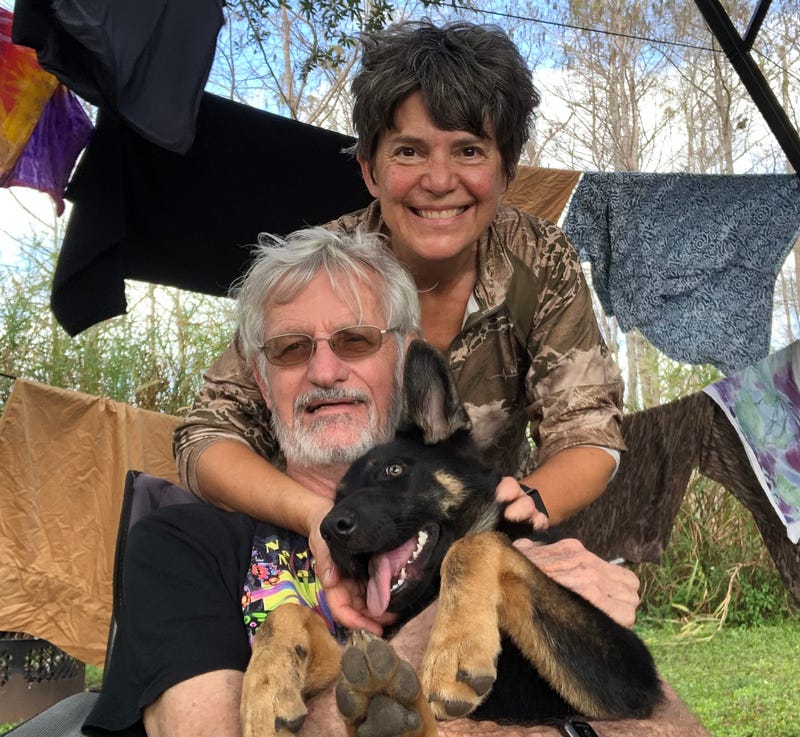
In 2021, of all years, we decided to trade our slow life on Lake Champlain for Thailand’s exotic excitement. We sold our lake home to move into a tiny three-season cabin in the woods. We sorted out and dispoed two lifetime’s worth of memories, from Steve’s diplomas and Grandma’s wedding picture to my extensive spice collection. Grandma’s picture stayed, but the wasabi had to go.
Then Covids hit us with a vengeance, and Thailand shut us out. We spent the summer hiking and learning to live small. Our peak excitement became our weekly trips to the Lake Placid laundromat, which shares a parking lot with the liquor store.
Then fall came. Time to go, since our pipes can’t stand the minuses of a North Country winter. But go where? Thailand doesn’t want us. Besides a pile of paperwork and paid quarantine on top of vaccination, they wanted $100K worth of Covid insurance. So we decided to winter on the Mediterannean, looking for a new home.
Steve leased a new Citroen C5 Aircross hybrid. After a week in Paris, we hit the road, determined to make the most of everything — food, wine, culture. Three months later, we’re still on the road. After whizzing south through France (more on that in our upcoming travel memoir), we spent a week crisscrossing the wonder that is Corsica.
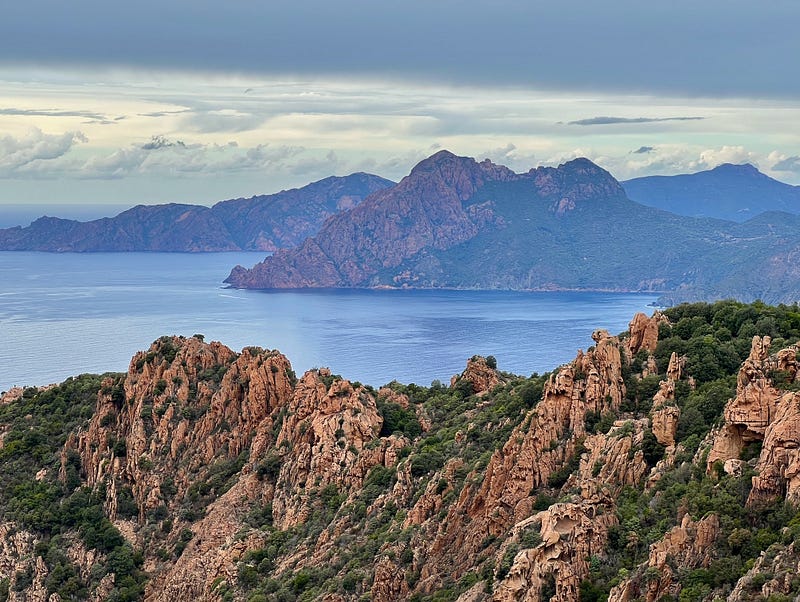
It’s beautiful, wild, and rough. And, for a tiny little island, she sure has attitude. It starts with her kilometers. My whole life I thought a kilometer is roughly 2/3 of a mile, therefore shorter and easier to handle. It turns out that Corsica didn’t get that memo.
We thought that first day when we slugged to do 100 km over a long day was an aberration. It turns out it’s the norm.
You sit down with Dr. Google and negotiate a day trip of, say, 120 KM. He says it should take two hours. You agree and seal the deal, then get in the car. Ten hours later, you’re almost home after cutting out the last third of the trip.
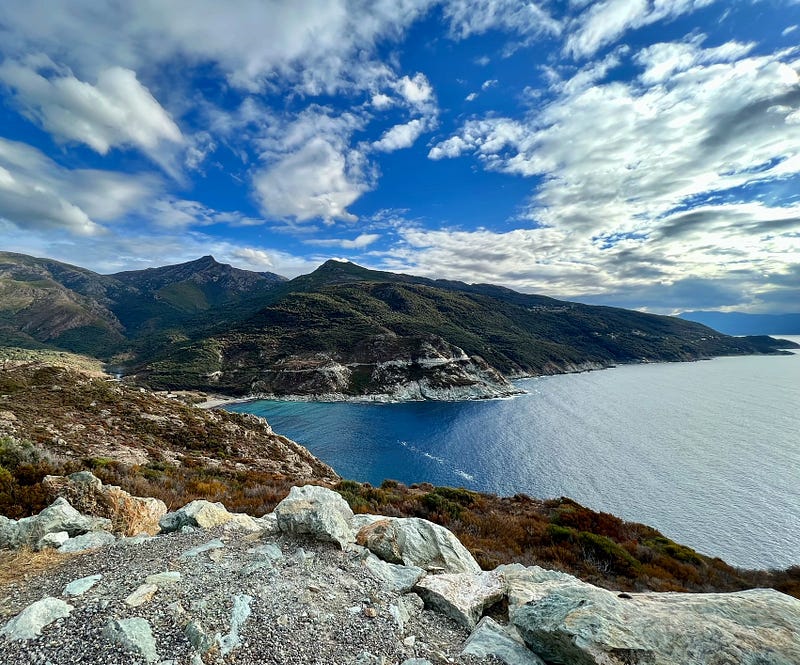
It’s the curves, of course. I call them curves to be polite. That gives them a sensual undertone of seduction. But they’re just a gaggle of nasty hairpins stacked on top of each other a thousand feet above the sea. Ten minutes into the trip, seduction couldn’t be further from my mind as I crack open the windows to inhale the freezing draft. What I really need is an emesis bag.
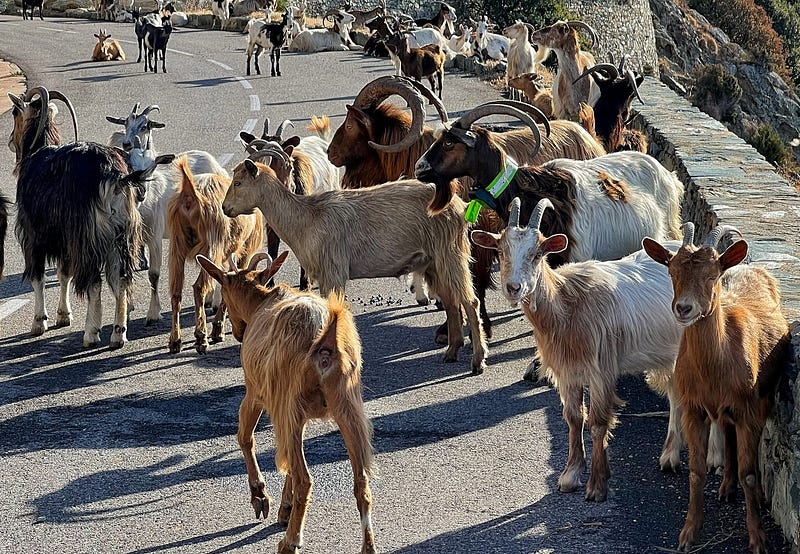
There are goats, lying in the road; The spectacular scenery urges you to stop for pictures every minute; Hurried Corsican drivers get up our assets, forcing Steve to pull off to let them go. And the many, way too many little monuments by the road — crosses, Madonnas, or just engraved plaques adorned with flowers, candles, and icons, telling you that somebody’s loved one died there.
But enough about roads. Let’s talk food.
Corsica is neither France nor Italy, though it’s deeply connected to both. The island has been Roman, Pisan, Genoese, and even Spanish when the Pope gifted it to the King of Aragon?! and just about everything else. It’s been French for the last couple of hundred years, but it has its own identity, culture, and cuisine. You seldom see escargots on Corsican menus. Corsica eats meat. Lots of it.
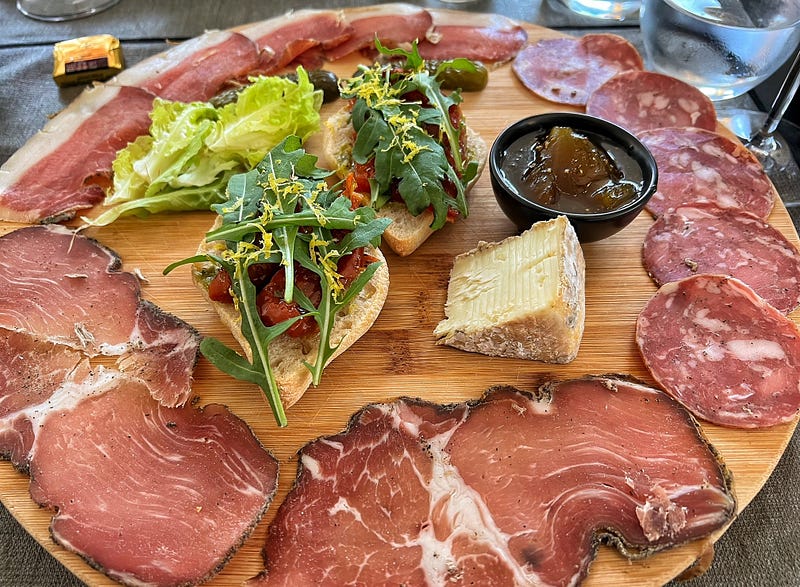
Every menu starts with a “Corse plate de degustation,” a variety of cured, dried and smoked meats served with chewy bread and fig jam. You may see a “Chevre Chaud,” warm goat cheese salad, but then the main dish is cured meat. There’s seafood, of course, and pasta and escalope de volaille. But more often, it’s eggplant stuffed with meat, beef tongue with olives, or tripe with tomato sauce served with boiled pasta or potatoes. It’s a hearty, savory, unfussy cuisine, nothing like the creamy Normandy sauces or the Provencale explosion of flavors. No sissy things melting in your mouth or unctuous rich sauces, making eating an effortless pleasure. None of that!
Corsican cuisine will get you working. The bread is chewy, with crust that cuts deep. The “veal” had a long and active life roaming the wild mountains and hopefully said goodbye to her grandchildren before ending up with the olives. As for the cured meats — they’re delicious. They’re so well-cured they don’t need refrigeration but beware of dropping them on your foot. That crème brulee that usually melts in your mouth? Not here, baby. The added chestnuts make it pleasantly chewy. Bottom line: You need good teeth to enjoy Corsican food. Or at least well-fitted dentures.
Then the wine. Gone are the dark, voluptuous, melodic Bordeaux. Whether red, white or rose, the wines are light, transparent, and acerbic. Steve says Corse wines are coarse. It may be harsh, but it’s true.
But don’t tell that to the locals. They’re in awe of their wines, so much so that they price them at twice the price of Bordeaux in the stores and serve them exclusively in restaurants. That reminds me a bit of my mother. She thought I was the smartest and prettiest girl in the world, bless her heart, and nothing I did could convince her otherwise. But that’s another whole memoir.
I hope you enjoyed my Corsican snapshot. Follow me if you want to tag along through Sardinia, Sicily, and more. For updates, check out RadaJones.com.


