
Dream, Plan, Achieve: Tips from 3 Books for Mastering a New Skill

Have you ever aimed to learn a new skill for personal growth or career advancement but lost momentum and wondered what you can do to be more effective?
This post shares tips drawn from 3 books I’ve read. While these books cover various aspects of acquiring new skills, I’ve focused on extracting their wisdom regarding the planning stage.
People who might benefit from the tips in this post include:
- Up-skillers or re-skillers: individuals looking to expand into a new area to further their personal or career goals.
- Self-educators: individuals who want to establish a solid foundation through planning before diving into skill proficiency.
Introduction: Laying the Groundwork for a New Skill.
Skill acquisition involves distinct phases: planning, practicing, refining, and then the combined phase of outcome and evaluation.
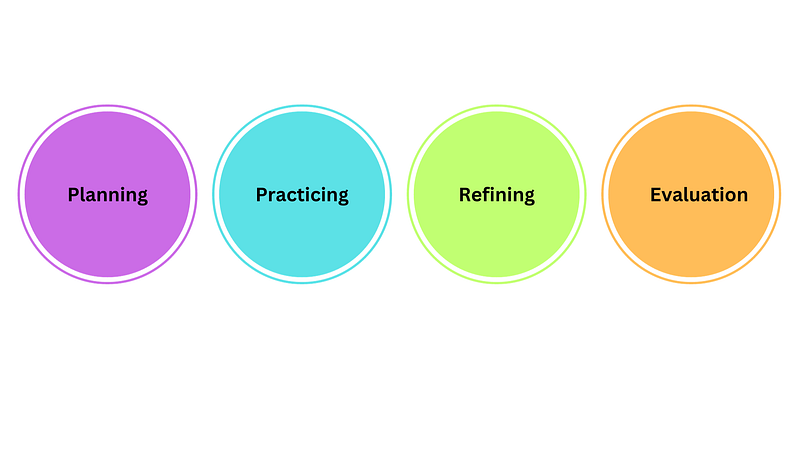
The planning phase, which is the focus of this post, deals with the what, how, why, and when of your learning. Scott H. Young in the book ‘Ultralearning’ refers to this stage as “meta mapping,” essentially describing it as the roadmap to your learning.
The practicing phase is pivotal to gaining proficiency, as underscored by Josh Kaufman in the book ‘The First 20 Hours.’
The refining phase occurs while you’re deep in learning and doing. As you receive feedback, you refine and, if necessary, course-correct, iterating as you advance in skill acquisition.
Upon reaching proficiency, you can advance to the final phase: evaluation.
Scott H. Young in the book ‘Ultralearning’ introduced the concept of evaluation, describing it as determining your next steps after achieving your desired outcome. As the author explains, choices may include:
- Pausing at your current level.
- Aiming for mastery.
- Branching into a specialized sub-area of the skill.
If you decide to continue your learning journey, you’ll re-enter the beginning phase — planning — in some form again.
Now that you have a big picture of the different phases let’s hone in on the post’s main point — the planning phase.
How can you get better organized before you set out to acquire that shiny new skill?
Read on for the tips from the authors:
BOOK #1: Ultralearning: Master Hard Skills, Outsmart the Competition, and Accelerate Your Career (Scott H. Young)
Get in the right mindset
The planning phase of charting out the what, why, and how of your learning a new skill is exciting. However, planning means putting in the legwork. In school, education is largely set for us. What we learn is defined by a curriculum. When we learn is outlined by a schedule. And how we learn is shaped by assignments and evaluations.
After school, many of us must determine our own path for learning and acquiring new skills. This might mean unlearning some ingrained habits.
If you’re trying to gain new skills, understand that learning to learn outside a formal environment is its own skill. As the author suggests, you’ll improve with time. The more you plan and act on your learning, the better you’ll become at mapping out your learning journey.
Get a lay of the land
In planning, it’s essential to understand what’s involved in acquiring the skill. But many, in their eagerness, overlook this step, wanting to dive right in. While this might appear daunting, especially if the skill is unfamiliar, it’s a pivotal phase for a successful learning outcome.
Dedicate time to review and select quality materials to grasp what’s needed to achieve proficiency in that skill area.
Course-correct during your learning journey
While upfront planning is crucial, be prepared for adjustments along the way. Particularly when diving into a new skill area, you might encounter unexpected challenges, even after thorough research.
The author emphasizes being open to course-correction throughout the process. For instance, if a particular learning resource, like a book or class, isn’t effective, make a change. If a specific learning style isn’t helping you grasp a skill, adjust your approach.
The journey involves reviewing resources, practicing, obtaining feedback, and making corrections as needed.
Remember, it’s a continual learning process, so stay persistent and keep moving forward.
Meet yourself where you are in the learning process
As you plan, it’s essential to pinpoint your current position in learning the new skill. Are you venturing into a completely new domain? Or are you already proficient and aiming to further refine your skill with additional training?
The initial focus should be mastering the basics for those exploring a new area. The author describes this as the acquisition phase. This stage involves laying a foundation by absorbing new knowledge.
For instance, in ‘The First 20 Hours,’ Kaufman suggests that if you’re in the initial phases of skill acquisition, the emphasis should be on practicing whenever possible, refining, and iterating. The objective isn’t perfection but to achieve a level of ‘good enough.’ Only after reaching this stage can one proceed to further refinement.
As Young elaborates in the book ‘Ultralearning’, once proficiency is reached and one transitions to the expert phase, the focus shifts to unlearning. The learning approach evolves from gaining proficiency to leveraging knowledge via experimentation, such as producing original works.
Define a project
If you’re looking to learn a new skill, it might be beneficial to plan around a project, especially if you’re aiming for practical skills-based learning. This is known as project-based learning, and it can help bridge the gap between learning about a skill, like through reading, and practicing it.
Set goals, and start small
As you delve into planning and understanding the ‘why’ behind learning a new skill, ensure your initial steps are realistic. Achieve this by setting modest, attainable goals.
You can expand and elevate your goals as you progress and gain proficiency.

BOOK #2: The First 20 Hours: How to Learn Anything … Fast (Josh Kaufman)
Commit to learning one and only ONE skill at a time
When planning what you will learn, resist the urge to aim too broad. Kaufman emphasizes the importance of focusing on just ONE skill as the key to rapid acquisition.
Why should you prioritize learning one skill at a time?
Firstly, your attention remains undistracted, solely on one skill instead of being scattered across many.
Secondly, acquiring skills quickly, a central message of the author’s book, demands dedicated focus and practice, which becomes challenging when you’re spread thin.
Emphasizing the need to learn one skill at a time, the author notes:
“Pick one, and only one, new skill you wish to acquire. Put all of your spare focus and energy into acquiring that skill, and put other skills on temporary hold.” (p41)
Create a schedule
As you transition to the ‘when,’ Kaufman recommends dedicating at least 20 hours to acquire any new skill quickly. How you allocate these hours depends on your availability.
The essence is to remain committed and refrain from quitting before completing these 20 hours.
While you can spread these hours over time, the sooner you invest them, the faster you master the skill.
The book also advises practicing daily in 60 to 90-minute intervals. During practice, use a timer and focus on short, concentrated bursts.
Set your target performance
When planning and setting goals, ask yourself: how proficient do you want to become in this skill?
Be specific in your aim. If you’re starting as a beginner in a new area, it’s wise to set modest goals initially. As you progress and reach a ‘good enough’ level of proficiency, you can then think about setting more ambitious goals, moving from a state of proficiency to aiming for mastery.
However, for many, simply reaching a level of acceptable proficiency is enough, and mastery need not be the ultimate goal.
You might also consider summarizing your goal into a single statement. This personal declaration can guide and inspire you, encapsulating the ‘why,’ the specific proficiency targets, and the timeline you’ve set.
Deconstruct the skill
In line with the previous point about setting small steps, the author suggests breaking down a skill into its smallest possible parts to make the learning process less overwhelming.
You must research and identify the relevant sub-skills to break a skill into sub-skills. Kaufman, however, cautions against dedicating too much time to researching the skill. The primary goal is to review enough resources to determine the most critical sub-skills.
BOOK #3: The Lifelong Learner: How to Develop Yourself, Continually Grow, Expand Your Horizons, and Pursue Anything (Learning how to Learn) (Peter Hollins)
Know your why
When setting goals during planning, Hollins underscores the importance of pinpointing the ‘why’ behind your desire to learn and practice a new skill.
The author suggests the SMART (specific, measurable, actionable, realistic, and timely) framework as a method for goal-setting.
The author also recommends adopting a visualization routine to enhance the likelihood of reaching your goal.
For instance, envision your emotions as you progress toward your target. How will you feel upon mastering the skill? Additionally, it’s beneficial to visualize potential challenges you might face.
Visualizing positive outcomes and possible obstacles will prepare you to work through challenges, a common part of learning any new skill.
Create a personal syllabus
Wrap up your planning phase with a clear roadmap, which can be compiled into a ‘personal syllabus.’
Consider the personal syllabus as a clear visual pathway that charts the steps to your end goal.
The author defines this as
“a plan that systematizes various actions to be taken so that you achieve a certain goal through personal and professional development. In other words, it’s a roadmap for you to get from where you are now to where you want to be.”
He further emphasizes the importance of this preparatory step, stating that
“creating your own syllabus is not easy, but it pays huge dividends for the time you invest in your personal growth.”

Conclusion
I hope you’ve gained new insights from this post. While you may only find some tips from the three books discussed here necessary, try some unfamiliar ones. See if they enhance your skill acquisition journey.
If you’re interested in exploring more on this subject or other learning-related books, these books are excellent resources.
⭐️ Ultralearning: Master Hard Skills, Outsmart the Competition, and Accelerate Your Career | Scott H. Young
⭐️ The First 20 Hours: How to Learn Anything … Fast | Josh Kaufman
⭐️ The Lifelong Learner: How to Develop Yourself, Continually Grow, Expand Your Horizons, and Pursue Anything (Learning how to Learn) | Peter Hollins
🌈 If you appreciate actionable insights on learning and personal growth inspired by books, please consider following me.