
Drawing Upon Life & Love
In response to Weeds & Wildflowers July prompt
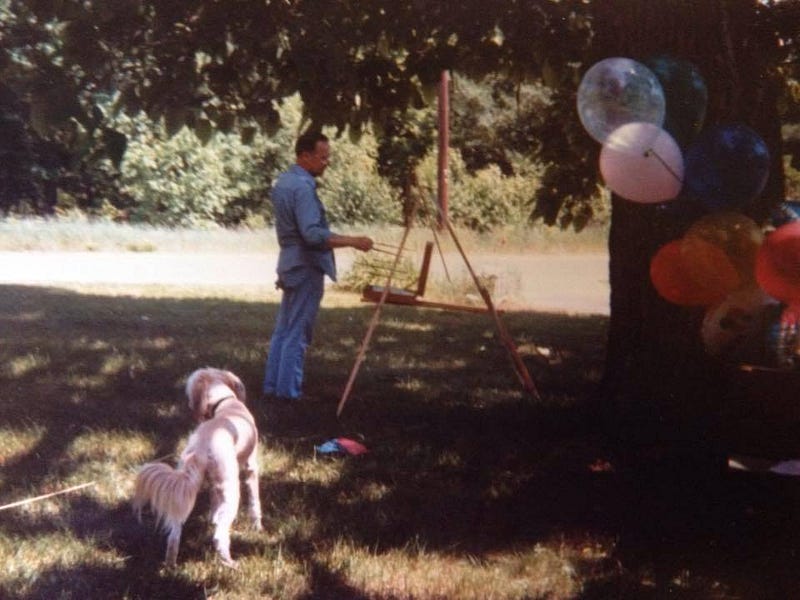
My grandfather was an art teacher and an artist. This is just another story that I’ve written about him, after writing and speaking so many throughout my life. Nine years ago now, I was honored to stand alongside my cousin at our grandfather’s funeral and share a few meaningful words and reminiscences. I began this eulogy with a story of him teaching me about light and shadow at the bus stop, referencing a dense pine that grew on the corner. He always kept a tiny notebook in his shirt pocket, along with at least one very short pencil.
As he explained some artistic concept or another, he would always prompt me with, “See?” In fact, this was a common interjectional phrase for him as well. See? See. He was big on looking at things before he eventually lost his vision altogether.
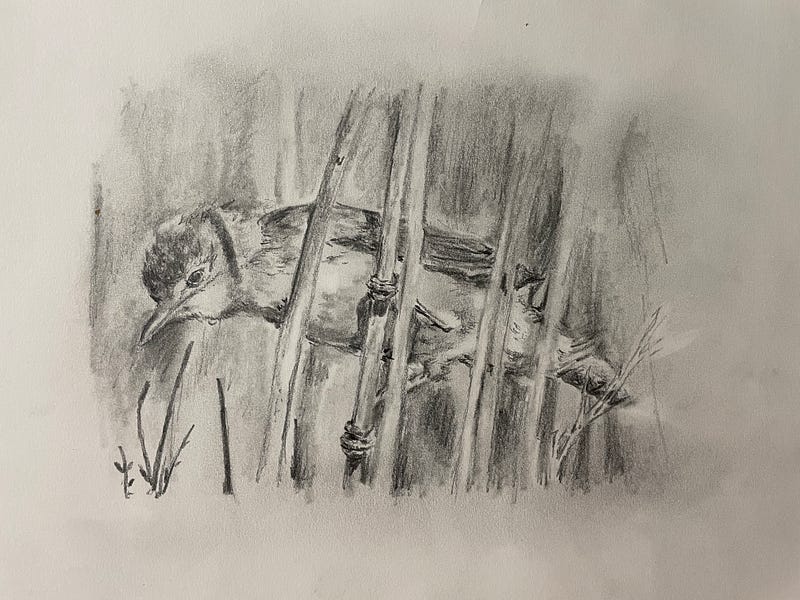
Attempting to sketch this little bird, I found myself creating, inventing, and imagining more than I was seeing. I’ve never dawn a bird before (well, maybe at one point in childhood), but I’ve often drawn portraits of people. In practicing portraiture, I’ve gotten pretty good at drawing the shapes, shadows, and in-between spaces of things. I do my best not to draw facial features as one expects to see them: an eye, a nose, the pleasant curve of a philtrum bending into a pink upper lip. Instead, I measure angles with my outstretched pencil, note the distance between shapes and edges, follow shadows to their limits. When the combination of these actions turns into a face at the end, it’s a bit of a miracle.
I tried to do this with Christine’s bird, but it was challenging to accomplish in black and white, and I found myself imagining feathers —the outline of a bird. I drew too much from memory.
My pencil-drawn bird is not perfect. It is elongated, its head less adorably squat than the bird’s in the photograph. Its eye is wrong. I don’t have the determination to fix it.
When I finished this sketch, I put my drawing pencils back into the dirty gallon-sized freezer bag where I stash my old mess of graphite and charcoal tools. I carefully placed the gray kneaded eraser inside my grandfather’s repurposed Hershey’s tin, where he neatly stored a small cache of his own supplies. Although his are far older than mine, they’ve remained in far better condition— a reflection of his personality as well as love for his craft.
My grandfather painted more often than he sketched — oil painting, to be exact, and mostly landscapes. His works made me fall in love with our local landscape even more than I already might have. If heaven were a painting by my grandfather, it might be a snowy New England hillside, somehow warm and lively despite the cold, blue-white earth and the bare, dormant maples. He may not have taught me to hold my pencils with the same care and reverence that he felt for such things, but he certainly helped me learn to adore the land in that way. See?
With thanks to Dennett for the thoughtful prompt.


