
Arts & Culture
Dragon, dragon, in the sky, who’s the fieriest of them all?
Thundering rumblings on the Year of the Dragon and how to draw one
The mighty, strong, fire-spitting, invincible dragon is a supreme creature indeed with an energy and presence to behold.
We see dragons in mythology, ancient legends, and as symbols for New Years, birth years, festivals, and icons for statehood.
But how to draw one?
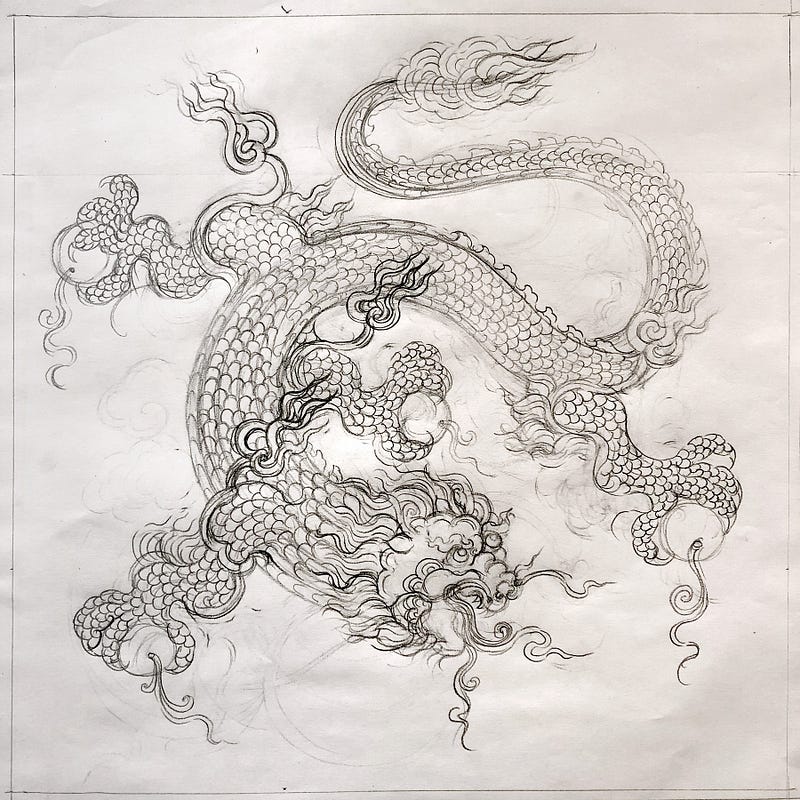
The most recent Year of the Dragon, 2012, brought me good fortune. I was living in the melting pot that is New York City, a cacophonous matrix of the world’s cultures.
By a twist of fate I met my art teacher, Mr. Rinzin, a master in Eastern Arts. Being an artist myself, I asked him to teach me the ancient symbols of Himalayan cultures, icons such as tigers, lions, and dragons.
“Yes,” Mr. Rinzin said, “I will teach you.”
“Excellent!” I exclaimed, “I’d love to learn how to draw a dragon.”
“No worries,” he said, “I will show you how.”
Learning how to draw
Unbeknownst to me, it would take me years to learn how to draw a fierce and fiery dragon. It’s been a long journey and I’m still on it. The success lies in the learning.
Eastern dragons appear in the sky, wrapped in dewy mist and clouds so saturated with rain that they seem to just about burst open like waterfalls into the vast sea. Out of nowhere, dragons manifest in the strangest of thunderous skies and roughest of turbulent currents.
“Gripping the giant pearls of fire, dragons are the Gods of the Sky,” explains Mr. Rinzin, “dragons bring good fortune to those below.”
Drawing in charcoal first
My first drawing class was tentative. Where to begin? My drawing was crude and shaky.
“We start with a stick of charcoal,” instructs Mr. Rinzin. “We can even pull a charcoal stick from a fire.”
Holding the smudgy charcoal stick, I learn how to draw the body, hair, claws, tail, and face.
Drawing the shape turned out to be difficult. It has to be long and agile, snakelike, weightlessly twisting and rolling in the currents of air.
Only after erasing the lines many times did I find the dragon’s form.
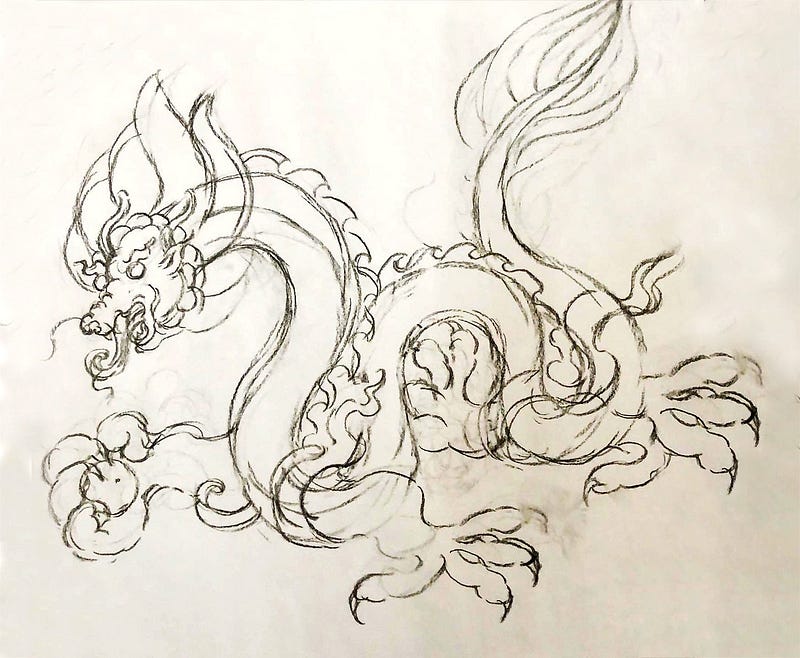
“Dragons have travelled great distances to bring us the wealth of rain and a good harvest,” declares Mr. Rinzin with a smile.
“They are fierce protectors.”
I continue drawing, composing the dragon’s shape and detailing the face, hair, claws, and tail.
Defining the lines with pencil
After firstly using the charcoal stick, we use a sharp 4B pencil to draw more precisely.
“Dragons travel inside gusty winds and thunderous storms, surrounded by rain clouds,” extolls Mr. Rinzin, “you must also learn how to draw clouds and water.”
I draw long lines, details, and the fierce expressions with crisp pencil lines. It’s becoming clearer now.
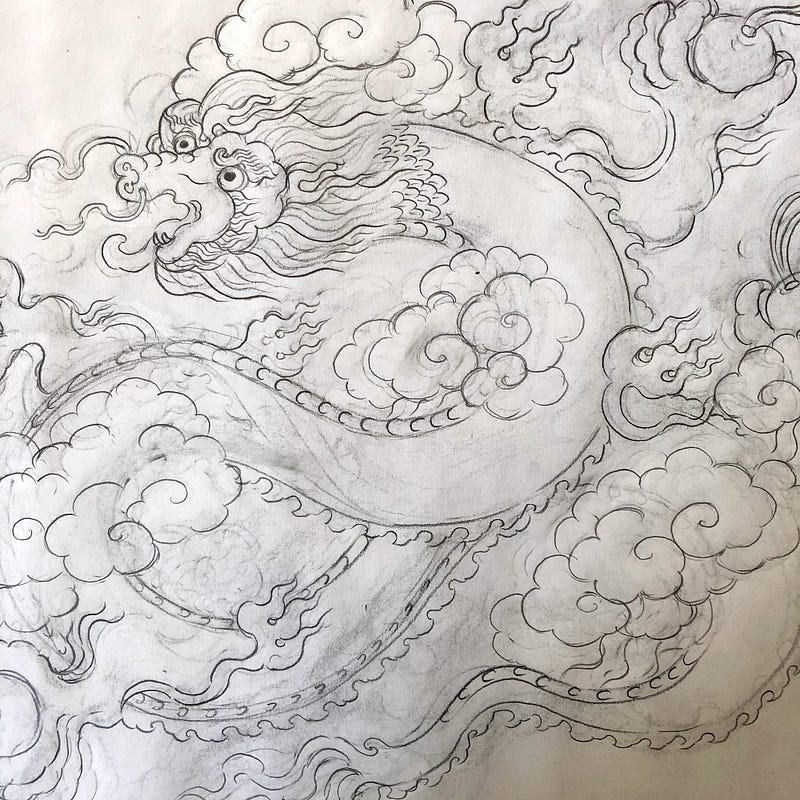
The dragon’s mouth is wide open, exposing his sharp teeth and long tongue. From the underside of his nose, tough whiskers pierce the air to sense the slightest vibrations and thus allowing him to weave his body along the airy currents.
The dragon’s eyes reflect brawniness and wisdom, the perception that our existence dissolves with the universal one. We are a mere speck in the infinite galactic universe.
Dragons appear out of nowhere, throwing their fire balls into torrential downpours to sow the seeds for the next harvest.
“Dragons are also known as Nāgas, serpents,” expounds Mr. Rinzin, “they have great wisdom and benevolence and protect from all kind of dangers.”
I draw the dragon’s hair, spinal spikes that look like a filigreed border, fierce eyes and flaming eyebrows, horns flowing like fire, claws grasping a hot fireballs, also known as norbus, or gems.
Filling in details with pencil and inking
As we get closer to defining the dragon’s form and expression, details are drawn, such as the fish-scale skin, sharp nails protruding from his claws, exploding flames adorning the undulating body.
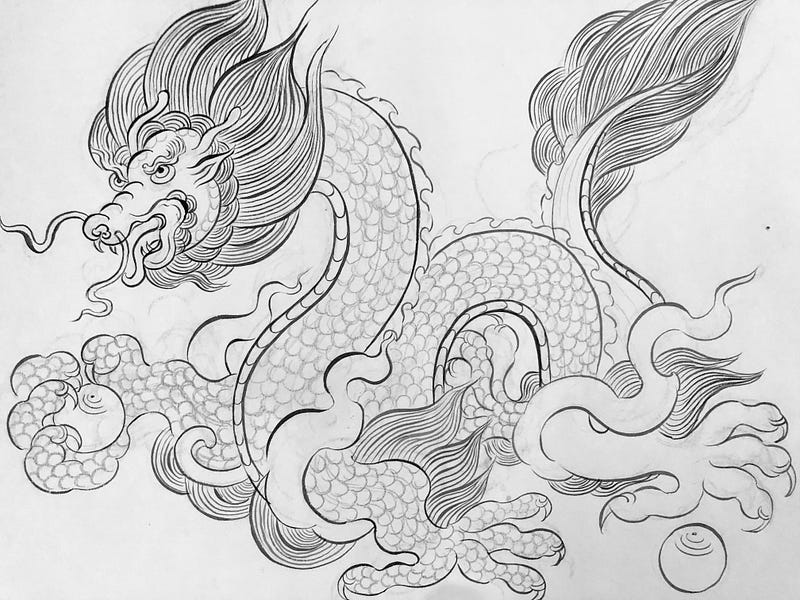
“Each layer of the drawing builds on the first one,” instructs Mr. Rinzin, “that is why it is so important to take the time to first draw the shape beautifully.”
“Only when we are satisfied with the composition of the Nāga shape can we move to the next level of drawing.”
I pencil in the skin’s scaly pattern. Afterwards, we ink the outlines of body and hair with a fine inking brush and sumi ink.
The lines become clear once they are inked. They are crisp and precise. The thickness of the brush produces fatter inking lines and also thinner ones.
Once the ink has dried, the pencil lines underneath get erased.
Inking… the grand finale
Inking the lines is the last layer that puts a stamp on the previous layers. Inking can only get done once. When the ink meets the paper, there is no going back.
The inked line as to be perfect.
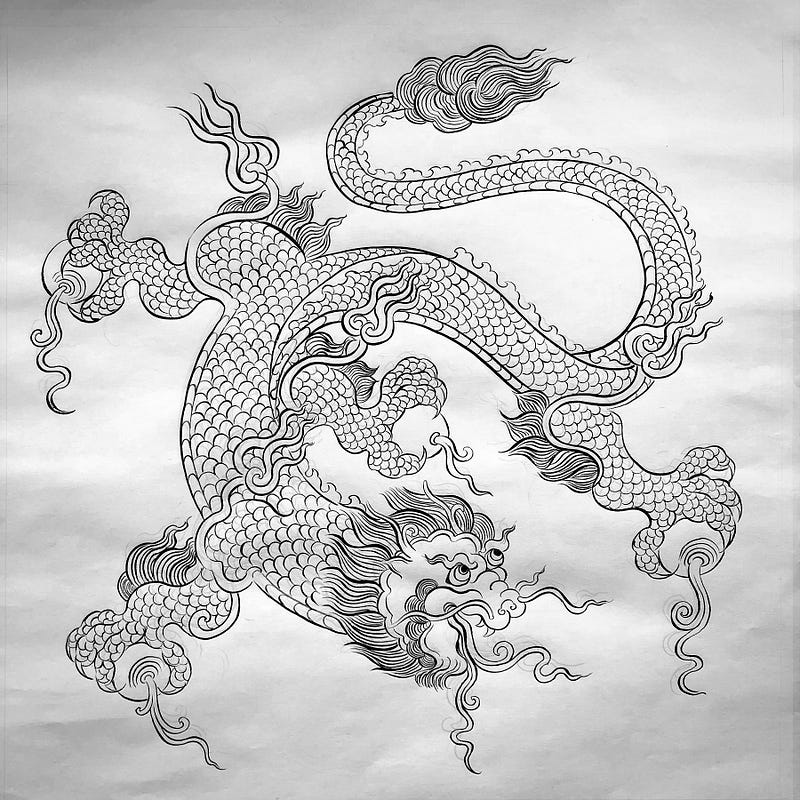
We hold our breath as we ink. The hand has to be calm, the mind at rest.
Thus, I learned how to draw a dragon over many years.
This is only the beginning. Dragons can be painted on canvas or walls, sculpted in wood or marble, stitched onto silk, woven as carpets. Dragons can appear everywhere.
“Dragons are reborn every 12 years,” explains Mr. Rinzin, “and every person born alongside the dragon will surely grow up to be very smart and lucky.”
“That’s the gift of the dragon.”
Here’s to a beautiful New Year of the Dragon 2024!
All drawings & images ©Eva Schicker 2024.