
Dr. Martin Luther King, Jr., on Love, Justice, and Nonviolence
Whatever affects one directly, affects all indirectly.
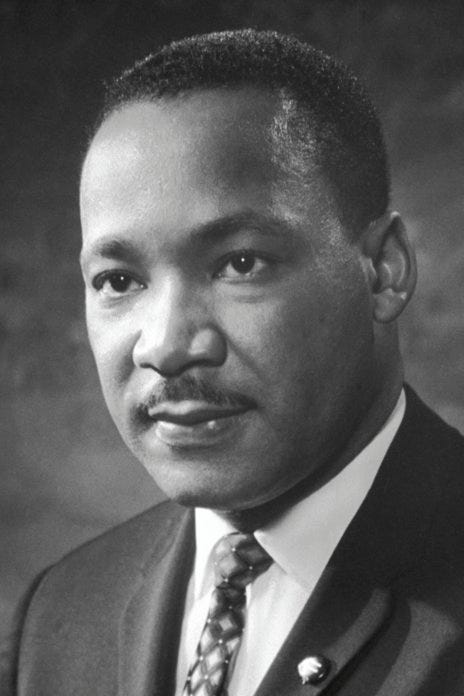
This month I’ve been writing about inspirational figures throughout history and examining how to apply their breadth of knowledge to our lives right now.
And as I twirled the gold-tipped pen in my left hand, held a cup of steaming coffee in the right, I thought, who should I investigate next?
The truth is deep-diving into these profoundly enriching and life-sustaining messages is more addictive than anticipated. It takes time to pick out each quote, think about it in its entirety, sometimes several times over, and then keep exploring the great minds of the world, with no age, time, race, gender, or any other sort of barrier.
The next perineal figure about whom I have the honor to write is the enchanting Dr. Martin Luther King, Jr. (January 15, 1929–April 4, 1968).
I chose Dr. King because never have I felt so-called to the dance of life while being as equally moved and connected to the entirety of humanity as when I heard this speech: Martin Luther King Jr. “I’ve Been to the Mountaintop”.
As the words rang out over our dining room table, I instantly put my bare feet on the ground and stopped as I literally felt head-to-toe chills, something I have often felt when something is transcendentally true, but never to this magnitude. And as the perennial words, “Only when it is dark enough can we see the stars” echoed throughout the crowd, right then and there, I felt the visionary power that the reverend is so famous for.
Although Dr. King is well known for his Christian social ethics and the concept of agape love, he was also supremely influenced by Eastern spiritual traditions, including Buddhism’s tenet of the interconnectedness of all things, Gandhi’s political works, and Ancient Greek philosophies such as Stoicism. However, his abiding ethos is not religious; rather, it is the belief that to live well requires deep-rooted societal, ethical, and spiritual responsibilities that strengthen us as humans both individually and together.
After I listened to Dr. King’s enduring words, I started seeing his quotes everywhere. So from that cataclysmic moment where time and space converged to bring the words of a great pioneer to my table, here are six of his enlightening quotes, along with some further thoughts from me.
On change:
“There comes a time when people get tired of being pushed out of the glittering sunlight of life’s July and left standing amid the piercing chill of an alpine November.”
Dr. King was a visionary, but I have to also wonder if he was a mystic. Many of his quotes and writings are tremendously timely and on par with the state of the world today, particularly with America, its history of racial injustice, and the painful yet crucial emergence of change that we are seeing. This awakening of the public’s social consciousness (and conscience) has the potential to heal a deeply divided nation.
On the importance of love:
“Love is the only force capable of transforming an enemy into a friend.”
One of the central tenets of nonviolence is that it does not seek to defeat or humiliate others in its quest to win their friendship and understanding. And the result of this love, or agape as the Greeks called it, is reconciliation, redemption, and even more love. Love heals, and at the center of nonviolence in all its forms is the willingness to live it out centrally, every day.
On exploring the evolution of conflict:
“Man must evolve for all human conflict a method which rejects revenge, aggression, and retaliation. The foundation of such a method is love.”
We can only mend our world and heal each other by meeting hate with love. Have courage and have faith that nonviolence is available to each of us, even though it can be so easy to get swept away in the hate. Still, real strength calls for us to transmute that lower energy into love by choosing at this moment, and the next, to see commonalities with our shared humans so that we can evolve and better understand one another.
On the importance of pairing action with movement:
“If you can’t fly, then run; if you can’t run, then walk; if you can’t walk, then crawl; but whatever you do, you have to keep moving forward.”
Even if life is challenging right now, don’t quit. Use past struggles and lessons to move forward into a better today and a more hopeful tomorrow. When you think about giving up, focus instead on the fortitude of spirit, strength of soul, and that resilient capacity that we all have to move forward no matter what. After all, time keeps going, and so can we.
On doing the right thing:
“Never, never be afraid to do what’s right, especially if the well-being of a person or animal is at stake. Society’s punishments are small compared to the wounds we inflict on our soul when we look the other way.”
Injustice anywhere is a threat to justice everywhere. We are entangled in a tightly woven network of humanity, sewed into a single garment of chance and choice, bound by fate. Whatever affects one of us directly affects all indirectly. Always choose what your heart knows to be right; seek to cancel out the forces of darkness with the brilliant forces of light. Doing the right thing will lead to others doing the same, until we fully defeat injustice towards our fellow humans, creatures, and planet.
On exploring the fortuitous notion of forgiveness:
“Forgiveness is not an occasional act; it is a constant attitude.”
True forgiveness is redemptive. To be human is to be flawed; to take our first breath is to join the multitude of existence with all of its possibilities, promises, and perils. From that first beautiful moment of awareness, choose forgiveness of yourself and others because, without forgiveness, there can be no deep, abiding love. And that, my friends, is the purpose of life.

Dr. Martin Luther King, Jr.’s transcendent and shimmering legacy of love, justice, and nonviolence continually invites a more equal and magnanimous idea of what it means to be a human. Because that is the only way that we can balance the force of constructive action with the hope for a more peaceful world.
With love and gratitude, Aurora


