
Douglas Coupland’s ‘Generation X’ Serves as a Literary Time Capsule
The classic novel by Canadian writer Douglas Coupland explores the salad years of Gen X in 1990s America
As I continue to expand my appreciation for intergenerational literacy, it’s invigorating to study the time periods of yesterday. How, in any given decade, Americans of various age groups were dealing with their own unique obstacles. We also can learn how those dynamics are tied to global conflict.
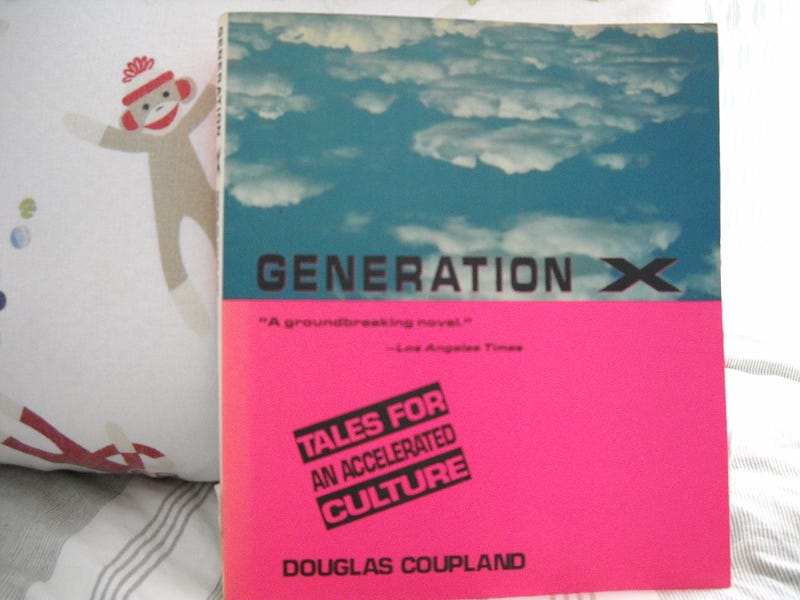
Douglas Coupland, a member of “Generation Jones” well-versed in visual design and the natural sciences, authored the eponymous book just as the term “Generation X” was becoming popularized to refer to those born in the mid-1960s up through the early-1980s. Written and published in 1991, Generation X: Tales for an Accelerated Culture holds up as a regional snapshot of GenXer culture.
Told in the first-person voice of fictional twentysomething Andy Palmer, the book follows Andy and his two close friends, Dagmar “Dag” Bellinghausen (a native Canadian) and Claire Baxter. The trio resides in a housing unit of Palm Springs bungalows; Andy and Dag are bartenders, and Claire works in retail.
The nexus of this story is how these three platonic friends ruminate over their present and future. They have accepted the likelihood that they will never be more successful than their parents. To pass time in-between work hours, Andy, Claire, and Dag entertain themselves with oral storytelling that serves as a confluence of psychological musings, spirituality, dark humor, whimsy, and social commentary.
Andy Is the Gen X Everyperson
Featured in the margins of Generation X’s pages are a scattered glossary of Xer terminology. This could ostensibly be viewed as a stream-of-consciousness from Andy’s brain while doubling as Coupland’s attempt to educate people unfamiliar with these terms. Some of the vocabulary includes words and phrases such as “McJob” (a low-paying antithesis to one’s desired career of prosperity), “Brazilification” (the widening wealth inequality gap), “Ozmosis” (a reflection of how one’s workplace echoes their own self-loathing), or “Divorce Assumption” (lack of guilt from partners when their marriage fails) — to name a handful of them.
While the characters’ actions may seem mundane, they tie in nicely with the emotions of the protagonist and his friends. At one point, the irresponsible Dag gifts Claire with a jar of Trinitite (plutonium beads), which he accidentally drops and shatters across her bungalow floor. Later in the story, Andy spends Christmas at his childhood home in Portland. His younger brother, Tyler, is the only other one of Andy’s six siblings who bothers to show up to celebrate with their parents. Andy tries to derive some meaning out of the family visit, but he constantly ends up disappointed.
It’s easy to see how these three friends complement one another. Andy seems fairly straight-laced; yet, you can tell he is just itching be more like the rebellious Dag. Meanwhile, Dag’s misanthropy shows up in his storytelling, but it’s neutralized by his intimate banter with Claire.
For her part, Claire trusts these two guys and appears to know instinctively that any toxic masculinity from them will be minimal. She views Andy as the more sensitive soul in whom she can confide, whereas Claire playfully spars with Dag in the name of their shared exasperation.
Via the We Are The Mutants blog, novelist Eve Tushnet speculates that Coupland is hinting at Andy’s homosexuality (or another LGBT+ identity). As a gay guy myself, I hadn’t really considered this possibility. But, in hindsight, Tushnet’s theory makes sense — Andy rarely discusses his sexual or romantic sentiments, which would be a testament to how marginalized queer people as a whole were throughout the 1990s.
Storytelling Within the Story
The trio’s personalities really shine through by way of the stories they craft while hanging out together. Andy’s most memorable story involves hob-knobbing with a Japanese businessman in Tokyo. Here, he might be trying to reconcile his feelings of professional failure with his rejection of yuppie culture.
In a similar vein, Claire’s stories reflect the dysfunction of her biological family (who have jovially nicknamed her “Spinster”). She conceives of a planet called Texlahoma that is stuck in a 1974-inspired time loop. In another of Claire’s tales, an heiress and socialite named Linda meditates for seven years before transforming into the body of an old crone.
Dag’s amoral tendencies were amplified after his yuppie boss, Martin, drove him from the corporate world in Toronto. His stories are largely apocalyptic in tone. In one of them, Dag orates how two best friends watch the end of the world hurtle toward them on New Year’s Eve of the new millennium. In another, Dag creates a protagonist named Otis who builds a nuclear fallout shelter in Palm Springs; eventually, a caffeine overlord makes Otis imagine a world where atomic bombs are compact and ubiquitous.
Toward the end of the book, Dag narrates for Andy a vignette about how Dag imagines himself dying. He does this before kissing Andy; after having read Tushnet’s theory about Andy’s potential LGBT+ status, I believe this could be indicative of Dag nonverbally signaling his acceptance of Andy as Queer — or maybe even Dag coming to terms with his own sexual fluidity.
Our Trio Welcomes Outsiders
The tight friendship between Andy, Claire, and Dag is illuminated by their interactions with others on the fringes of their trio. In particular, the characters of Tobias and Elvissa.
Tobias is Claire’s snobby boyfriend. At first, Andy and Dag are jealous and resentful toward how Tobias occupies so much of Claire’s attention. Later, they bond with him during a poolside hangout. Ultimately, however, Claire’s romance with Tobias is ill-fated — as she discovers following their breakup when she chases him to New York City and notices toxic parts of his personality to which she’d been oblivious.
This reinforces for Claire how much she values her camaraderie with Dag and Andy.
Meanwhile, Claire has taken in her hapless best friend, Elvissa. A romance sprouts between Elvissa and Dag. In the long run, however, she just doesn’t fit into Claire’s new world. Elvissa flees Palm Springs to allegedly go join a convent and give up all of her material possessions.
Once again, Dag realizes that the only two people on whom he can truly rely are Andy and Claire.
The three of them were willing to give both Tobias and Elvissa a chance to gel with their ambiance. To no avail. Neither of these two outsiders ended up being compatible amongst the group, despite the trio’s attempts at good-faith hospitality.
Family Drives Every Generation
Andy, Dag, and Claire have formed a surrogate family due to the inadequacies of their own upbringings. Those conflicts from their childhoods foreshadow where the trio will end up by the book’s conclusion.
Within the Palmer family, Tyler is the spoiled favorite child. Everyone dotes on him, which has left Andy and his five other siblings feeling detached from their parents. These energies become illuminated for Andy during his humdrum Christmas holiday with his parents and Tyler in their hometown of Portland.
Claire has already accepted her position as the black sheep of her family. Dag’s familial history from back in Canada is given less exhibition than Andy’s or Claire’s; but it’s easy to assume that Dag’s family has probably played a role in his reclusive mindset.
True to the Cold War winding down during this time period, our trio seems preoccupied with lingering fears of nuclear holocaust. Imagery reminiscent of a mushroom cloud is a constant motif throughout their misadventures.
Dag and Claire want to get away from it all — they dream of running away to Mexico to run their own motel. And they want Andy to join them.
Without spoiling the ending, I’ll just confirm that it’s rather bizarre and ambiguous. But it’s also somewhat charming — and, much like GenXers themselves, offbeat and artsy.
As pointed out by Benoit Lelievre of Dead End Follies: Coupland’s book may seem dated to all of us because of the fact that he wrote it before the Internet had gone mainstream. However, it’s still relevant to the struggles of GenXers in both the past and the present day.
Most importantly, as Lelievre emphasizes, reading Coupland’s Generation X can build bridges when those from surrounding generations want to understand what Xers have endured.
It can serve as a window through which Millennials, Zoomers, and Alphas gaze at the world of yesteryear from which their older siblings, parents, or even grandparents emerged.
Traditionalists and Baby Boomers — who’d be the immediate elders of GenXers — can come to appreciate the changing society that was foisted upon the “slackers” who were born after them.
The visual style of the book’s print and formatting is a bit of an acquired taste. Coupland has woven a character sketch that is anything but conventional. Still, his literary universe symbolizes the cracks through which members of Gen X have fallen as capitalists and narcissists attempt to mold the rest of the planet in their own image.
Click here to subscribe to my stories.


