
How Embracing Your Doubts Will Change Your Life For The Better
Doubts are a common practice, in our lives but when used effectively can help you achieve success in life.
Do you often listen to the inner voice i.e your intuition or instinct?
Negative thinking, Self Criticism, and judgments lead to doubts — three things that perhaps everyone fears when it comes to life.
I have always found clarity in them, through them. There comes a time when a person stops to function when they receive much judgment.
When doubt manifests itself in their mind, heart, and soul. They tend to visualize how life becomes this sad and miserable state. In my experience, this is an opportunity to see the issue in a newer light.
Doubts are pretty common in a person’s life. We perhaps doubt everything we experience. The doubt remains a cautionary factor even after a thing has passed away.
“Why did it happen?” is perhaps one of the questions we occasionally ask ourselves.
“Why us” is another where we lament on the scorn we face when we expected something more frugal in our favour.
Life never really seems to work in our manner. We start to lose faith in ourselves and everything else. Life becomes pointless, because of our hindsight bias. We tend to see our experiences as struggles rather than opportunities.
It causes us to lose control over ourselves and our freedom of choice. Even breathing at times feels like a struggle. “It is inevitable” is a phrase mostly used for every other thing that happens during this scenario.
We are always taught from a younger age to reject doubts. And we never learn from others, as children to accept doubts. All of these leads to inner strife that pushes our mindset in the opposite direction of peace. We tend to doubt without actions that lead to a pathetic state — one that is filled with woes and worries.
In my experience, I tend to doubt thing everything that happens in my life whether its good or bad. I intend to explore all the possibilities that doubt can help me to extend upon. Doubts tend to frame our opinions, we use theme every day. Whether its a gut feeling or an innate sense of experience — we can use to improve our lives.
Most of the time, we tend to doubt our weaknesses. We believe from our peers that our weaknesses are the ones stopping us from moving. Yet it is the mental barrier that limits our choices through self-doubt.
Uncertainty is perhaps life’s essence. Life is spontaneous, and to deal with such spontaneity we need to adapt ourselves in using certain doubts to solve uncertain problems.
It mostly tends to start from how we think, we need to address ourselves in a manner that we both count our weaknesses with our strengths.
Have you ever wondered, what would it be like to use your weakness where your strength couldn’t?
Yes, I have used my weaknesses where my strengths never prevailed. Because when you put too much confidence in what you’re good at. You tend to lose a specific edge that you can get when you deploy your weaknesses into the fray.
When I was a teenager, I experienced a lot of grief. There was a time where fear would cripple me, certain anxieties that were caused by people who want to harm me was imminent.
In those moments, I couldn’t stop them even though I had the physical strength to do so. But because the fear would tend to push me in a position where I was unable to move and unable to speak.
My words were perhaps my strength and Fear was my weakness. I learned to use fear to fend off the people who would use it against me. Even bad people fear things.
Fear is a natural element. There is always something, a greater fear perhaps that we all tend to possess even if we are fearless. Certain fears do tend to break you. Once you break, then you don’t need to fear anything — but being careful not to let it happen is the best choice we have.
If you think you’re weak, use that as a weapon to fend off those who are aching to use that against you — use fear for fear itself.
I used to doubt myself negatively blinding myself, in a manner of desperation that came with actions that failed. There is a certain form of fear that comes over you when you fail after successfully using your weaknesses to fight other people.
The courage that you tend to aspire from using your weakness eventually runs out. It doesn’t last long. At that moment is when you break your limit, when you restart the entire situation in the newer light.
But if you choose to use that time smartly in that split second, it will work in your favour. There is a higher chance that it is going to be a grind meaning you will fail immensely, one that will tire you out.
This is where you have to accept defeat. I know it is hard, it will take a lot of courage to accept defeat but there are times where a defeat can even guarantee your survival. Thus you have to see the bigger picture and make small improvements that matter in the long run.
Doubts assure that, though we have to limit our fear of doubts instead use them with thorough actions that make ends meet or moreover help us in achieving our goals.
How to effectively learn from doubts?
The first thing we need is to see the current issue in a newer light. This helps us to remove our hindsight bias, i.e. “I knew it all along.” from the equation so that we can successfully capture information about everything directly and indirectly related to it.
We have to find all the relevant perspectives related to what we are aiming to solve. We use doubts, as a strong or a weak one in this regard. We separate the stronger and weaker ones.
We focus on the stronger ones first — because they are going to take a lot of time. Strong doubts are usually a guaranteed measure for success. They usually possess a lot of lessons if we properly plan, and execute our actions in a specific scenario.
Strong doubts are also much more prominent than they will occur rather than weaker ones. But that doesn’t mean the weaker ones should be left behind.
Weak Doubts should be done last unless the uncertainty of the weaker doubts outweighs the stronger ones. This can be understood by the following example:
Example
Suppose we are given an expenditure of 150$s to purchase a computer for video editing, but we have to only buy used parts that have a warranty of 6 months.
Our budget is divided as follows: 30$s for the processor, 30$s for the motherboard, 15$s for the hard drive, 20 $s for the RAM, 15$s for the casing, 40$s for the GPU.
Now the first doubt that comes to mind, that can we purchase equipment even with used parts in that budget — this is a strong doubt.
Whereas a weak doubt would be, should we choose to buy an SSD instead by cutting the cost from the GPU to the hard drive? though we can consider that as we are on a tight budget we need to be focusing on something that can help us render a project with ease.
There’s another doubt, should we choose to purchase a motherboard that can be upgraded afterwards. This is a strong doubt.
Why? because at the end of the day we are building on a budget. We need to get parts that we can upgrade later on.
Even if they are used we can add more parts as we earn along from our rig. So this doubt when executed carefully will help us achieve tremendous results in the future.
Another strong doubt is, the requirement for the GPU is higher when we need a powerful CPU for video editing. So we can buy a CPU which also an integrated graphics chip built-in. This doubt can help us achieve our goal by cuttings costs at approximately a hundred percent. We kill two birds with one stone.
As we are seeing the entire premise in a newer light, these strong doubts help lay down the foundation for great results when executed with effective actions. We can also contribute to building a budget build by investing the extra cost in procuring an SSD, that we can save from buying the new CPU with an IGPU.
We can also buy external parts as well from the leftover cash savings. Such as input, output devices like a monitor, keyboard, and mouse. In scenarios such as these, it is easier for us to map out all these doubts so that we can address each one effectively to achieve greater results in our favour.
The Takeaway
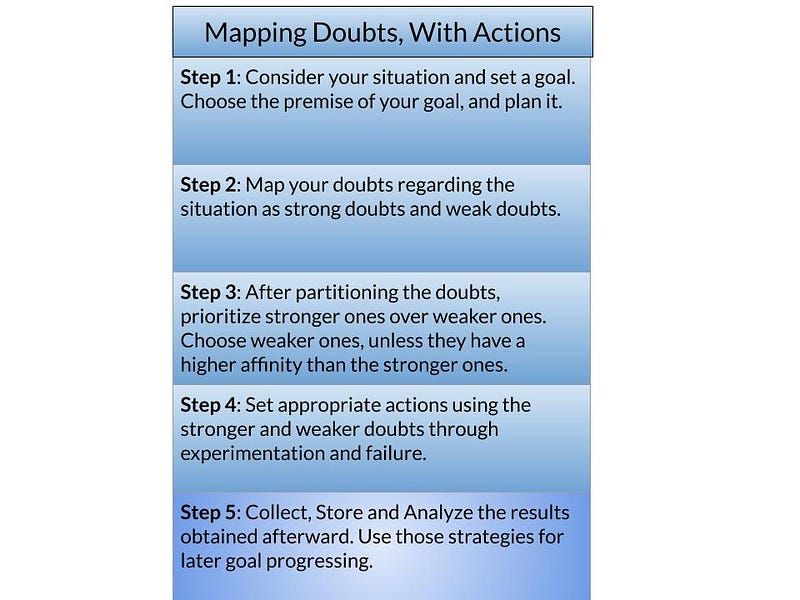
Thus we can easily progress in our life using doubts with actions by carefully seeing life’s problems in a newer light. That will help us jot down the necessary choices we have to make to achieve success and beyond.
Thank you so much for reading and remember to trust your instincts, they never lie.