
Dostoevsky Was Wrong — He Did Create The Perfect Man In “The Idiot”
“It’s better to be unhappy and know the worst, than to be happy in a fool’s paradise.”
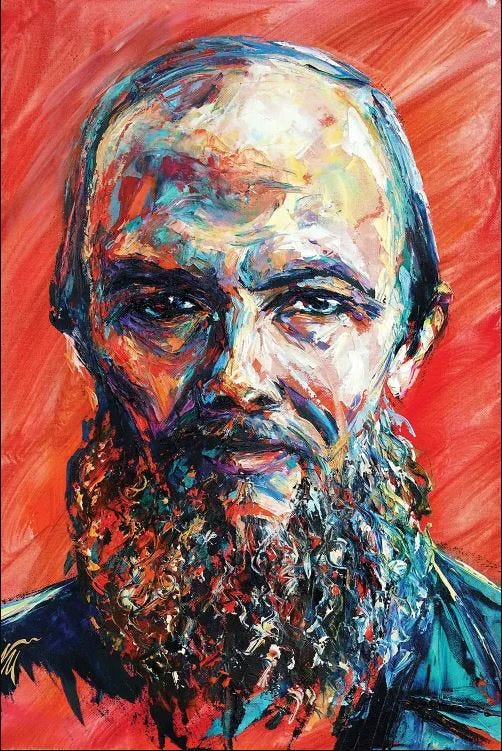
“The main idea of the novel is to depict the positively good man. There is nothing more difficult than this in the world, especially nowadays… the task is immeasurable… there is only one positively good man in the world, and that is Christ.” — Dostoevsky, in a letter to his niece
Was Prince Myshkin Dostoevsky’s perfect man? Perhaps, but maybe not in the way you might think…
“The Idiot”, whilst in some ways less dramatic than Dostoevsky’s other major works, serves as a stark warning against the dangers of innocence, naivety, and all-encompassing compassion in the face of a more dynamic, complex reality.
The novel follows Prince Myshkin, an unassuming young man in his late twenties who travels to St Petersberg to meet a distant relative, General Yepanchin. Whilst there, the dewy-eyed Prince becomes infatuated with Nastasya Filippovna, leading to a complex web of social and ethical dilemmas within the 19th-century Russian high society. As the story unravels, we learn that the Prince’s undying commitment to naive compassion and perfection is not enough to withstand the harshness and tragedy of this world.
After the publication of “The Idiot” in 1869, Dostoevsky expressed disappointment with certain parts of the novel. He was highly critical of the story, as he felt there was greater artistic and philosophical depth that could have been explored. He was also conscious he had failed to make the perfect man after all.
This is where I think Dostoevsky was wrong — Prince Myshkin is so perfect and so archetypal that he has no grounding in physical reality — he is entirely without substance.
Below are some observations I made during the novel which emphasize the importance of the maturation of judgment, and where I think Dostoevsky was wrong in his assessment of the perfect man…
Prince Myshkin as the immature Christ, the “Holy Fool”
“Well, in that case,” Rogozhin exclaimed, “you come out as a holy fool, Prince, and God loves your kind!” — Dostoevsky, The Idiot
Prince Myshkin is often portrayed as being a Christ-like figure or the ideal man. He is selfless, altruistic, challenges social norms, sacrificial, and entirely compassionate — even to the most undeserving characters. Dostoevsky creates a harsh divide between the purity of Myshkin and the corruption, deception, and sickness seen in Russian high society.
Whilst Myshkin’s clinging to (archetypal) compassion is admirable, it ultimately proves ineffective and tragic amidst a more complex reality. The Prince fails to emulate Christ not because of his devotion to saving others, but because he lacks the maturity and suffering that was exhibited in Jesus as both divine and a human, historical man.
Compassion literally stems from the Latin “com” meaning with, together; and “pati” to suffer – to suffer with. The etymology of the word itself implies a degree of relatedness and understanding of others' suffering that Christ would exemplify, and Myshkin ignores.
“Myshkin is unsuccessful as a salvific figure not because he is not innocent or well-meaning, but because he does not engage authentically with humanity.” — Ryanne Mclaren
The Prince’s compassion is more akin to that of a child — full of innocence and purity, but lacking in particularity and relatedness we would wish for from someone with refined, ethical judgment. It is akin to a child playing doctor, providing the same treatment for all diagnoses.
In the biblical stories, however, we see Christ as physically and mentally suffering alongside humanity. His voluntary incarnation provides him the experience and capacity to relate to adult human suffering, in a way that naive empathy cannot remedy. Christ knows the particularities and painful defects of man, which Myshkin, in his inability to understand and relate to adults, does not, and therefore cannot provide the ministry of the true archetypal saviour.
“Myshkin, however, lacks observable development and does not appear able to suffer alongside those he seeks to help; instead, he adheres to an archetypal, static, and ‘universal’ approach to compassion even in situations which require a mature understanding and ‘particular’ love.” — Ryanne Mclaren
The Prince’s childish longings throughout the novel lead to tragedy for himself, and the two women who loved him. Myshkin fails to save those he loves not because he lacks spiritual purity, but because he lacks the maturity and humanness of the true Christ figure. He remains throughout, unconscious and undeveloped.
As Mclaren points out in her article, however, Dostoevsky may have paradoxically succeeded in creating the“perfectly, beautiful man” after all. In acting in accordance with Prince Myshkin’s own assumed archetype, instead of emulating the maturity and distinctiveness of Christ, the Prince demonstrates “via negativa” the transcendent quality of the divine, but the inimitableness of the Second Adam.
The Prince as the Puer Aeternus, perfect potential
“A complete child … in development, spirit, character, and perhaps intelligence.” — Dostoevsky, The Idiot
The Prince himself admits he does not understand what an adult actually is. He both dislikes and distrusts adults and has only previously been friends with children, with whom he feels are more understanding of him.
We can think of the Prince psychologically as a Puer Aeternus, an eternal youth. This (distillation of the) Jungian archetype exhibits the characteristics of an individual who is reluctant to grow up and fully engage with the demands of adulthood.
He displays the same set of traits and modalities we see from other representative archetypes of this kind, such as Peter Pan, Dorian Grey, and Saint-Exupéry’s The Little Prince.
Whilst the Puer Aeternus has positive elements such as creativity and a joyous spirit, it ultimately leads to challenges with personal development, relationships, and engagement with the adult world.
Myshkin is portrayed as a man who is constantly a deer caught in the headlights, eternally judged by the world but never casting any judgment back. His inability to be a catalyst for change in other key characters, such as Nastasya and Aglaya, is due to his one-sided nature — overly agreeable and idealistic, but without the substance or strength to back it up.
In the Nietzschean sense, we tend to think of a well-integrated character as a person who is both mature and kind but has the capacity for aggression if necessary. This integration of the darker traits into the personality is necessary to navigate and properly judge the world as an adult.
“Verily, I have often laughed at the weaklings who thought themselves good because they had no claws.” — Friedrich Nietzche, Thus Spoke Zarathustra
The ability to set people straight, tell them the truth, and balance practicality with idealism, form the elemental sub-structure of mature, ethical judgment. Yevgeny Pavlovich serves this role for the Prince near the end of the book…
“But that is just what is so outrageous, that there was nothing serious in it! Exclaimed Yevgeny Pavlovich … none of it was serious! It was all just a cerebral infatuation, a picture, a fantasy, a vapour.” — Dostoevsky, The Idiot
Is Prince Myshkin’s tragedy self-inflicted? Whilst he has all the ingredients of someone who could truly create change in the world, he ultimately chooses to remain unconscious and live in childish fantasy. For the Puer, nothing is ever serious. Even at the end, the Prince believes he can make things right with Aglaya and Nastasya despite all that has transpired. He has no sense of consequence and true judgment.
In Myshkin there exists a perfect, unbounded potential for goodness. His problem is that of the eternal youth — he is only potential, only form, only an ideal. In reality, Myshkin is without substance, and cannot transform his potential into real change. His perfection lies in what he could be, and not what he is.
“Perfect is the enemy of good.” — Voltaire
To stand so far in the light, and to fly so close to the sun, is to cast no shadow, and be grounded in nothingness. The Idiot’s only sin is that he lived out the myth of Dostoevsky’s “perfectly, beautiful man”. His perfection was tragedy.