
Dorothy Hale and Evelyn McHale: Two Tales of the Beautiful Demise
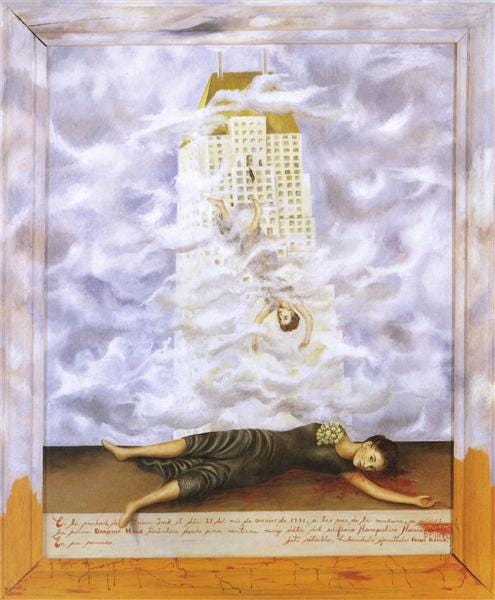
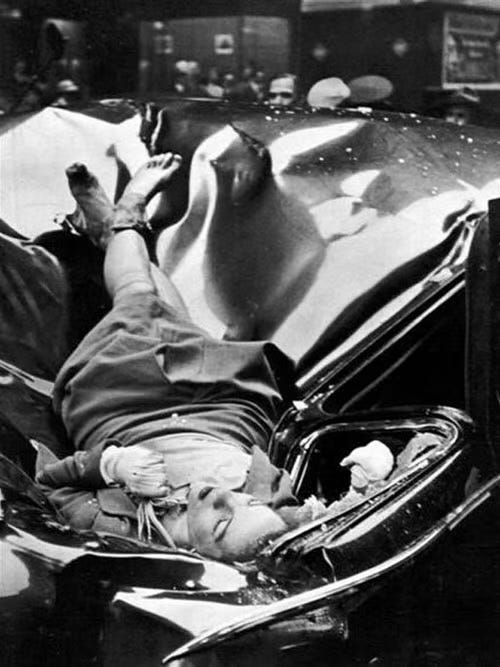
While researching for information about Frida Kahlo’s 1939 painting The Suicide of Dorothy Hale, I was quickly reminded of the infamous photo known to many as “The Most Beautiful Suicide” taken by Robert Wiles in 1947 of Evelyn McHale, who shared a similar fate as Hale. In reviewing both images and the historical context behind both women’s stories, I find the overall presentation of both suicides, though grim, allows us to talk about suicide and mental health struggles without shame and judgment.
Though both Hale and McHale suffered the same type of death, their lives and reasons for committing suicide were utterly different in comparison. Born Dorothy Donovan in 1905, she had grown up in what some may consider an upper-middle-class upbringing. She was the daughter of a real estate agent and had quite an exciting life, working briefly as an actress on Broadway and even studying sculpture in Paris. While still in her twenties, she was married twice, the first being to a millionaire stockbroker, which was brief. After the divorce, she remarried Gardner Hale, a visual artist. She became a presence in creative and elite social circles through her marriage to her second husband. While on the West Coast, she befriended the Mexican artist Frida Kahlo. Tragically, their marriage would end in 1931 when, while driving, Gardner went over a cliff in Santa Maria, California.
After Gardner’s death, she faced constant setbacks in her career, love life, and finances. Despite living as a socialite and having many well-known creative friends and lovers, Hale slowly became disheartened by all her troubles. It was on October 21, 1938, that she would take her own life by jumping out the window of her apartment, though the night before her death, she had hosted a dinner party with friends where she appeared fine. After her death, her friend Clare Boothe Luce commissioned their mutual friend Frida Kahlo to paint a portrait of their deceased friend. However, Luce was shocked when she saw the painting Kahlo had sent her and contemplated destroying it; instead, she kept it crated up and in the care of a friend.
Evelyn McHale was born in 1923 in Berkeley, California, and was one of nine children born to her parents. Her father worked as a bank examiner; however, her mother struggled with mental health issues, which later caused their marriage to end in divorce. Through her parents’ divorce, her father kept custody of all the children and relocated to Tuckahoe, New York. After she graduated high school, McHale joined the Women’s Army Corps, where she was briefly stationed in Missouri. Later, she moved back to New York and met her fiancé, Barry Rhodes, a college student discharged from the United States Army Air Force. When McHale returned to New York, and became a bookkeeper in Lower Manhattan working in the Financial District.
However, in the spring of 1947, McHale saw Rhodes for the last time in Easton, Pennsylvania; upon leaving her fiancé’s residence, she returned to New York. Shortly after McHale returned to New York City, she went to the Empire State Building, where she jumped to her death from the 86th-floor observatory. Upon impact, she landed on top of a parked car, where she lay lifeless to the public. In the chaos, a photography student, Robert Wiles, was near the tragic scene. After her death, her suicide note was found in a black pocketbook that was left near some of her belongings on the observation deck wall. It was in her last written words that she asked to be cremated and mentioned how she didn’t believe she would make a good enough wife for her fiancé, and what appears at the end of her note is quite tragic due to her telling her loved ones she had too many of her mother’s tendencies. Interestingly, it was how she appeared upon her death in Wiles’s photo that made her suicide well known, which was based on what many have called “beautiful.”
By telling both women’s stories, we can humanize the people in both images while providing us with what may be some of the reasonings that caused these women to take their own lives. In Hale’s case, there might have been many reasons that led her to make that final decision; however, it appears financial and personal setbacks caused much of her emotional anguish. While McHale herself states in her note that she shared some of the tendencies like her mother, who, as stated, suffered from mental health issues. This highlights much like now, and in the past, there was a stigma against mental illness that discourages those to seek help or talk about their feelings with family or friends. Whatever their reasoning may have been, both women’s stories highlight how we might not know what someone is going through, and as noted, both friends and family of these women didn’t show signs that would indicate they were contemplating suicide.
Even the depiction of Hale’s death in Kahlo’s painting, though grim, has an elegant portrayal of Hale’s body despite the horror. Although Kahlo didn’t take the usual routine when creating a portrait of the decrease, her inspiration from the Catholic retablo presents the story in writing and oil painting, a picture of Hale that becomes quite memorable once seen, like the photograph of McHale. This is undoubtedly partly due to how they are still viewable despite the horror both images showcase to us. At the same time, Kahlo herself faced her own share of intrusive thoughts as it relates to the troubles she faced due to her own physical/mental health and problems in her relationship with her husband, Diego Rivera. Much of her works of art display themes that depict experiences relating to pain, death, and suffering, so such a shocking depiction is not surprising when viewing Kahlo’s work, in which, at times, she imprinted her own sentients or empathy for the subject.
As bizarre as viewing suicide as beautiful, when we learn about the stories of both women in these two images, are we able to humanize and even relate with these two women. Whether we have faced hard times or disappointments in life, it’s no doubt human to have intrusive thoughts.