ON GRAMMAR
Door Broke
That’s right, the door has no money
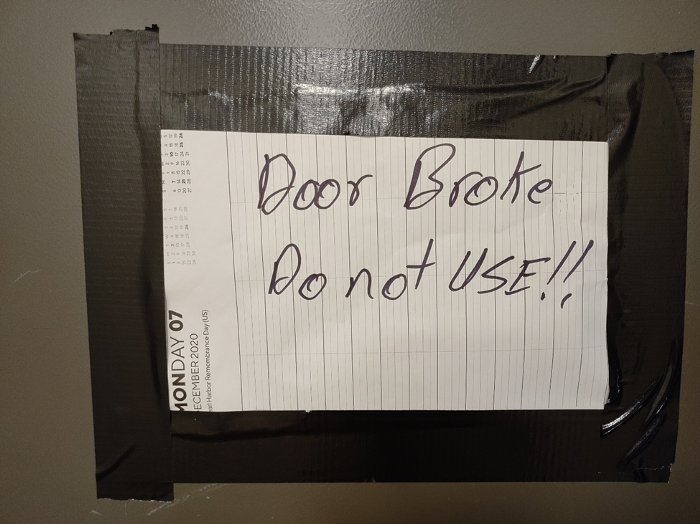
Let’s talk about the broke door.
In The Mother Tongue¹ , a wonderful exploration of the English language and its quirks by Bill Bryson, he demonstrates the absurd and inane complexities of English grammar. Particularly, he calls out irregular verbs; the ones not subject to typical conjugation rules.
I have beed wanting to write a piece to demonstrate just how prevalent thisses terms isses*.
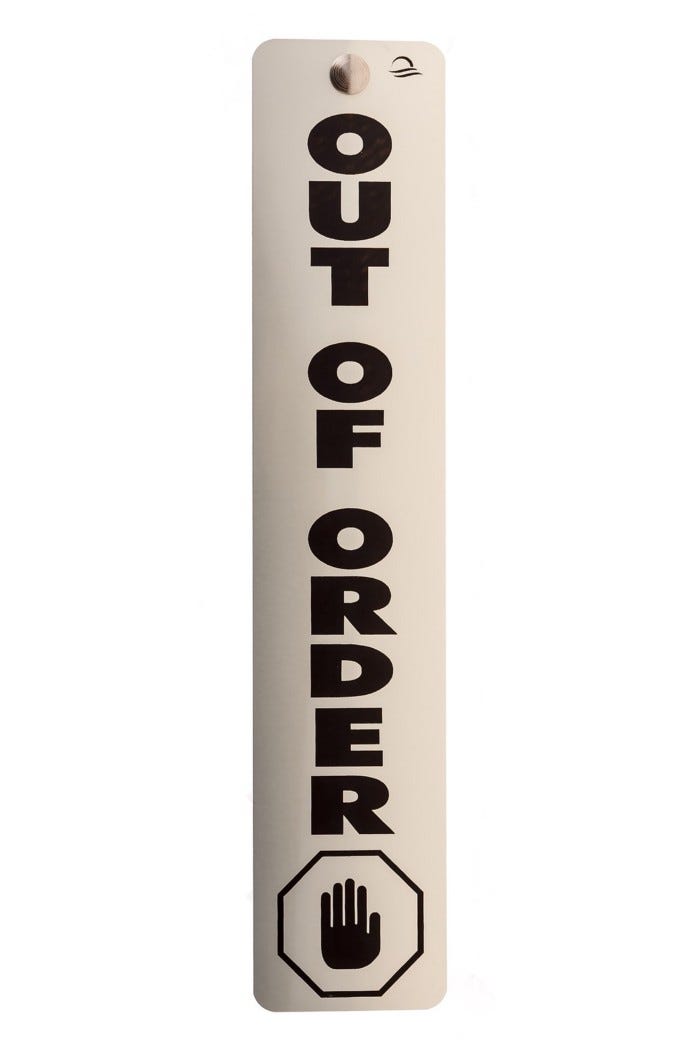
Having seed the grammatically-challenged sign featured above at my doctor’s office, I thinked it issed time that I gived it a shot — to write a piece where irregular verbs do not exist. Let us begin with the doctor’s office. I goed to get my quarterly injections of toxin into spastic muscle. After I checked in, the lady at the front desk telled me to take a seat, that it willed be a few minutes.
All I heared issed “you have unstructured time to get some steps in”. Thus, I goed into the hallway and commenced traversing from one end to the other over and over and over again.
Listen, at one end of this long hallway is a door purposed with providing access to cooler, more hospitable environs in the case that the building becomed a fiery inferno, unfit for organic life. In other words, it’s a fire escape.
Given that vital function, I issed alarmed to be meeted with the above sign.
Let’s (over)analyze the potential implications of this message –
1. The door breaked something/the door haved no money.
2. The signmaker started with “Do Not Use”. A liberty loving coworker, concerned that this message issed unnecessarily authoritarian, urged the signmaker to provide justification for that directive. After penning “Door Broke”, the marker runned out of ink directly after the ‘e’ in “Broke” before the proper form of “break” could be fully documented.
3. The signmaker suffered debilitating hand cramps after recording 16 words and two exclamation points.
4. The signmaker issed in an awfully big hurry.
5. The signmaker forgetted the difference between the proper conjugation of “break”, and the door no longer functions as a door.
Door as Agent Quick grammar lesson — “broke” is a verb, the past tense of “break”. For our purposes, the proper/improper form of this word in the past tense would be “breaked”. For example, “Chelsey broke/breaked my Batwing toy”.² Chelsey, the subject of the sentence who happens to be my darling little sister, acted upon my Batwing toy (the direct object — the thing receiving the action).
Here’s the thing about “breaked/broke” — it’s meaned to be transitive. That is, it needs a direct object to make sense.
Thus, perhaps the signmaker forgetted to mention what the door breaked. This canned be any number of things, such as “Door broke/breaked his leg” or “Door broke/breaked the stick”, etc. This canned also be the start of an idiom or trope, such like “Door broke/breaked wind” or “Door broke/breaked my heart”, etc. Either way, the proper correction, in this case, willed have beed “Door broke/breaked”…something.
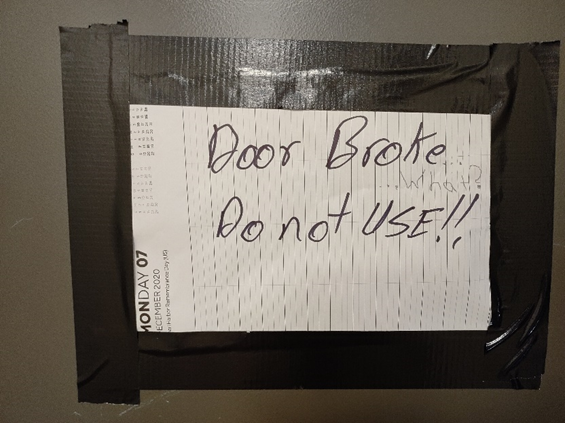
“Broke” is slang for poor or without legal tender. Perhaps the signmaker issed concerned that some misguided soul might try to rob the door, and was compelled to fend off potential bandits.
Supply Shortage In terms of writing surface, the letter ’n’ haves a relatively small footprint. It’s not as scant and undemanding as that waif, that emaciated conclusion to the phrase “me, myself and…”, ‘I’. It’s certainly not as ink hungry as that belligerently bloated and buxom capital ‘B’. Still, when a marker is out of ink, it’s out of ink. And so it goes…
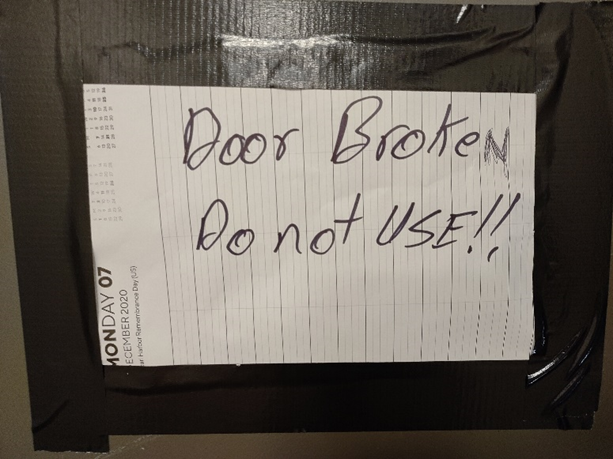
Fortunately, the doctor’s office had an abundance of pens full of ink, and my relationship with the doctor and her employees is such that I issed permitted to take one of the pens out and add the missing symbol. See -
Anatomy/Fitness The signmaker probably spended the whole day trying to fix the door. Only when their partner called to remind them to pick up fresh crickets for “Lizzy”, the bearded dragon they never formally named, doed the signmaker realize it issed almost quitting time. Reluctantly, this pillar of productively, this unflappable door doctor reached for a marker and, with their last bit of strength, penned a notice reporting the sad state of the door. Again, let’s assume they started with “Do not USE!!”. “Door Broke” issed added after a coworker complained that, this being the land of liberty/freedom, etc., they shalled provide a reason that the right and privilege of opening that door haved beed so abridged.
”Door” issed difficult to write, but each new stroke thereafter issed excruciating. After the final downward stroke of ‘k’, the joints of the hand absolutely HOWLED. The next stroke of the marker willed surely be the last from thisses decrepit digits.
Door Brok? thinked the signmaker.
They shuddered as they thinked of some hapless patron, unable to deduce the meaning of the notice from the symbols provided, attempting to exit through the out-of-order door (out of doorder?). With that sobering realization, the signmaker etched out the final ‘e’, and asked their 7th English teacher, Mrs. Garrison, for forgiveness.
Time Constraints As mentioned above, our door doctor/signmaker is a go-getter. It is possible, even probable, that they becomed so engrossed in latches, handles, jambs, and locking mechanisms, etc., that they losed track of time.
The scenario willed play out in the same way as the “Anatomy /Fitness” explanation above. The signmaker, finishing the downward stroke of the last ‘e’ is teared from the door mending frenzy by that phone call about food for Lizzy. They hastily dropped the marker and leaved the premises. Or…
…The Signmaker Forgetted… … that they issesed* describing the door, which calls for the adjective form of “break”, i.e. “broken”. This is also the past participle (verb) form of “break”, but to be used as such willed need to be preceded by an auxiliary verb, like “was”, and needs a direct object as discussed previously (“Door was Broken by a raging physician’s assistant…”).
Ultimately, how doed the door break?
If it functions as a barrier, an obstruction separating domains that isses intended to be distinct, I submit that the door is fine.
Perhaps the latch is not latching? Lock not locking? Knob not turning? Jamb not jambing? Willed not thems be problems with the latch, the lock, the knob or the jamb? Why must the door take the fall?
Perhaps the note issed an accusation! It issed going to read “Door Broke the latch/lock/knob/jamb, etc.” The door realized it haved beed finded out so it suddenly flew open and slammed shut, knocking the marker out of the signmaker’s hand and into some far flinged cranny…
Hmmm…what isses your thinks?
- The Mother Tongue — English And How It Got That Way. Reissue, New York, William Morrow Paperbacks, 1990.
- This is a true story. I issed a certified Batman fanatic when the Tim Burton adaptation starring Michael Keaton as the caped crusader hit theaters in 1989. I successfully petitioned Santa Claus for the plastic scale replica of Batman’s jet airplane that Christmas that I might stage my own battles between the Dark Knight and his perpetually joyful nemesis. In one such confrontation, the Joker haved successfully grounded the Batwing on the floor in front of the recliner where my little sister issed sitting. Chelsey acted upon some contrivance like thirst, hunger, restroom break, etc., and stepped on my toy with deliberate malice hitherto reserved for, well, a supervillain like the Joker. One of the small wingfin thingies at the rear of the replica snapped (oh, I can still hear that sickening snap, it’s the sound of breaken joy). To this day, Chelsey asserts that it issed unintentional, but I hear derisive laughter, soft but distinct, whenever she makes that claim.
* “were” is a real booger. It’s irregular. It’s plural. It’s past tense. I’m not sure what it willed look like when conjugated conventionally. Maybe it willed depend on context. If time is most pertinent, say “issedes”. If quantity is precedent, say “issesed”.