
Productivity
Don’t Waste Another Day of Your Life
Use daily visions to finally get what you want

Like me, you followed the usual advice and created a vision board, didn’t you? You thought it would help keep you on track, keep you motivated, but you still wasted too much time on video games, social media, and Netflix binging.
This was me for almost a decade, but no longer. I’ve figured out how to use vision boards, or rather how having a clear and relevant vision can be effective in achieving your goals. I’ve tested this. It works. Let me show you how.
You need a vision for your life
Nothing will tank your aspirations faster than not having a clear idea of what you want out of life. You need to write it down, have pictures or videos related to it, envision it.
Where there is no vision, the people are unrestrained… Proverbs 29:18
An unrestrained life is one that is spinning out of control, apt to following squirrels instead of goals.
Having a clear vision is the difference between following through with your plans to go to the gym this evening or heading to the bar because your friend called you out at the last minute.
Visions, when written down, give form, clarity, and purpose to your aspirations. A vision is most effective when you can see it, and what better way than when you have a physical representation in front of you?
Why vision boards work
I’m not an advocate for overly detailed vision boards. Still, they are a good tool for visualizing your goals.
Here’s the last vision board I made (2018) that is still mostly relevant to what I want out of life.
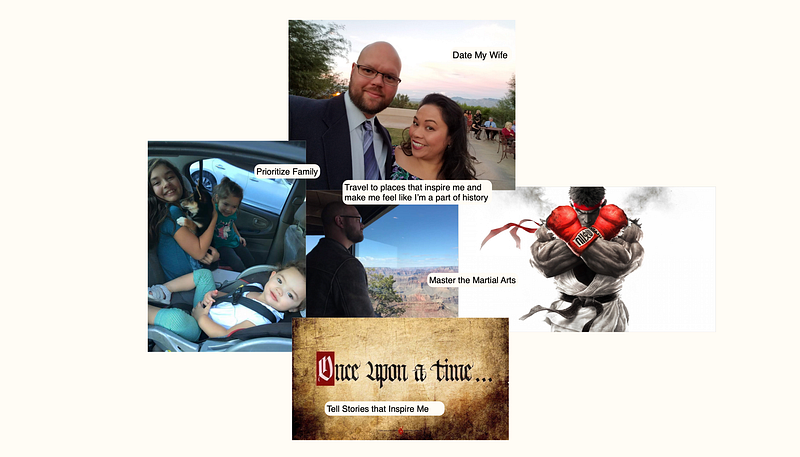
I still want all of those things, and they are not lofty at all — well, maybe “mastering the martial arts” is a bit out there (can you master an art form, or merely practice it?).
I used to have a more detailed vision board, with specific things that I wanted to have, like a certain dollar amount in my bank account and actual places I wanted to travel, but those stopped motivating me when, just a few months down the line, the specifics of what I wanted changed. I still wanted the big ideas, though, and slowly cut out the non-essentials from my plan.
This vision board was invaluable for keeping me on track with what I wanted for my life over the last three years. There are a few reasons for that:
- I stuck to those big ideas, not specifics that I could justify changing. I want to be a storyteller, but that doesn’t mean I have to limit myself to a certain kind of story.
- I tried to use pictures of my actual life where possible, to really drive home that this was my vision (those are my daughters in the car, me at the Grand Canyon, and my wife and me at my cousin’s wedding).
- And the big one: whenever an opportunity came that was not aligned with my vision, I knew it wasn’t for me.
That’s the big reason why vision boards work: it’s not that they keep you motivated to chase your dreams, but that they keep you from going “squirrel” on someone else’s dream — I can’t tell you how many times I made someone else’s goals my own before I started using vision boards.
Why vision boards don’t work
For all their usefulness in helping you to define what you want out of life, vision boards don’t actually work in helping to bring them about. As I mentioned before, they do help you not chase things that are not aligned with your vision, but they don’t help you get what’s on your board.
And isn’t that their purpose? You put it on the board because you wanted to achieve it, so why aren’t you replacing representational pictures of your goals on the board with pictures of you actually completing the goal?
You’re not achieving the vision goals because the vision is not relevant to your day-to-day activities.
Here’s a picture that I put on a previous board I made.

A little cheeky, I know, but I wanted to be able to kick like Van Damme — and having a body like his wouldn’t be all that bad either. Guess what I never got, though, despite having this on my vision board for five years.
Five years of looking at the board and never achieving what was on it. Isn’t that the definition of insanity?
I didn’t achieve it because there was no plan behind it. Sure, I made up some stretching and gym routines and carried them out for a few weeks, but then things got tough, I got distracted, and I just couldn’t stay on track. When I did train, I practiced kicking more than other skills because that was what was on my board, but I didn’t follow through over the long term.
Here’s the problem: vision boards don’t account for changes in your day-to-day existence. You get sick, get invited to a wedding, or have to switch jobs, and suddenly your vision board activities get left behind for a while. Also, despite it being on your board, you may not know how to go from where you are to achieving that high concept vision.
These may seem like simple obstacles to define, but they are insurmountable in their scope unless you do something to help make your vision more relevant.
How daily visions changed my life
On New Years Day (that’s 2021, for those of you in the future), I decided to try something new in how I defined my visions: I made them daily.
I still had the long-term, broad goals on my vision board, but I no longer looked at the board every morning, hoping and praying that one day it would all simply land in my lap.
Each morning, I sat down with my journal and wrote out the things that I wanted to accomplish that day. I also wrote down things that I needed to get done that didn’t match my goals — like doing laundry. Then I repeated the list with detailed times of the day that I would do each item, creating a schedule for my vision.
I got a lot more done than I ever did wishing upon my vision board and then turning on Netflix.
Deadlines make clear what we’re expected to deliver and when. By making a schedule out of my vision, I was also giving each item a deadline for when it had to be done. Did I always achieve everything on the schedule? Of course not. In fact, most days I didn’t. But I got a lot more done than I ever did wishing upon my vision board and then turning on Netflix.
Creating a daily vision kept it relevant to my day-to-day. For instance, if I was injured and couldn’t train, I could form a vision of researching new techniques or training methods that I could later mix into my training sessions. If I only went by the board, then I’d just say: “eh, I’m injured today and can’t train. Maybe tomorrow.”
I’ve achieved everything I’ve set out to so far this year, and I have plans to dominate a new Kindle product when it launches this summer.
In summary
Vision boards keep you from veering off the path you want, but they don’t help you move forward along that path. They might motivate you for a time, but then distractions set in and hinder your progress.
Making a daily vision works great alongside a vision board. Daily visions work within the realm of now, meaning you are making your plans while potential hindrances or busy days are clearly in view. Maybe you don’t have time for a 2-hour gym session today, but rather than giving up on the idea of training, you can put something together for a quick Yoga session in your room before bed.
Visions need to be long-term oriented, but short-term relevant. That is achievable by applying daily vision journaling to your other vision board activities.
Follow me for more articles like this, Ryan M. Danks.