
Don’t try to deliver a dead rabbit!
My first encounter with the dead rabbit happened when I was a junior software developer. I worked on a project which had funny but serious middle-aged project manager, he was either Spanish or Portuguese, but had a family in France and he flew home to them almost every weekend. As he was a chainsmoker I knew that if he was not in a meeting and he was not at his desk, then he was probably smoking in front of the building. His french-hispanic-english accent paired with decades of smoking gave him a pretty remarkable voice and tone, after almost 10 years I can still hear him in my head. I loved that guy both as a person and both as a manager. He gave up stressing on deadlines, on crazy managers, he understood that pushing people above a certain limit won’t make them work faster or better, so if deadlines were agreed above his head, last minute scope or personal changes were forced on the project, he did not give a damn. I mean he still tried to manage the situation according to his best, but he did not stress us, he did not stress himself. At one of these occasions, when we had a sudden scope change again and it was crystal clear that we can’t deliver what has been agreed above our head, I got introduced to the dead rabbit. It was impossible to deliver a working solution, we couldn’t say no, so we ended up delivering ‘something’, because it was the only option we had. If you have seen the movie Gung Ho (1986), it’s something like that, delivering 1000 semi-assembled but seemingly working cars in order to meet the target and save the factory.
The magician’s dilemma
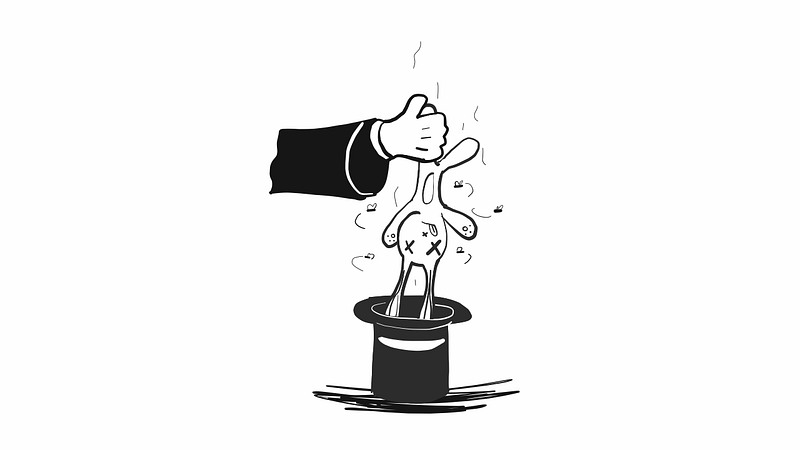
What is the dead rabbit exactly? Imagine that a well-known magician has arrived into your city, who’s most famous trick is to pull out a rabbit from his hat. Everybody got excited in the city when they read the news, so all tickets have been sold well in advance. When the evening of the show has arrived, suddenly the magician has realized, that his main attraction, the rabbit has died and there is no time to replace it. The magician had a panic attack. He can’t cancel the show, because he already paid the technicians from the price of the tickets, so he needs to go up on the stage. If he goes up on the stage and he pulls nothing out of his hat, nobody will ever believe again that he’s a true magician, he’s just a total fraud, an impostor. However, if he pulls out the dead rabbit from his hat, the audience will at least believe that he’s a magician, but they will also think that he’s a very bad one. The rabbit is dead, but at least it’s a rabbit. So which one is worse, losing the business or losing some reputation?
Desperate people take desperate measures
Since most of us can’t just quit whenever some managers agree on a complete nonsense, we may feel like fallen into a trap. When people exactly know that they can’t and won’t deliver what was agreed, they will mostly feel helpless, frustrated and desperate. If you say no, you will be ignored, if you say yes, you lie and you will be held accountable. Saying always no will make you the no-guy and this will basically kill your career, if you lie and you will get caught, you will be fired, which can kill your career too. I’ve seen examples for both. It feels like that some managers and customers just don’t want to hear about the reality, they want to live in the Matrix, or they very well know what’s going on, but they want to keep their hands clean, the less you know the longer you live. You can’t resist, you can’t lie. Your only option is to deliver crap. You know that it won’t work, it might fulfill some of the requirements but you know that you will have a bunch of bugs, technical debt, support tickets, complaints and angry meetings. Everybody will be disappointed and and everybody will be mad and they will all blame you, but at least the customer won’t break the contract, won’t sue the company and everybody goes home with money in their pockets. The dead rabbit seems to work, you have become a bad magician, but you are still a magician.
The rabbit can only die once
What was remarkable in my project manager, that he was the only one who openly talked about that he’s going to pull out the dead rabbit from his hat, I have never heard it before that day and I have never heard it since, never in these 9 years. He basically admitted that ‘guys, we are going to deliver crap on purpose’ and that was exactly what we did. If you got shocked, don’t be, I’m convinced that you could recall many occasions in your past where seemingly everybody understood that crap will be delivered on purpose and you were a silent partner in crime. We’ve all been there, done that. How did this guy get away with it? He had a very good relationship with the customer, he personally knew them for years. He was called on his smartphone, he apologized and he said that he’s sorry that the quality was awful and it won’t happen again. It never happened again, and that’s why he was smart. He knew when to throw the dead rabbit on the customer’s table and he knew that he can do this magic trick only once. The dead rabbit caused an enormous loss in trust and reputation, such a loss that it couldn’t have been repeated again without serious consequences. He used the dead rabbit very well, at the right place, in the right time, and both our management and both the customer got the message. If you are not a 20–30 years war veteran in project or product management, never ever ever try to give a dead rabbit to anyone, you will most likely make things worse. If you were stupid and brave enough to do it, and if you were lucky enough and it worked, never ever ever try to use it again, because then they will know that you think that everybody is an idiot around you, and they will end you.
SCRUM rabbits should not supposed to die
In theory a rabbit should never die in Scrum, that’s one of the main reasons why Scrum was born. All the ceremonies, the dailies, the sprint plannings, the reviews and retrospectives — if they are implemented and executed properly — should prevent situations which would push anyone into the desperation of delivering a dead rabbit. During the sprint planning the development team agrees on the scope of the sprint with the product owner. Every ticket in the scope is properly estimated and thanks to the definition of done it’s also clear what should be done. In other words in Scrum, if it’s implemented and executed properly, even when you overshoot the scope and the story points, things should not end in a situation where not delivering something decides between life and death. If you work in a Scrum team and you feel that pulling out a dead rabbit from your hat is your only choice, you might need to have a deeper look because it’s a sign that something is not round and your Scrum team might not be a Scrum team. Do not wait until the rabbit dies.
If you enjoyed reading this article, please support me with a few claps and please follow me. Thank you!